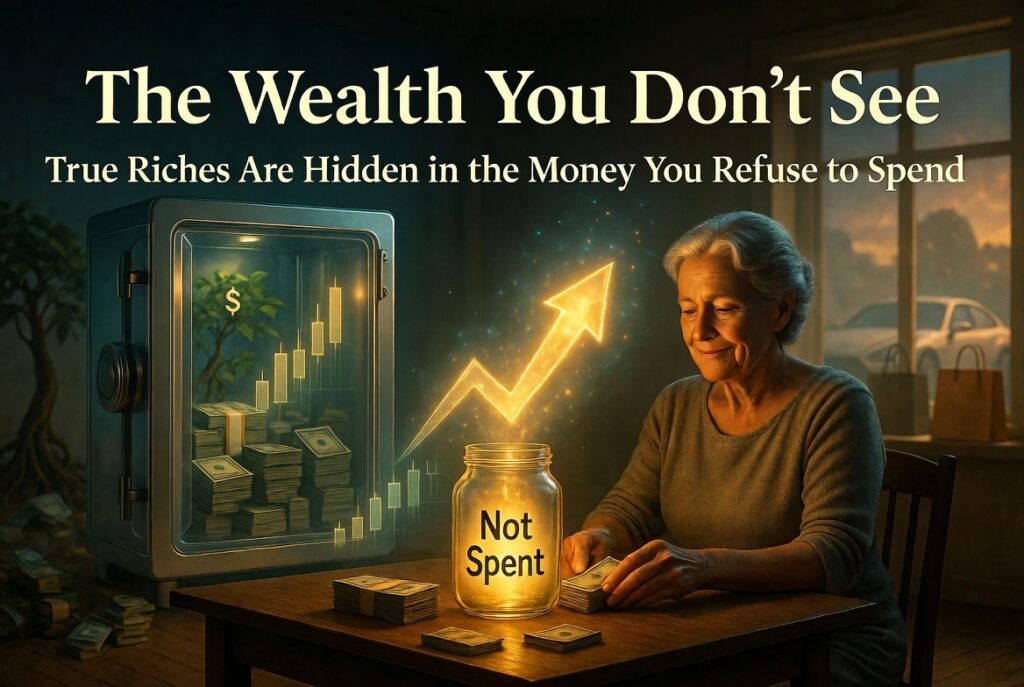
- The Invisible Fortune: How Unspent Money Becomes Freedom, Options, and Real Power
- Before You Buy the Car, Watch, or First-Class Ticket, Understand What Wealth Really Is
The Rich Man You See May Not Be Wealthy
There is a dangerous mistake many people make when they think about wealth. They look at the car, the mansion, the wristwatch, the jewelry, the designer clothes, the business-class ticket, the expensive restaurant, the loud birthday party, and the luxury vacation, then they say, “That person is wealthy.”
But what they are often seeing is not wealth at all. They are seeing money that has already been spent, financial assets that have been converted into objects, and yesterday’s liquidity turned into today’s display. They are seeing money that no longer has the power to compound, protect, rescue, invest, negotiate, or create options. This is the brutal truth: wealth is what you do not see.
Wealth is the nice car not purchased. Wealth is the first-class upgrade declined. Wealth is the diamond not bought. Wealth is the watch not worn. Wealth is the designer outfit forgotten. Wealth is the bigger apartment delayed. Wealth is the luxury trip postponed. Wealth is the money that quietly remained in assets instead of being converted into applause.
“The money you spend becomes a thing. The money you keep becomes a choice.”
That sentence can change a person’s financial destiny.
Because many people say they want to be millionaires, but what they truly mean is that they want to spend like millionaires. They do not want the discipline, restraint, patience, and quiet compounding that build wealth. They want the feeling of spending a million. They want the social evidence. They want the visible confirmation. They want people to look at them and say, “You have arrived.”
But spending a million is not the same as having a million.
One is consumption.
The other is power.
The Core Philosophy: Wealth Is Hidden Because Restraint Is Invisible
The world makes it easy to see rich people. It is much harder to see wealthy people.
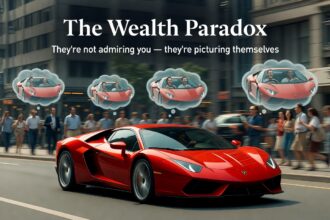
A rich person can be visible because spending is visible. A car can be photographed. A house can be admired. A luxury bag can be posted. A hotel room can be shown. A watch can shine under good lighting. A first-class seat can be captured before takeoff. Spending announces itself.
But wealth hides.
You cannot easily see the emergency fund. You cannot easily see the investment account. You cannot easily see the debt avoided. You cannot easily see the asset not sold. You cannot easily see the quiet restraint that allowed money to remain available for future growth.
That is why society produces more role models for spending than for wealth building. We see the people who consume money, but we rarely see the people who preserve, invest, and compound it. The wealthy person may drive an ordinary car, live in a reasonable house, dress simply, and avoid loud display. The crowd may underestimate him because the crowd has been trained to measure wealth by evidence of consumption.
But true wealth does not always beg to be seen.
“Real wealth is often silent because its greatest work is not to impress people but to protect your future.”
This is the lesson many Nigerians, Africans, and members of the diaspora must learn in an age of social media pressure, inflation, economic uncertainty, black tax, exchange rate anxiety, and public competition. The money you do not spend may be the money that saves your family during a crisis. The money you do not waste may become the capital that starts a business. The money you do not use to impress your classmates may become the down payment for land. The money you do not turn into luxury may become the investment that buys your time back.
Wealth is not always what you add to your body.
Sometimes wealth is what you refuse to remove from your future.
The Psychology: Why We Confuse Spending With Wealth
Human beings are visual creatures. We believe what we can see faster than what we can understand. If someone drives a luxury car, we assume financial strength. If someone dresses expensively, we assume abundance. If someone travels often, we assume success. If someone lives in a highbrow area, we assume stability.
But appearances can deceive.
A person may be driving debt.
A person may be wearing insecurity.
A person may be living in rented prestige.
A person may be flying on borrowed confidence.
A person may be posting luxury while quietly drowning in obligations.
This does not mean every visible display is fake. Some people can afford what they show. Some have worked hard and deserve to enjoy their money. The issue is not enjoyment. The issue is measurement. You cannot measure wealth accurately by what has already been spent.
Behavioural economics tells us that people are heavily influenced by social comparison and status signaling. We do not only buy things for utility. We buy them for what they say about us. A car is not only transportation; it can become a status announcement. A phone is not only communication; it can become a social badge. A house is not only shelter; it can become evidence of achievement. Clothes are not only covering; they can become a performance.
This is where danger begins.
When spending becomes identity, restraint begins to feel like failure. When people define success by visible consumption, the person who saves looks ordinary, the person who invests looks boring, and the person who refuses lifestyle inflation looks as if life has not favoured him.
But the opposite may be true.
The quiet person may be building options.
The modest person may be building freedom.
The disciplined person may be building power.
“The world claps for spending because spending is loud. Wealth grows quietly because discipline does not need an audience.”
The Nigerian and African Context: The Pressure to Look Successful
In Nigeria and across Africa, the pressure to appear successful is not small. People want proof that you are doing well. Family members want evidence. Friends want signs. Classmates are watching. Village people are measuring. Social media is comparing. In some circles, your credibility is judged by your visible lifestyle before your character is examined.
This creates a dangerous financial culture.
A young man gets a good job and immediately feels pressure to upgrade his car, apartment, wardrobe, phone, and social life. A woman starts earning well and feels pressure to show elegance in every gathering. A businessman gets a good contract and suddenly believes he must buy a bigger vehicle so people will know business is moving. A family organizes a wedding, burial, naming ceremony, birthday, or anniversary beyond their true financial capacity because society must not say they are poor.
This is how many people trade wealth for appearance.
They do not realize that every naira spent to impress others has lost the ability to serve them later. It can no longer become inventory. It can no longer become emergency savings. It can no longer become an investment. It can no longer reduce debt. It can no longer compound. It can no longer buy freedom.
It has become a thing.
And things are not always wrong, but things are limited.
A car can move you from one place to another, but it cannot compound. A watch can tell time, but it cannot buy your freedom from a toxic job. A designer outfit can attract compliments, but it cannot protect you from medical emergencies. A luxury vacation can create memories, but if taken recklessly, it can weaken the very financial foundation that should protect your future.
“Never let the hunger to look successful make you financially naked.”
This message is urgent because many Africans are fighting economic battles with image-driven decisions. Inflation is rising, currencies are unstable, jobs are uncertain, businesses are facing higher costs, and family obligations are heavy. In such an environment, hidden wealth is not a luxury. It is survival strategy.
The Danger: If You Spend the Money, You Have the Thing and Not the Money
This sounds simple, but it is one of the deepest truths in personal finance.
If you spend money on things, you end up with the things and not the money.
That means you also lose the future options attached to that money. You lose flexibility. You lose liquidity. You lose growth potential. You lose bargaining power. You lose margin of safety. You lose the ability to say yes later to something more meaningful.
The ₦10 million used to buy unnecessary status may give you attention today, but if invested wisely, it could have become a stronger business base, a land purchase, a diversified portfolio, a child’s education fund, a reserve against medical emergencies, or capital that produces future income.
The ₦500,000 spent every month on lifestyle inflation may feel enjoyable, but over five years, it could represent serious financial power if saved and invested. The first-class ticket upgrade may bring comfort for a few hours, but the money not spent may contribute to assets that buy months of freedom later.
The goal is not to reject pleasure. The goal is to understand opportunity cost.
Every financial decision chooses one future and rejects another.
When you buy something, you are not only paying money. You are paying with what that money could have become.
“The true cost of a purchase is not only the price tag; it is the future you surrendered to own it.”
This is why wise people pause before spending. They do not ask only, “Can I afford this?” They ask, “What will this money no longer be able to do for me?”
That is a better question.
Can I afford the car? Maybe.
But what will the money no longer do?
Can I afford the luxury trip? Maybe.
But what option am I sacrificing?
Can I afford the bigger apartment? Maybe.
But how much freedom will the rent consume?
Can I afford to impress people? Maybe.
But will I become poorer in options?
The Mechanics: Wealth Is Income Not Spent
Income is what comes in.
Spending is what goes out.
Wealth is what remains, grows, and gives you power.
This is why a high income does not automatically create wealth. A person can earn a lot and still be financially fragile if almost everything is consumed. A person can earn moderately and become wealthy if they consistently save, invest, and avoid unnecessary lifestyle inflation.
There are doctors, engineers, bankers, politicians, entertainers, business owners, and executives who earn large incomes but have little real wealth because their lifestyle expands to consume everything. They are rich in cash flow but poor in retained assets.
Meanwhile, there are quiet traders, disciplined salary earners, prudent entrepreneurs, and modest professionals who accumulate wealth because they understand the secret: the money you keep is the money that works.
Wealth is income not spent.
Wealth is an option not yet taken.
Wealth is the ability to buy later, invest later, rest later, help later, relocate later, start later, survive later, and choose later.
Its value lies in flexibility.
The ₦5 million sitting in an emergency fund may look boring, but it can protect you from panic. The investment portfolio may not attract attention at a party, but it can grow while you sleep. The debt you refused to take may not impress anyone, but it gives you peace. The modest lifestyle may not trend, but it creates room for compounding.
“Wealth is not the noise your money makes today; it is the strength it gives you tomorrow.”
This is why hidden wealth is so powerful. It gives you time. It gives you options. It gives you negotiation power. It gives you courage. It gives you patience. It gives you the ability to wait for good opportunities instead of grabbing bad ones out of desperation.
The Hardest Part: There Are Few Visible Role Models of Restraint
One reason many people struggle to build wealth is that restraint is difficult to admire from a distance.
You can admire a car instantly. You can admire a mansion instantly. You can admire a luxury outfit instantly. You can admire a vacation picture instantly.
But how do you admire the investment account you cannot see?
How do you admire the debt someone avoided?
How do you admire the business reserve sitting quietly?
How do you admire the emergency fund?
How do you admire the discipline of not upgrading lifestyle?
How do you admire the person who said no to unnecessary spending?
The world gives medals to visible consumption but rarely celebrates invisible restraint. Yet invisible restraint is the foundation of real wealth.
This is why many people copy rich-looking people and ignore truly wealthy people. The wealthy person may not look like a lesson because the lesson is hidden. The discipline is hidden. The assets are hidden. The options are hidden. The peace is hidden.
“The greatest financial role models may not look impressive because the thing worth copying is what they refused to buy.”
This requires maturity. You must train yourself to respect hidden strength. You must stop assuming that modesty means lack. You must stop assuming that visibility means wealth. You must stop using another person’s consumption as your financial compass.
The Blueprint: How to Build Hidden Wealth
First, separate rich from wealthy in your mind. Rich is often visible. Wealthy is often hidden. Rich can be current income. Wealth is retained and growing assets. Rich can spend loudly. Wealth can choose quietly.
Second, create a gap between income and lifestyle. This gap is where wealth is born. If every increase in income leads to an equal increase in spending, you are only upgrading your expenses, not your freedom.
Third, invest before you impress. Before upgrading your image, strengthen your assets. Build emergency savings. Pay down toxic debt. Invest in productive opportunities. Build skills. Strengthen your business. Let your foundation grow faster than your display.
Fourth, practice delayed consumption. You do not have to deny yourself forever. But allow money to work before you make it perform. Let assets buy luxuries later instead of using capital to buy luxuries now.
Fifth, reduce status-driven spending. Before buying something expensive, ask: “Would I still want this if nobody saw it?” If the answer is no, you may be buying validation, not value.
Sixth, protect your liquidity. Do not convert all your money into things that cannot help you during crisis. A house may be valuable, but you cannot easily cut off one room and sell it to pay urgent medical bills. A car may be useful, but it depreciates. Keep some wealth flexible.
Seventh, teach your family the difference between looking rich and being wealthy. If your household worships appearance, your financial foundation will always be under attack. Wealth building requires a family culture of discipline, patience, and purpose.
“Build wealth so quietly that by the time people notice, you no longer need their approval.”
The Benediction: May Your Money Become Freedom Before It Becomes Display
May you not spend your future trying to decorate your present. May you never become poor in options simply because you wanted to look rich in public, nor confuse applause with assets. May you refuse to let social media teach you to despise hidden progress, and may you never exchange compounding for compliments or convert every blessing into display before it becomes a foundation. Because wealth is what you do not see. It is the income not spent, the asset not sold, the money not wasted, and the opportunity not yet taken. It is the quiet freedom waiting inside your financial life: the option to rest, to invest, to help, to wait, to say no, to survive, and ultimately, to choose.
The world may admire the person who spends loudly, but life often rewards the person who builds quietly. The car not purchased may become capital. The watch not worn may become an investment. The upgrade declined may become breathing space. The clothes not bought may become freedom. The money not spent may become the seed of a future your current self cannot yet imagine.
So enjoy life, but do not let enjoyment destroy your wealth. Buy good things, but never allow those things to buy your freedom. Celebrate progress, but do not turn every achievement into a performance. Let some money remain unseen, some blessings remain private, some assets grow quietly, and some options stay alive.
Because the power of wealth is not only in what it can buy today. Its deeper power is in what it makes possible tomorrow.
Subscribe to Naija Street Matters for regular news update and click on the Whats-app green button below to join our community.