
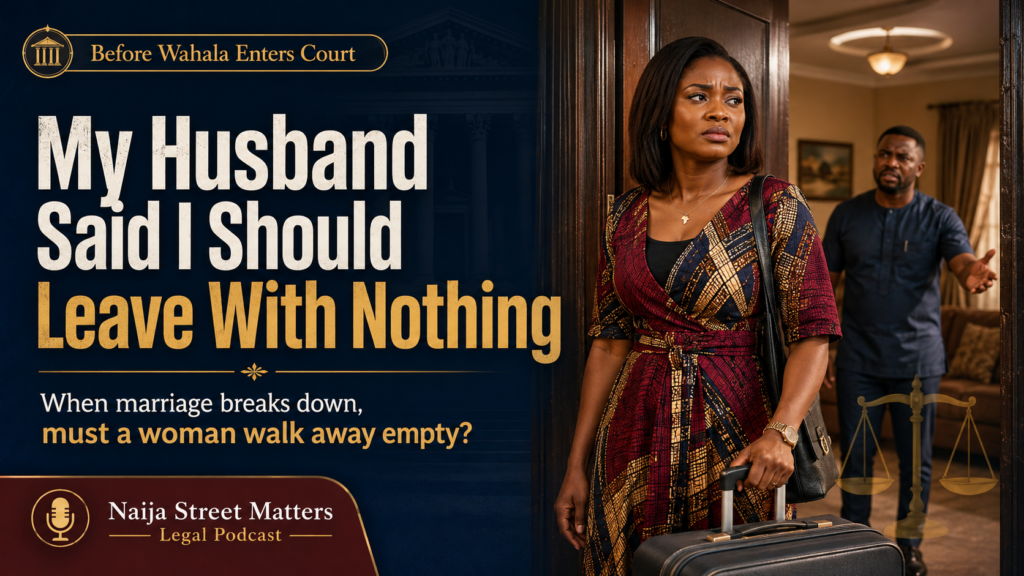
- Divorce, Property and Dignity: Why ‘Leave With Nothing’ Is Not Always the Law
There are sentences that do not just break the heart; they break the spirit.
One of them is this:
“Pack your load and leave. This house is mine. You came with nothing, you will go with nothing.”
Many Nigerian women have heard a version of that sentence. Some heard it after ten years of marriage. Some after three children. Some after helping a husband build a business from scratch. Some after paying rent when things were hard. Some after carrying the emotional weight of a home while the man carried the title documents.
And sometimes, the sentence does not come alone. It comes with shouting. It comes with family pressure. It comes with threats. It comes with the husband’s relatives standing by the door as if marriage is a tenancy at will and the wife is an unwanted visitor.
But let us say it clearly: the breakdown of a marriage is not a licence to humiliate, intimidate, abandon, or financially bury the other spouse.
Marriage may fail. Love may grow cold. People may separate. Divorce may become necessary. But even when a marriage collapses, the law does not automatically permit one party to turn the other into a refugee.
This is where many people misunderstand family law in Nigeria. They think the person whose name appears on the rent receipt, land document, car paper, or company registration has the final say. They think if the man paid the bride price or paid for the wedding, he has purchased total control. They think a woman’s years of unpaid labour, child care, emotional support, sacrifice, business support, and domestic contribution mean nothing because her name is not on the certificate of occupancy.
That thinking may be popular on the street, but it is not always the final position before the law.
Marriage Is Not Slavery, and Divorce Is Not Punishment
When a statutory marriage breaks down in Nigeria, the Matrimonial Causes Act provides the legal framework for divorce and related matters such as maintenance, custody, and settlement of property. This means that when a court is properly approached, it can look beyond shouting, ego, and family pressure.
The court can ask important questions.
What is the condition of the parties? What are their means and earning capacities? Are there children? Who has been caring for the children? What arrangements will protect their education, welfare, shelter, health, and emotional stability? Was one party financially dependent on the other? Did one spouse contribute directly or indirectly to the acquisition, improvement, or preservation of property? Is one party trying to quickly sell, transfer, hide, or dispose of property in order to defeat the other person’s claim?
These are serious questions. And they show why no spouse should simply accept the sentence, “Leave with nothing,” as if it is a court judgment.
It is not.
It is only a threat until the law has spoken.
“This House Is Mine” May Not End the Conversation
Let us be careful here. Nigerian law does not automatically say that once divorce happens, property must be shared equally. It is not every marriage dispute that will lead to a fifty-fifty division of property. The court does not operate by social media emotion. Evidence matters. Documents matter. Contributions matter. The needs of the parties and children matter. The nature of the marriage matters. The type of marriage also matters.
But it is also wrong to assume that because only the husband’s name is on the property, the wife must necessarily walk away empty.
The court may consider whether a settlement of property is just and equitable in the circumstances. That phrase — just and equitable — is very important. It means the court is not blind to reality. It can look at fairness. It can look at the entire picture. It can look at the wife, the husband, and the children.
For example, a wife may not have her name on the title document, but she may have contributed money toward the purchase. She may have paid for building materials. She may have supported the family business that funded the property. She may have used her salary for food and school fees while the husband used his income to acquire assets. She may have provided unpaid labour at home that enabled the husband to build wealth outside.
These things may not automatically give her ownership, but they may become relevant when the court considers maintenance, property settlement, and the welfare of children.
So, when a man says, “This house is mine,” the legal question may become: What are all the facts? What are the documents? What are the contributions? What does justice require in this particular case?
Maintenance Is Not Begging
One of the most painful mistakes in Nigerian matrimonial disputes is the belief that asking for maintenance is begging.
It is not begging.
Maintenance is not “please help me.” It is a legal request that may arise from the duties and realities of marriage, separation, divorce, and child welfare. A court can make maintenance orders where appropriate. This may relate to a spouse or children of the marriage. It may be temporary while proceedings are pending, or it may be part of final orders.
This is especially important where one spouse has been financially dependent, where children need food, school fees, medical care, accommodation, and stability, or where one party has the means to contribute but refuses out of anger.
Let us be honest: in many homes, when separation begins, the first weapon is money.
School fees stop. Feeding money stops. Rent is threatened. The children become emotional ammunition. A spouse who once enjoyed the labour and loyalty of the other suddenly says, “Go and suffer.”
That is why the court exists — not to encourage laziness, not to reward irresponsibility, but to prevent power from becoming cruelty.
Children Are Not Weapons of War
When a marriage breaks down, the children often become the silent victims. Adults fight over pride, property, betrayal, and pain, but the child is the one who starts failing in school, crying at night, losing confidence, and feeling abandoned.
The law does not treat children as trophies. Custody is not ownership. Custody is not revenge. Custody is not a medal given to the parent who shouted loudest or accused the other person most dramatically.
The court’s primary concern is the welfare and best interest of the child. That includes the child’s education, emotional stability, health, safety, moral development, shelter, and overall well-being.
This is the lesson ordinary Nigerians must understand: a child does not stop having two parents because the marriage has failed. One parent may have custody, but the other may still have access. One parent may be ordered to pay maintenance. The court may also consider welfare reports and other evidence to determine what arrangement best protects the child.
So when one spouse says, “Leave my house and leave the children,” or “You will never see your children again,” that person may be speaking from anger, not law.
The court, not bitterness, should determine what arrangement is best for the children.
Do Not Sign Your Future Away Under Pressure
Many women make dangerous decisions at the point of emotional breakdown. They are tired. They are ashamed. Their family says, “Just leave first.” The husband’s family says, “Sign this paper and go.” A pastor, imam, elder, or relative may say, “Don’t fight. God will judge.” Then, under fear and tears, the woman signs a document she does not understand.
Later, she discovers that she has signed away claims, custody arrangements, property interests, or maintenance issues without proper advice.
This is dangerous.
Do not sign any document under pressure. Do not sign because people are shouting. Do not sign because someone says, “It is just formality.” Do not sign because you are embarrassed. Do not sign because you want the argument to end that night.
Before signing anything connected to separation, property, children, maintenance, custody, or divorce, speak with a qualified legal practitioner. Family pressure is not legal advice. Sympathy is not strategy. Prayer is powerful, but prayer does not replace proper documentation.
Keep Records Before Wahala Enters Court
In marriage, many people do not keep records because they trust each other. That is understandable. Marriage is not a business partnership in spirit. But when trouble starts, evidence becomes important.
If you are facing this kind of situation, begin to organise your documents calmly and lawfully.
Keep records of bank transfers, rent payments, school fees, medical bills, building contributions, land payments, business investments, chats, emails, receipts, loan documents, property documents, children’s expenses, and any proof of contributions. Keep copies safely. Do not steal documents. Do not forge anything. Do not destroy property. Do not make false claims. Do not secretly manufacture evidence.
The court is interested in credible facts, not emotional exaggeration.
If there are threats, violence, unlawful lockout, seizure of personal belongings, or danger to you or the children, seek urgent legal and protective assistance. Do not wait until the matter becomes tragic before taking lawful steps.
A Message to Husbands
Brother, listen carefully.
Being the husband does not make you a military governor over another human being. Paying rent does not give you the right to humiliate your wife. Having your name on documents does not give you the right to weaponise hunger, shelter, or children.
If the marriage has broken down, handle it with dignity. Go through lawful channels. Do not throw clothes outside. Do not seize certificates. Do not lock her out with children inside. Do not hide assets in panic. Do not transfer property to friends or relatives just to frustrate claims. Do not use money as a whip.
A man does not become stronger by making the mother of his children homeless.
If you believe you have a genuine case, present it properly. Let the court decide. Let lawyers advise. Let the welfare of the children guide your conduct.
A Message to Wives
Sister, listen carefully too.
Do not assume that social media anger is legal victory. Do not destroy property. Do not deny the children access to their father without lawful basis. Do not use false allegations as a weapon. Do not abandon the children in anger. Do not allow shame to silence you. Do not walk away from your rights because somebody says, “A good woman does not fight.”
Seeking legal protection is not stubbornness. Asking for maintenance where appropriate is not greed. Asking the court to consider property settlement is not wickedness. Protecting your children’s welfare is not disrespect.
But do it lawfully. Do it with evidence. Do it with proper advice. Do it without drama that can damage your own case.
The Real Issue Is Not Just Property — It Is Dignity
When a husband says, “Leave with nothing,” he may think he is talking about property. But deeper than property, he is talking about dignity. He is saying, “Your years here have no value.” He is saying, “Your sacrifices do not count.” He is saying, “Because I controlled the money, I control the ending.”
That is why this topic matters.
Many women have built homes they do not own on paper. Many have raised children while losing career opportunities. Many have supported businesses where they are not listed as directors. Many have contributed silently because they believed marriage was forever.
When forever fails, fairness must still matter.
And fairness does not mean one party must win everything while the other disappears into poverty. Fairness means the law should look at the facts, the children, the needs, the conduct, the means, and the justice of the case.
Before Wahala Enters Court: What Should You Do?
Do not wait until the day your bags are outside. Once serious matrimonial conflict begins, get advice early. Understand the type of marriage you contracted — statutory, customary, or Islamic — because the process and legal consequences may differ. Gather your records. Protect the children from emotional warfare. Avoid violence. Avoid threats. Avoid public defamation. Avoid signing documents in panic.
Most importantly, do not allow street intimidation to replace legal process.
A spouse can say anything in anger. But anger is not law. Threat is not judgment. A family meeting is not a court order. And “leave with nothing” is not the final word unless you surrender your rights without understanding them.
Final Word
Marriage may begin with love, music, rice, aso-ebi, prayers, and dancing. But when it begins to break down, people must remember that the other person is still a human being.
You may no longer want the marriage. You may no longer want the relationship. You may even have good reasons to leave. But do not turn the end of love into the beginning of oppression.
Because before wahala enters court, wisdom should enter the room.
And the message is simple:
A woman should not be forced to leave a marriage with nothing merely because a man says so. A man should not be condemned without evidence merely because emotions are high. The children should not suffer because adults are angry. Let the law, fairness, evidence, and dignity speak.
This podcast is for public education and general information only. It is not personal legal advice. For your specific situation, please consult a qualified legal practitioner.