- The Hidden Trap of Status Money: When Your Wealth Becomes Another Person’s Insecurity
- Before You Spend to Impress People, Understand This Brutal Psychology of Wealth
The Expensive Mistake of Trying to Be Admired
There is a quiet tragedy in the way many people pursue wealth. They do not only want money for comfort, freedom, security, or dignity. They want money to become visible. They want money to speak for them before they enter the room. They want the car to announce their arrival. They want the house to confirm their importance. They want the wristwatch, phone, perfume, vacation, school fees, wedding, birthday party, and designer outfit to whisper to the world, “Respect me. Admire me. I have arrived.”
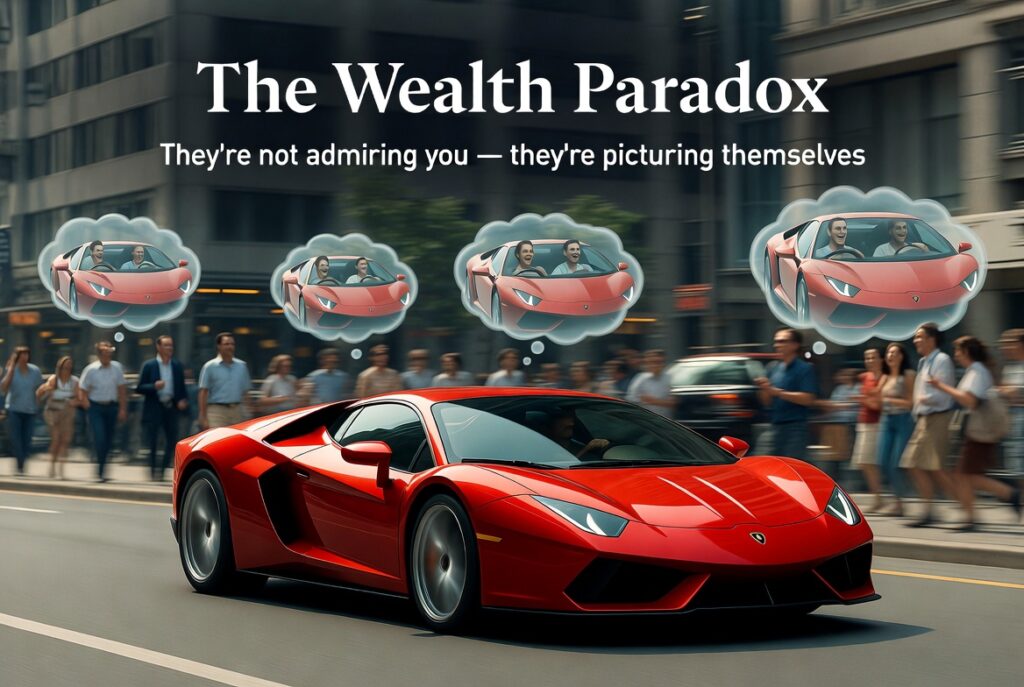
But here is the paradox: most people are not thinking about you as deeply as you imagine.
When they see your wealth, they may not pause to admire your discipline, sacrifice, intelligence, or progress. Instead, they often use your wealth as a mirror for their own desires. Your car becomes a reminder of the car they want. Your house becomes a reminder of the house they have not built. Your vacation becomes a reminder of the life they feel they are missing. Your success becomes a benchmark for their own hunger to be liked, admired, and validated.
So the thing you bought to make people focus on you often makes them focus on themselves.
That is the wealth paradox.
“The man who buys admiration with money often discovers that people are not admiring him; they are measuring themselves against him.”
This is why the pursuit of status through wealth can become spiritually exhausting and financially dangerous. You keep spending to be seen, but the people you want to impress are busy imagining how they too can be seen. You are not the destination of their admiration. You are the trigger of their comparison.
The Core Philosophy: Wealth Is Powerful, But Status Wealth Is a Trap
Money is not evil. Wealth is not shameful. Prosperity is not a sin. A person who works hard, invests wisely, builds businesses, creates jobs, serves customers, solves problems, and becomes wealthy should not apologize for progress.
But there is a difference between using money as a tool and using money as a costume.
Money as a tool buys freedom, time, security, health, opportunity, education, assets, dignity, and peace.
Money as a costume buys applause, envy, attention, and temporary social elevation.
The problem is that applause is addictive. Once a person begins to use wealth as a signal, the signal must keep getting louder. Yesterday’s car no longer impresses. Yesterday’s house no longer satisfies. Yesterday’s outfit becomes ordinary. Yesterday’s vacation becomes old content. Yesterday’s achievement becomes forgotten.
So the person is forced to keep upgrading the signal again and again. The clothes must become more expensive, the car must become bigger, the birthday must become louder, the wedding must become more dramatic, and the lifestyle must appear more luxurious. Spending becomes more visible, expectations become heavier, and the pressure to remain impressive keeps growing. Slowly, what began as a desire for status turns into a financial prison.
“When money becomes your costume, you must keep paying to remain in character.”
The wise person understands that wealth should reduce pressure, not increase it. Wealth should give you control, not make you a slave of public opinion. Wealth should buy peace, not force you into endless performance.
The Psychology: Why People Don’t Admire You the Way You Think
Human beings are self-centered in a very ordinary way. This does not always mean they are wicked. It means most people interpret the world through the lens of their own desires, fears, insecurities, and ambitions.
When people see your success, they may say, “Wow, he is doing well.” But beneath that thought, another thought often rises: “What about me?”
When they see your new house, they think about their rent.
When they see your new car, they think about their own transportation struggle.
When they see your child studying abroad, they think about their own children’s future.
When they see your business expansion, they think about their own delayed dreams.
When they see your luxury, they think about their own lack.
This is the psychology of social comparison.
People may admire wealth in general, but they often personalize what they see. Your display becomes their measurement tool. Your success becomes their emotional calculator. Your lifestyle becomes the evidence they use to judge whether they are winning or losing.
This is why trying to win admiration through wealth is unreliable. The audience is not neutral. They are not sitting quietly as judges of your greatness. They are also contestants in the same invisible competition for validation.
“In the theatre of status, everyone is both performer and spectator.”
That is why the applause never satisfies. The people clapping for you also want to be clapped for. The people praising your car may secretly be imagining their own. The people liking your pictures may be comparing your visible life to their hidden struggle. The people calling you “boss” may not love you; they may love the idea of becoming what they think you represent.
This does not mean everyone is fake. It means status is psychologically complicated. Admiration, envy, inspiration, insecurity, respect, resentment, and desire often sit together in the same room.
The Nigerian and African Context: The Pressure to Show That You Have Arrived
In Nigeria and across Africa, wealth is often treated as proof of destiny. People are not only trying to live well. They are trying to prove that life did not defeat them.
A man returns to the village in December and feels pressure to arrive in a way that silences gossip. A woman attends a wedding and feels pressure to wear something that says she is not suffering. A young entrepreneur wants clients to see him as successful, so he spends heavily on image before the business has strong cash flow. A family organizes a burial, birthday, or wedding far beyond their means because they want society to say, “They tried.”
This pressure is real.
In many communities, visible wealth is interpreted as competence, blessing, intelligence, favour, and importance. If you appear poor, people may underestimate you. If you appear successful, doors may open faster. So people learn to package themselves. They learn that perception matters.
But perception can become a dangerous master.
A salary earner borrows to fund a lifestyle that colleagues will respect. A businessman uses working capital to buy a luxury vehicle because he wants people to “take him seriously.” A young person enters questionable money because legitimate progress feels too slow. A couple spends their future on a wedding designed to impress guests who will forget the food by next week.
This is how many people become poor trying to look rich.
“The most expensive poverty is the poverty that dresses itself as success.”
In Lagos, Abuja, Port Harcourt, Accra, Nairobi, Johannesburg, and among the African diaspora, the performance of success has become a serious financial disease. Social media has made it worse. Now people do not only show success to neighbours and classmates; they show it to thousands of people, many of whom do not care about them personally.
And because everyone is watching everyone, the benchmark keeps rising.
What used to be impressive becomes normal.
What used to be luxury becomes expectation.
What used to be occasional celebration becomes lifestyle requirement.
This is why many people are tired. Not because they are not making progress, but because they are trying to fund an image faster than their foundation can carry.
The Danger: Spending for Admiration Can Destroy Real Wealth
The danger of status spending is that it converts money from a servant into an actor. Instead of money quietly working for you, money begins to perform for others.
That performance has a cost.
Every naira spent mainly to impress people is a naira that cannot build emergency savings. Every unnecessary debt used to signal success reduces future freedom. Every lifestyle upgrade made for public validation increases the pressure to maintain appearances. Every financial decision made for applause weakens the discipline required for long-term wealth.
The worst part is that the admiration you are trying to buy may not even arrive in the form you expect. Some people will envy you, some will resent you, some will copy you, and some will begin to see your success as an invitation to ask you for money. Others will quietly expect more from you, while some will use your visible progress as a mirror that makes them feel worse about their own lives.
Some will assume you had help, stole money, joined politics, did fraud, married rich, or used some hidden advantage.
And even those who genuinely admire you may move on quickly. Human attention is brief. Today they are praising your car. Tomorrow someone else buys a bigger one. Today your birthday trends. Tomorrow another person’s wedding floods the timeline. Today your outfit is discussed. Tomorrow nobody remembers.
So why mortgage your peace for temporary attention?
“Do not spend permanent money to buy temporary admiration from distracted people.”
This is not a call to live small. It is a call to live free. Buy good things because they serve your life, not because they serve your insecurity. Enjoy beauty because it brings genuine pleasure, not because you need strangers to validate your existence. Celebrate success because gratitude is healthy, not because you are auditioning for public approval.
The Mechanics: Wealth Signaling Versus Wealth Building
Wealth signaling and wealth building often move in opposite directions.
Wealth signaling is visible. Wealth building is often invisible.
Wealth signaling buys things that people can see. Wealth building buys assets, skills, systems, equity, reserves, and freedom.
Wealth signaling says, “Look at me.” Wealth building says, “Protect the future.”
Wealth signaling wants speed. Wealth building requires patience.
Wealth signaling often increases expenses. Wealth building increases options.
A person signaling wealth may have a luxury car but no emergency fund. Another quietly building wealth may drive a modest car but own productive assets. One may look richer. The other may actually be freer.
This is one of the painful realities of money: what looks wealthy is not always wealth, and what builds wealth is not always visible.
A business owner who reinvests profits may not look glamorous. A family that lives below its means may not impress society. An investor who buys assets patiently may not trend online. A professional who avoids lifestyle inflation may look ordinary. But quietly, they are building the real thing.
“Real wealth often grows in silence because noise is expensive.”
The truly wealthy understand that money’s greatest job is not to impress people. Its greatest job is to give you control, security, time, opportunity, and dignity. Once you understand this, your financial decisions change.
You stop asking, “Will people respect me if I buy this?”
You start asking, “Will this make my life better or merely make my image louder?”
You stop asking, “How do I look?”
You start asking, “How strong is my foundation?”
You stop asking, “What will they say?”
You start asking, “What will this cost my future?”
The Social Media Mirror: Where Wealth Becomes a Benchmark for Insecurity
Social media has turned wealth into a public scoreboard. People post cars, houses, vacations, restaurants, watches, hotel rooms, airport lounges, shopping bags, engagement rings, business-class seats, and luxury lifestyles. Some of it is real. Some of it is borrowed. Some is staged. Some is financed by debt. Some is funded by sources that cannot survive public scrutiny.
But the viewer rarely knows the full story.
The viewer only sees the signal.
And the signal becomes a benchmark.
A young man sees his mate with a Benz and begins to despise his Toyota. A woman sees another woman’s Dubai vacation and begins to feel her own life is dull. An entrepreneur sees a competitor’s office launch and begins to feel behind, even though the competitor may be drowning in debt. A couple sees another couple’s wedding and starts planning beyond their means.
This is how comparison steals financial sanity.
“When you use another person’s display as your financial compass, you may drive your life into a ditch.”
The wise person must learn to look at visible wealth with emotional discipline. Admire good things without becoming enslaved by them. Celebrate others without despising your process. Learn from success without copying every display. Remember that people show outcomes, not full balance sheets. They show arrivals, not sacrifices. They show luxury, not liabilities. They show smiles, not anxiety.
Your financial life must not be governed by another person’s camera angle.
The Blueprint: How to Escape the Wealth Paradox
First, define what wealth means to you before society defines it for you. Is wealth peace? Is it time freedom? Is it family security? Is it business ownership? Is it the ability to help others? Is it retirement control? Is it spiritual calm? Is it impact? Until you define wealth internally, you will keep chasing external symbols.
Second, separate admiration from financial success. It is natural to want respect, but do not make respect the foundation of your money decisions. Respect built on display is fragile. Respect built on character, competence, integrity, generosity, and consistency lasts longer.
Third, audit your spending motives. Before a major purchase, ask yourself: “Would I still want this if nobody saw it?” That question is powerful. If the answer is no, you are not buying utility; you are buying validation.
Fourth, protect your financial foundation. Build emergency savings. Invest consistently. Avoid unnecessary debt. Strengthen income. Acquire assets. Keep records. Protect your reputation. Wealth that cannot survive silence is not yet strong.
Fifth, practice quiet wealth. Not every achievement needs announcement. Not every purchase needs posting. Not every blessing needs public display. Privacy protects peace. Silence protects strategy. Modesty protects freedom.
Sixth, learn to enjoy money without worshipping attention. There is nothing wrong with comfort. There is nothing wrong with beauty. There is nothing wrong with celebrating progress. The issue is not enjoyment. The issue is dependence on being seen.
Seventh, remember that the people you are trying to impress are also busy trying to impress others. This should liberate you. The crowd is not thinking about you as much as you fear or hope. Everyone is carrying private battles, desires, insecurities, and ambitions.
“Stop living as if the world is holding a permanent meeting about your life.”
The Benediction: Become Wealthy Enough to Stop Performing
May you become successful, but may success not turn you into an actor on the stage of public approval.
May you make money, but may money never become a costume for insecurity.
May you enjoy good things, but may you not lose your soul trying to be seen.
May you rise, but may you not become addicted to being noticed.
May your wealth buy freedom, not pressure.
May your money serve your purpose, not your ego.
Because the paradox of wealth is real: many people want wealth so others will admire them, but others often use that wealth as a mirror for their own desire to be admired. So the chase continues. One person displays. Another person compares. Another person upgrades. Another person borrows. Another person envies. Another person performs. And the wheel keeps turning.
The wise person steps off that wheel.
The wise person says, “I do not need every blessing to become a billboard.”
The wise person says, “My financial peace is more important than your applause.”
The wise person says, “I will build wealth that gives me options, not a lifestyle that gives me anxiety.”
The wise person says, “I can admire others without copying them, and I can succeed without begging for validation.”
That is maturity.
That is freedom.
That is wealth with wisdom.
So build. Grow. Invest. Prosper. Enjoy the fruit of your labour. But do not become trapped in the endless hunger to be liked and admired through possessions. The people watching you are not always admiring you. Many are measuring themselves. Many are projecting their desires. Many are chasing their own stage.
Let your money do a higher work. Let it buy you time, peace, dignity, security for your family, and the freedom to choose from better options when life presents them.
Let it buy the ability to live without begging the crowd to confirm your worth.
Because the richest person is not the one everybody looks at.
The richest person is the one who no longer needs to be looked at before feeling complete.
Subscribe to Naija Street Matters for regular news update and click on the Whats-app green button below to join our community.