- The 'Skyscraper' Secret: What the Nigerian 1% Know About Building Wealth That the Masses Ignore.
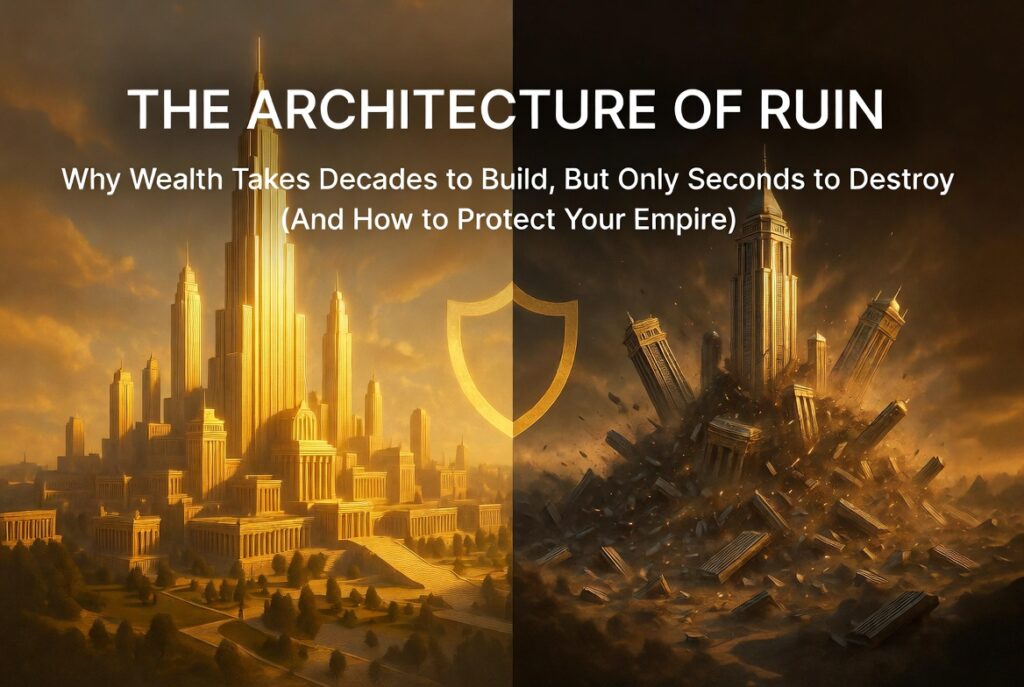
Imagine standing on Broad Street in Lagos, staring up at a magnificent, towering skyscraper. To build that structure, it required years of agonizing, meticulous effort. It required architects drafting blueprints for months. It required deep, structural excavations to lay the foundation. It required thousands of workers, hundreds of thousands of tons of steel and concrete, and an endless stream of capital poured into the project day after day, year after year.
That is the nature of creation, It is slow, It is methodical, It is often exhausting.
Now, imagine a demolition crew walking into that same building. They strategically place a few explosive charges at critical structural points. They press a single button. In less than ten seconds, the entire skyscraper—the product of years of human ingenuity and labor—implodes into a blinding cloud of dust and rubble.
This is not just a lesson in engineering; it is the most brutal, unforgiving law of economics, finance, and business.
Growth is driven by compounding, which always takes time. Destruction is driven by a single point of failure, which can happen in seconds, and a loss of confidence, which can happen in an instant.
If you are navigating the turbulent waters of the Nigerian economy, you must understand the deep asymmetry between building and destroying. Whether you are scaling an e-commerce empire, building a professional career, or investing in the financial markets, the rules of gravity apply to your money. Understanding this dynamic is the difference between building a generational fortress and building a house of cards.
Part 1: The Agonizing, Invisible Magic of Compounding
Let us dissect the anatomy of growth. True growth—the kind that builds unbreakable empires and generational wealth—is never an overnight phenomenon. It is driven exclusively by the principle of compounding.
In the financial world, compounding is the process where the returns on your investments begin to generate their own returns. It is the snowball effect. But compounding does not only apply to money in a bank account or a stock portfolio. Compounding applies to every single metric of success in the modern Nigerian marketplace.
Compounding Skills: When you first learn high-impact copywriting or digital marketing, your skills are rudimentary. But as you execute campaign after campaign, your intuition sharpens. You begin to understand consumer psychology. You learn what makes a Nigerian buyer click “Add to Cart.” Over the years, that compounded knowledge turns you into a lethal operator who can command the market.
Compounding Brand Equity: Building a brand on platforms like Naija Commerce takes time. Your first ten customers buy from you with hesitation. But when you deliver quality non-tarnish jewelry or high-end electronics exactly as promised, you earn trust. They tell their friends. Their friends buy. Over years of consistent, excellent service, your brand equity compounds into a massive, fiercely loyal customer base.
Compounding Networks: Your professional reputation is built one interaction at a time. Every promise kept, every deadline met, and every problem solved adds a tiny brick to your reputation.
The most frustrating aspect of compounding is that it requires time—and time is the one thing human beings are biologically wired to hate waiting for. We want the result immediately. We want the “10 Billion Dollar Code” to activate tomorrow morning. But the mathematics of compounding demands that the most massive gains happen at the very end of the timeline.
During the first few years of building an e-commerce business, sourcing products, and reinvesting your profits, it feels like you are moving at a snail’s pace. You are putting in 18-hour days, battling logistics companies, and navigating fluctuating exchange rates, yet your bank balance only creeps up slightly. This is where 90% of entrepreneurs quit. They abandon the compounding machine just before the snowball gets big enough to create an avalanche of wealth.
Growth demands extreme patience. It demands that you wake up every day and lay one more brick, perfectly aligned, regardless of whether anyone is clapping for you.
Part 2: The Terrifying Speed of the “Single Point of Failure”
While growth is a marathon that takes years, destruction is a sniper bullet. It is fast, efficient, and lethal.
The primary engine of financial and business destruction is the Single Point of Failure (SPOF). In complex systems engineering, a single point of failure is a part of a system that, if it fails, will stop the entire system from working. In the Nigerian business ecosystem, single points of failure are everywhere, hiding in plain sight.
Let us look at the practical reality of a modern digital business. You might spend three years compounding your brand, building a massive e-commerce operation, and scaling your daily revenue. But examine the structural integrity of your operation:
The Traffic SPOF: Are 100% of your sales coming from a single Facebook or Instagram ad account? If a rogue algorithm suddenly flags your account and permanently bans it, your revenue drops to absolute zero in three seconds. That is a single point of failure.
The Supply Chain SPOF: Do you rely on a single manufacturer in Shenzhen for your flagship product? If that factory burns down, or if a global shipping crisis halts their exports, your inventory dries up instantly. Years of momentum are destroyed because you lacked redundancy.
The Infrastructure SPOF: Do you rely on a single payment gateway to process your customer transactions? If their servers crash on the day of your biggest product launch, or during a massive Valentine’s Day campaign, your customers cannot pay you. The opportunity evaporates.
A single point of failure means you have built a skyscraper on top of a single, fragile wooden pillar. It doesn’t matter how beautiful the building is; if that pillar snaps, the entire structure comes down.
The economic history of Nigeria is littered with the corpses of businesses that had single points of failure. We have seen entrepreneurs who kept all their operational capital in a single, struggling commercial bank. When the bank went under, their capital was trapped, and the business suffocated in a matter of days. We have seen professionals whose entire livelihood was dependent on a single political appointment or a single client contract. When the administration changed, their income was annihilated.
Destruction does not care about how hard you worked. It only looks for the weakest link in your chain. Once it finds it, the collapse happens in seconds.
Part 3: The Fragility of Confidence
If a single point of failure is a structural threat, the loss of confidence is a psychological one. And in the world of money, psychology is everything.
Confidence is the invisible currency that holds the entire global economy together. Why does a piece of polymer paper with the CBN logo hold value? Because we collectively have confidence in it. Why do investors park billions of Naira in a financial institution? Because they have confidence they can withdraw it tomorrow. Why do customers pre-order products from your online store before seeing the physical item? Because they have confidence in your brand. Like compounding, confidence takes an agonizingly long time to build. You must prove yourself repeatedly. You must survive economic downturns, honor your warranties, and consistently deliver value.
But the loss of confidence? That can happen in a fraction of an instant.
All it takes is one viral, devastatingly negative review from a massive influencer. All it takes is one leaked audio recording of a CEO insulting their customers. All it takes is one missed payroll cycle for your top employees to start secretly sending their CVs to your competitors.
When a market, a customer base, or an investment board loses confidence in you, the reaction is not a slow decline. It is an immediate, violent stampede for the exits. This is known as a “bank run” in the financial sector, but bank runs happen in retail and personal branding as well. Once the whisper of doubt enters the ecosystem—”Are they running out of money? Are they selling fake products? Are they going bankrupt?”—the panic feeds on itself.
Warren Buffett famously summarized this brutal reality: “It takes 20 years to build a reputation and five minutes to ruin it. If you think about that, you’ll do things differently.”
Part 4: The Strategic Defense (How to Bulletproof Your Empire)
If you understand that growth is agonizingly slow and destruction is terrifyingly fast, how do you survive? How do you build an empire that cannot be demolished by a single button?
You must become an architect of redundancy and resilience. You must design your financial and business life so that no single event, no matter how catastrophic, can take you to zero.
1. Aggressive Diversification (Eliminate the SPOF) You must audit every area of your business and personal finances to identify the single points of failure.
If you rely on one traffic source, you must immediately begin building SEO, an email list, and an SMS marketing database. You must own your audience so that an algorithm change cannot bankrupt you.
If you rely on one supplier, you must find a secondary and tertiary supplier. They may be slightly more expensive, but you are not paying for better margins; you are paying for insurance.
If you rely on one stream of income, you must aggressively build secondary pillars.
2. Guard Your Reputation with Lethal Force Because confidence can vanish in an instant, you must treat your integrity as your most valuable, highly guarded asset. Never compromise on the quality of what you sell. Never make a financial promise you cannot keep. In a market where trust is incredibly low, extreme transparency and radical integrity become a massive competitive advantage. When you make a mistake, own it immediately and fix it publicly before the market narrative can turn against you.
3. Build a “Margin of Safety” In engineering, a bridge is never designed to hold exactly the maximum weight of the cars expected to cross it. If the expected weight is 10,000 tons, the engineers design the bridge to hold 30,000 tons. That 20,000-ton gap is the margin of safety. In wealth creation, your margin of safety is your liquidity. It is your emergency cash reserves. It is the capital you hold back so that when a systemic shock hits the Nigerian economy, you are not forced to liquidate your compounding assets at a loss.
The Final Verdict: Respect the Asymmetry
You are playing a game where the rules are fundamentally unbalanced. The forces of destruction require almost zero energy to execute, while the forces of creation require every ounce of your intellect, discipline, and endurance.
Do not be discouraged by the slow pace of your compounding growth. That is exactly how it is supposed to work. The fact that it is difficult is what keeps your competitors from succeeding. Embrace the grind, honor the time it takes to build, and relentlessly aggressively protect your blind spots.
Build your skyscraper. Lay the foundation deep. But make absolutely sure you leave no room for the demolition crew.