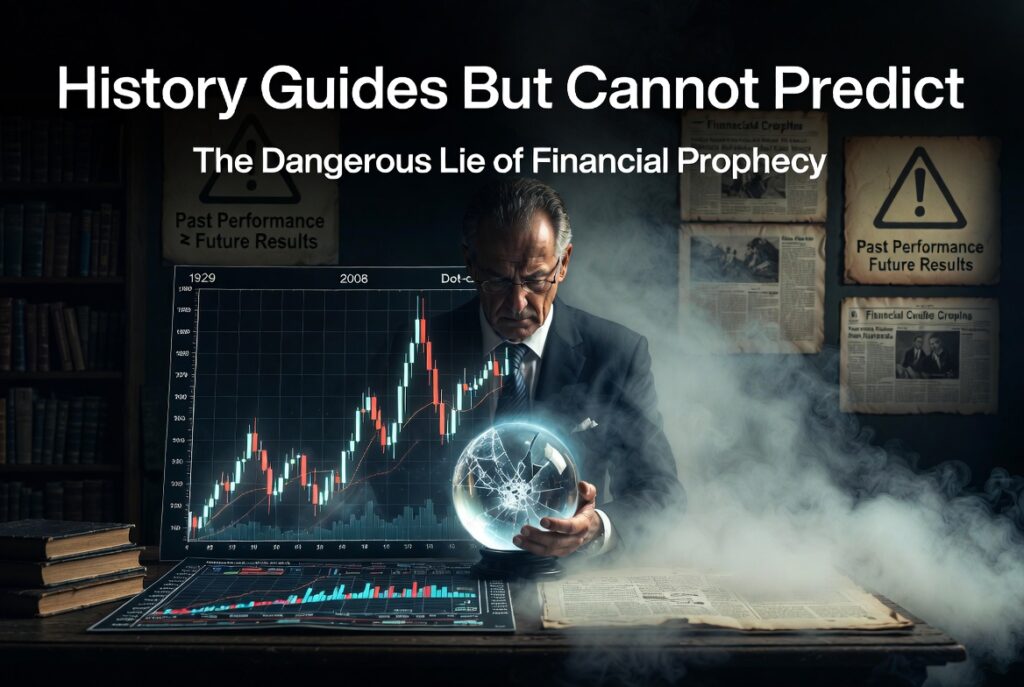
- The Future Will Not Look Like the Past: The Brutal Lesson Every Investor Must Learn Before the Next Shock
- History Teaches Wisdom, Not Certainty: Why the Biggest Money Events Are Usually the Ones Nobody Saw Coming
The Future Does Not Obey Your Charts
There is a dangerous comfort in looking backward.
History gives us stories. It gives us patterns. It gives us charts, dates, cycles, recessions, booms, crashes, wars, bubbles, recoveries, innovations, bankruptcies, and miracles. It helps us understand how people behaved when fear was high, when greed was fashionable, when markets were rising, when currencies were falling, when businesses were collapsing, and when everyone thought the world had changed forever.
But history also has a trap.
The trap is believing that because you studied what happened before, you now know what will happen next.
That is the historians-as-prophets fallacy.
It is the mistake of treating history like a crystal ball instead of a mirror. It is the mistake of assuming that yesterday’s pattern will repeat tomorrow with enough accuracy for you to build your entire financial life on it. It is the mistake of forgetting that history is mostly the study of surprising events, not predictable ones.
“History is a teacher, not a prophet. It can make you wiser, but it cannot make you all-knowing.”
This is one of the deepest lessons every investor, entrepreneur, business leader, and wealth builder must understand. The future is not a photocopy of the past. It may rhyme with the past, but it does not kneel before it. The most important events that will shape tomorrow’s economy are often events that history gives us little or no direct guide about.
They will be unprecedented.
And because they are unprecedented, many people will be unprepared.
That is why they will matter so much.
The Core Philosophy: History Calibrates Expectations, But It Does Not Remove Uncertainty
History is valuable. Let no one misunderstand this. A person who ignores history is financially naked. History teaches us where people tend to go wrong. It shows us the danger of greed, panic, leverage, overconfidence, bubbles, debt, fraud, speculation, and mass delusion. It shows us that markets can crash, currencies can weaken, empires can fall, industries can disappear, and new technologies can change everything.
History helps us calibrate expectations.
It reminds us that good times do not last forever.
It reminds us that bad times do not last forever.
It reminds us that people panic at the bottom and become greedy at the top.
It reminds us that debt feels harmless until conditions change.
It reminds us that every generation believes its own bubble is special.
It reminds us that human behaviour is often more predictable than market prices.
But history should not be worshipped as prophecy.
The world is not a laboratory where the same chemical reaction produces the same result every time. Investing is not a hard science. It is not physics. It is not mathematics in a vacuum. Investing is a massive crowd of human beings making imperfect decisions with limited information about things that affect their well-being, identity, security, family, future, pride, fear, and survival.
That kind of environment can make smart people nervous, greedy, paranoid, arrogant, hopeful, irrational, and blind.
“Markets are not machines. Markets are human emotion wearing numbers.”
This is why the future remains slippery. You are not only forecasting earnings, interest rates, inflation, exchange rates, oil prices, and policies. You are forecasting people’s stories, fears, preferences, confidence, and behaviour. And those things change.
They change with culture.
They change with technology.
They change with generations.
They change with politics.
They change with social mood.
They change with pain.
They change with opportunity.
They change with what people believe the future will reward.
The Psychology: Why Experience Often Creates Overconfidence
There is a strange thing about experience. It can make people wise, but it can also make them proud.
Someone survives one market crash and begins to believe he understands all crashes. A business owner survives one recession and assumes the next one will behave the same way. An investor makes money in one property cycle and begins to believe every land opportunity will reward patience. A trader catches one currency move and starts speaking like an oracle. A politician, banker, entrepreneur, or analyst reads past data and begins to talk about the future with dangerous certainty.
But experiencing a specific event does not necessarily qualify you to know what will happen next. In fact, it can make you overconfident.
This is because people often confuse memory with forecasting ability.
They say, “I have seen this before.”
But have they?
Maybe they have seen something that looks similar, but the details may be different. The debt levels may be different. The policy response may be different. The technology may be different. The demographic structure may be different. The global linkages may be different. The speed of information may be different. The culture may be different. The investor base may be different.
Two events can look alike from a distance and behave very differently up close.
“Experience is useful when it makes you humble. It is dangerous when it makes you certain.”
This is why many experts fail loudly. They have knowledge, but they also have attachment to old frameworks. They know what happened last time, but they underestimate what has changed this time. They become prisoners of their own experience.
The young investor can be foolish because he has not seen enough.
The old investor can be foolish because he has seen too much of one kind of world and assumes it will continue.
Wisdom sits between them. Wisdom studies the past but keeps enough humility to admit that the future can arrive wearing unfamiliar clothes.
The Nigerian and African Context: A Continent Where the Future Keeps Refusing to Follow the Script
If there is any place where investors should understand uncertainty, it is Nigeria and Africa.
We have seen exchange rates behave in ways that destroyed business plans. We have seen inflation turn yesterday’s comfortable income into today’s survival struggle. We have seen government policy create sudden winners and sudden losers. We have seen fuel subsidy changes reshape household budgets and business costs. We have seen import restrictions, border closures, banking reforms, fintech disruption, insecurity, global oil shocks, and sudden regulatory decisions change the direction of whole industries.
A trader imports goods based on one exchange rate assumption, only to meet a new reality before the goods arrive. A real estate investor buys land expecting one development path, only for government acquisition, road alignment, drainage issues, or litigation to change the story. A fintech entrepreneur builds under one regulatory climate, only to wake up to new compliance demands. A farmer plans based on normal weather and input prices, only for climate, insecurity, fertilizer cost, or transport disruption to rewrite the season.
This is not theory.
This is daily African reality.
And yet, many investors still speak with too much certainty. They say, “This is how it always works.” They say, “Land never goes down.” They say, “Dollar will always do this.” They say, “This business can never fail.” They say, “Government cannot change that policy.” They say, “People will always buy this product.”
No, sir.
The invisible hand hates anything staying too good or too bad indefinitely. When something becomes too profitable, competitors rush in. When a business model becomes too easy, regulation appears. When an asset becomes too loved, the price may become dangerous. When a market becomes too crowded, margins collapse. When conditions become too painful, innovation or political pressure begins to force change.
“Any opportunity that remains too sweet for too long will eventually attract the crowd, the regulator, the fraudster, or the correction.”
This is why history must not become laziness. What worked in Lagos ten years ago may not work today. What worked in importation five years ago may fail under a new exchange rate regime. What worked in media before TikTok may struggle after audience behaviour changes. What worked in banking before fintech may look outdated. What worked in retail before e-commerce may need reinvention.
The market is always moving because human preferences are always moving.
The Mechanics: Money Follows Stories and Preferences
The most important driver of anything tied to money is not only numbers. It is the stories people tell themselves and the preferences they develop for goods and services.
A company can have good numbers, but if the public story changes, valuation can collapse. A product can be useful, but if culture moves away from it, demand can decline. A currency can have technical fundamentals, but if people lose confidence, behaviour can change fast. A neighbourhood can be ignored for years, then one infrastructure story can turn it into a hot zone. A business can be small, then one social trend can explode demand.
Money moves toward stories people believe.
This is why markets are so unstable. Stories change. Preferences change. Generations change. What your parents valued may not be what your children value. What one generation saw as luxury, another may see as normal. What one generation trusted, another may distrust. What one generation bought physically, another may order online. What one generation learned in school, another may learn on YouTube. What one generation considered a stable career, another may see as a cage.
Think of how quickly the world has changed around technology, remote work, fintech, artificial intelligence, digital media, logistics, smartphones, streaming, online education, influencer marketing, and mobile payments. Many of these changes were not obvious decades ago, yet they now shape money, business, jobs, and identity.
“The economy is not only built on factories and balance sheets; it is built on what people believe is worth wanting.”
This is why investors must study human behaviour, not just financial statements. Numbers tell you what has happened. Stories help explain what people may do. But even stories can change quickly, which is why humility remains essential.
The Danger: Using the Past as a Map for a Road That No Longer Exists
The danger is not studying history. The danger is overtrusting it.
A person who studies past stock market crashes may assume the next crash will follow the same timeline. A person who studies past inflation may assume the next inflation shock will behave the same way. A person who studies past currency cycles may assume the naira, dollar, or any currency must move in a familiar pattern. A person who studies past business winners may assume future winners will come from the same industries.
But the future often humiliates those assumptions.
The majority of what happens in the global economy at any given moment can often be traced back to a handful of past events that were nearly impossible to predict before they happened. Wars, pandemics, terrorist attacks, policy mistakes, technological breakthroughs, financial crises, political shocks, and cultural shifts can move the world more than the predictable events analysts spend years modelling.
This does not mean forecasting is useless. Forecasting can help planning. But forecasting becomes dangerous when it creates certainty. The investor who says, “Here is one possible future,” is safer than the investor who says, “This is what must happen.”
“The future is not dangerous because we know nothing. It is dangerous because we know just enough to become overconfident.”
This is why many financial models fail. They may be precise but not accurate. They may use impressive formulas but weak assumptions. They may depend on the past behaving like the future. They may ignore human panic, greed, policy surprises, innovation, and social change.
A beautiful spreadsheet can still be blind.
The Correct Lesson From Surprises: The World Is Surprising
When a major surprise happens, people often rush to explain it. After the fact, everything looks obvious. Analysts come on television. Experts write long essays. Commentators say, “The signs were there.” People create neat stories from messy reality.
But before the event, many of those same people did not see it clearly.
This is hindsight bias. It makes the past look more predictable than it was. It makes people believe the future should be easier to forecast than it is. It gives false confidence.
The correct lesson from surprises is not that we should have perfectly predicted them.
The correct lesson is that the world is surprising.
That means your financial life must be built to survive surprises, not merely predict them. Your investment strategy must have room for error. Your business must have buffers. Your household must have emergency savings. Your portfolio must be diversified. Your skills must keep improving. Your debt must be controlled. Your plans must be flexible.
A rigid plan may look strong until reality bends it.
A flexible plan can survive impact.
“Do not build your financial life around being right. Build it around surviving when you are wrong.”
This is the wisdom many people ignore. They want certainty. They want the perfect prediction. They want someone to tell them exactly what will happen to markets, currencies, property, interest rates, commodities, technology, and politics. But the better goal is resilience.
The real test is whether your financial life can survive pressure. Can you withstand a job loss, a delayed business payment, a market crash, a health emergency in the family, an industry disruption, or even the painful discovery that your plan was wrong? That is where true financial strength is revealed.
Scary Events and Great Events Are Both Often Unprecedented
When we think about uncertainty, we often think only about danger. Recessions. Wars. Market crashes. Inflation. Currency collapse. Policy shocks. Pandemics. Bank failures. Insecurity. Debt crises.
But uncertainty is not only negative.
Some of the most important positive events are also unprecedented. Innovations. New technologies. New industries. New medicines. New platforms. New business models. New markets. New forms of communication. New ways of working. New sources of energy. New opportunities for ordinary people to build influence and income.
The same unpredictability that can hurt you can also bless you.
Many people did not predict the scale of mobile money in parts of Africa. Many did not predict how smartphones would change commerce, banking, entertainment, education, relationships, and political participation. Many did not predict how social media would create new careers. Many did not predict how artificial intelligence would begin reshaping work. Many did not predict how quickly remote work would become acceptable in many industries.
The future shocks us in both directions.
This is why the wise investor is neither permanently fearful nor blindly optimistic. He is prepared. He respects risk, but he remains exposed to opportunity. He knows some surprises will hurt, but some surprises will create wealth. He builds a life that can absorb damage and still participate in growth.
“The future is not only a threat. It is also a warehouse of opportunities wearing unfamiliar clothes.”
The Blueprint: How to Invest When the Future Refuses to Be Predicted
First, study history for behaviour, not exact prediction. Learn how people respond to greed, fear, uncertainty, bubbles, crashes, debt, and opportunity. Human behaviour repeats more often than specific events.
Second, respect change. Do not assume that because something worked before, it will work forever. Industries mature. Margins shrink. Technology disrupts. Consumer preferences shift. Regulation changes. Competitors arrive. Culture moves.
Third, build room for error. Every plan should include the possibility that your assumptions are wrong. Keep emergency savings. Avoid excessive debt. Diversify. Do not invest money you need urgently. Do not build your life on perfect forecasts.
Fourth, avoid overconfidence from experience. Experience is valuable, but it can also blind you. Keep learning. Listen to younger trends. Pay attention to new behaviours. Study what is changing, not only what has happened.
Fifth, position yourself for positive surprises. Invest in skills, networks, businesses, and assets that can benefit from change. Stay curious. Build flexibility. Do not become so defensive that you miss opportunity.
Sixth, control what you can control. You cannot control the global economy, exchange rates, elections, wars, inflation, or technological shifts. But you can control your savings rate, debt level, spending habits, asset allocation, learning, work ethic, integrity, and emotional discipline.
Seventh, remain humble. Humility is a financial asset. The person who admits uncertainty prepares better than the person who pretends to know everything.
“In a world ruled by surprises, humility is not weakness. It is risk management.”
The Benediction: Let History Make You Wise, Not Arrogant
May you study the past without becoming imprisoned by it. May history sharpen your judgment without deceiving you into believing you can predict everything. May experience give you wisdom without arrogance, and may success give you confidence without blindness. May you prepare for shocks while remaining open to opportunity, understanding that the future may not look like the past. This truth should not create fear; it should call you to build resilience. The world will keep surprising us. Recessions will come that people did not see coming. Wars will reshape markets. Innovations will create new fortunes. Companies will rise from nowhere, industries that once looked strong will decline, policies will rewrite old assumptions, and technologies will make some skills less valuable while turning others into priceless assets. Cultural shifts will also change what people buy, admire, trust, and desire. This is the reality of money.
So do not build your financial life like a man who believes tomorrow has signed an agreement to repeat yesterday. Build like a person who respects uncertainty. Save. Invest. Diversify. Learn. Adapt. Avoid ruin. Keep cash for surprises. Keep humility for decisions. Keep courage for opportunities.
History is useful, but it is not God.
It can teach you that people panic, but it cannot tell you the exact shape of the next panic.
It can teach you that bubbles happen, but it cannot always tell you where the next bubble will form.
It can teach you that innovation changes lives, but it cannot always tell you which innovation will dominate.
It can teach you that the world is surprising.
And that may be the most important lesson of all.
The future belongs not to those who pretend to know it perfectly, but to those who prepare wisely, adapt quickly, and remain humble enough to change their minds when reality changes the road.
That is how wealth survives uncertainty.
That is how investors endure.
That is how nations, businesses, families, and individuals build strength in a world that refuses to sit still.
Subscribe to Naija Street Matters for regular news update and click on the Whats-app green button below to join our community.