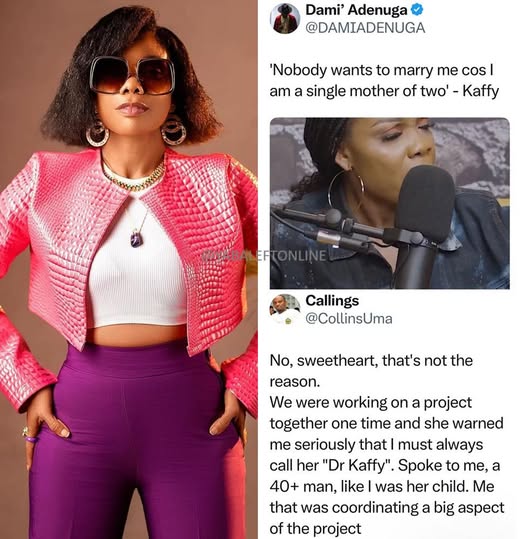
Nigerian dance queen Kaffy recently opened up about her struggles with finding love, revealing that a man once told her he couldn’t date her because she is a single mother of two. Her honest confession sparked conversations online, with many sympathizing with her situation while others offered different perspectives.
One user, reacting to Kaffy’s claim, argued that her single motherhood status might not be the issue. He recalled a time when they worked together on a project, and she insisted on being addressed strictly as “Dr. Kaffy”, even speaking to him, a man in his 40s, as though he were her child. To him, her strict personality, not her motherhood status, was the real challenge.
This raises a deeper question: Does single motherhood make women less desirable in today’s society, or is it more about personal attitudes and perceptions?
For many, single mothers represent strength, resilience, and the ability to balance responsibility with ambition. Yet, in some circles, biases persist—painting single motherhood as a burden rather than a badge of courage. The incident with Kaffy reflects the wider societal debate: is the stigma against single mothers rooted in outdated traditions, or are personal values and behaviors the deciding factor in modern relationships?
Whatever the case, Kaffy’s revelation has reignited conversations about love, respect, and how society views single mothers in 2025.