

In a society where success is often mistaken for submission and wealth for wisdom, the story of Regina Daniels serves as both a cautionary tale and a cultural mirror. The actress, who allegedly married billionaire Ned Nwoko at a very young age, has long been at the center of public fascination and now, with reports suggesting cracks in the marriage, her journey forces us to confront the hidden costs of child marriage and grooming.
Regina’s story began like a fairy tale, the cars, the mansions, the silk and gold. But underneath the glitter was a pattern familiar to many young girls who are groomed into relationships with older, wealthier men. Grooming thrives in admiration and innocence; it conditions the younger person to believe that love must be earned through obedience, and that provision is the highest form of affection.

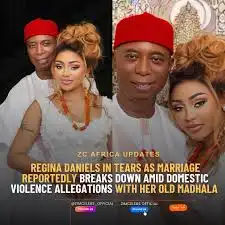
In such arrangements, affection becomes a tool of control, and the girl’s emotional development freezes in the shadow of her provider. Child marriage often creates an unequal partnership, where the younger bride’s voice is muffled by the older partner’s authority. For Regina, the age and experience gap allegedly meant that her opinions could easily be overshadowed, her decisions influenced, and her independence quietly taken apart. In any relationship where power tilts too heavily to one side, freedom dies in silence. The young woman learns to smile through discomfort, because she was told this was the dream.
One of the most destructive effects of child marriage is dependency, both emotional and economic. Regina was reportedly introduced to a world of unimaginable luxury at an age when most of her peers were still figuring out their paths. Such exposure creates a psychological trap; once a young person is conditioned to a certain lifestyle, walking away feels impossible. If indeed her marriage is struggling, it would not be surprising if she finds herself torn between leaving and returning, not necessarily out of love, but out of the comfort that has now become part of her identity.
When a person’s formative years are spent adjusting to another’s expectations, self-discovery becomes a foreign concept. Grooming steals the “becoming” phase of womanhood, that period where a young woman learns who she is, what she wants, and how she loves. In child marriages, that phase is replaced with domestic expectations and social performance.
Regina’s public image, always glowing, always perfect, could be read as a mask many women in similar situations wear: smiling for the cameras, while privately questioning who they might have been if life had waited a little longer.
Even if Regina walks away, the impact of grooming doesn’t disappear. Psychologically, she may find herself drawn back, not to the person, but to the feeling of safety, control, and status that grooming built around her. That’s the cruelest part: the loop of return. Grooming creates emotional habits that are hard to unlearn, making true independence an uphill battle.
Regina Daniels’ alleged failed marriage is not just celebrity gossip; it is a social symptom, one that reminds us how child marriage and grooming continue to rob young girls of their freedom, voice, and identity. When society normalizes the idea that a young girl’s success must come through the arms of an older man, it creates generations of women who confuse comfort for consent and luxury for love. Child marriage is not a shortcut to success. It’s a slow erosion of self, polished with diamonds, wrapped in designer fabrics, and broadcast for likes.
And when the lights fade, what remains is often a woman still searching for the girl she never got to be.