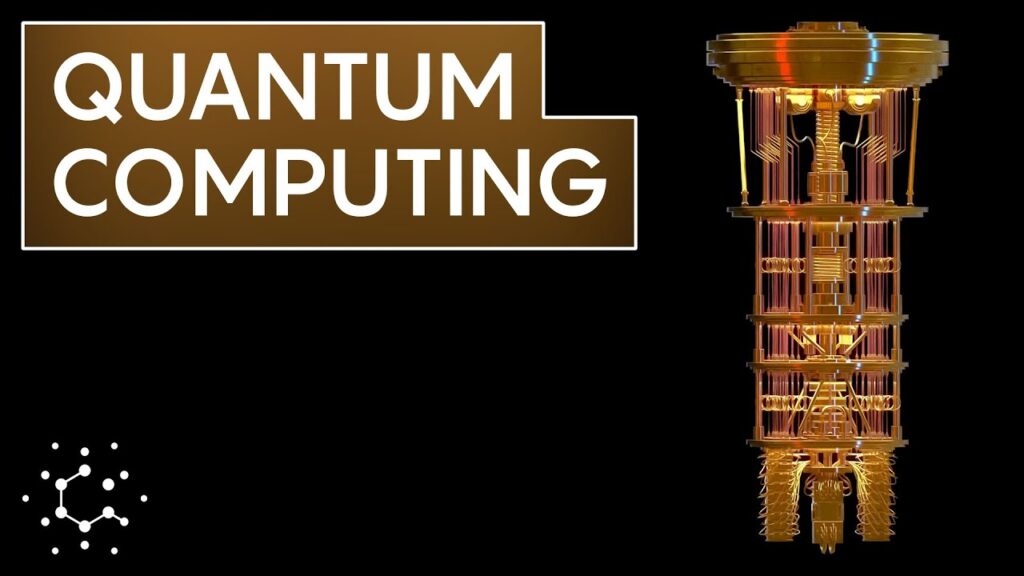
Quantum computing is an advanced field that uses quantum mechanics principles to process information more powerfully than classical computers. It consists of quantum bits (qubits), which can exist in multiple states simultaneously due to the quantum phenomenon called superposition. This allows quantum computers to handle complex computations more efficiently.
Quantum computers can also be used for cryptography, drug discovery, optimization problems, and artificial intelligence (AI). They can break encryption methods used in security by solving complex mathematical problems faster than classical computers. In pharmaceuticals, quantum computing can simulate molecular structures with greater accuracy, leading to faster and more effective drug discovery.
In optimization problems, quantum computing can be applied to logistics, supply chain management, and financial modeling. Additionally, quantum computing could greatly accelerate machine learning algorithms, making AI systems more powerful and capable of solving more complex problems.
However, quantum computing faces challenges such as error rates, scalability, and temperature sensitivity. Researchers are working on quantum error correction techniques to improve reliability. Building large-scale quantum computers with many qubits is difficult due to their limited number of qubits. Additionally, quantum computers typically need to be operated at extremely low temperatures to maintain qubit stability.
quantum computing has the potential to revolutionize fields like cryptography, medicine, and AI. As technology develops, quantum computers may solve problems that are currently unsolvable by classical computers, paving the way for groundbreaking advancements across industries.
Quantum computing is a type of computing that uses quantum mechanics, the fundamental theory in physics, to represent data at the smallest scales, such as at the level of atoms and subatomic particles. Unlike classical computers, which use bits to represent data as either 0 or 1, quantum computers use quantum bits, or qubits, which can represent both 0 and 1 simultaneously due to a property called superposition. Quantum computers also utilize entanglement, a phenomenon where two or more qubits become interconnected, and quantum interference is used in calculations to amplify correct results and cancel out incorrect ones.
Quantum computing has the potential to revolutionize cryptography by breaking traditional encryption systems, such as RSA encryption, which are based on the difficulty of factoring large numbers. Researchers are developing quantum-resistant encryption methods to safeguard data in a post-quantum world. Quantum computers can also transform drug discovery and material science by simulating molecular structures, leading to the discovery of new materials with specific properties, such as superconductors or materials with better energy storage capabilities.
Optimization problems in supply chain and logistics can be dramatically improved by quantum computing, leading to faster and more powerful AI algorithms. Quantum-enhanced machine learning could lead to breakthroughs in pattern recognition, natural language processing, and autonomous decision-making systems. Quantum computers can handle huge datasets and optimize AI models far more efficiently than classical computers, leading to improvements in everything from image recognition to predictive analytics.
Climate modeling and weather prediction can benefit from better simulations, as quantum computers can process large, complex systems with many variables, making them ideal for climate modeling. However, challenges remain, such as qubit stability, scalability, and cost and infrastructure. Despite these challenges, quantum computing holds transformative potential in fields ranging from cryptography and AI to material science and drug discovery. As the field progresses, quantum computing could usher in an era of breakthroughs that were previously unimaginable with classical computing.