
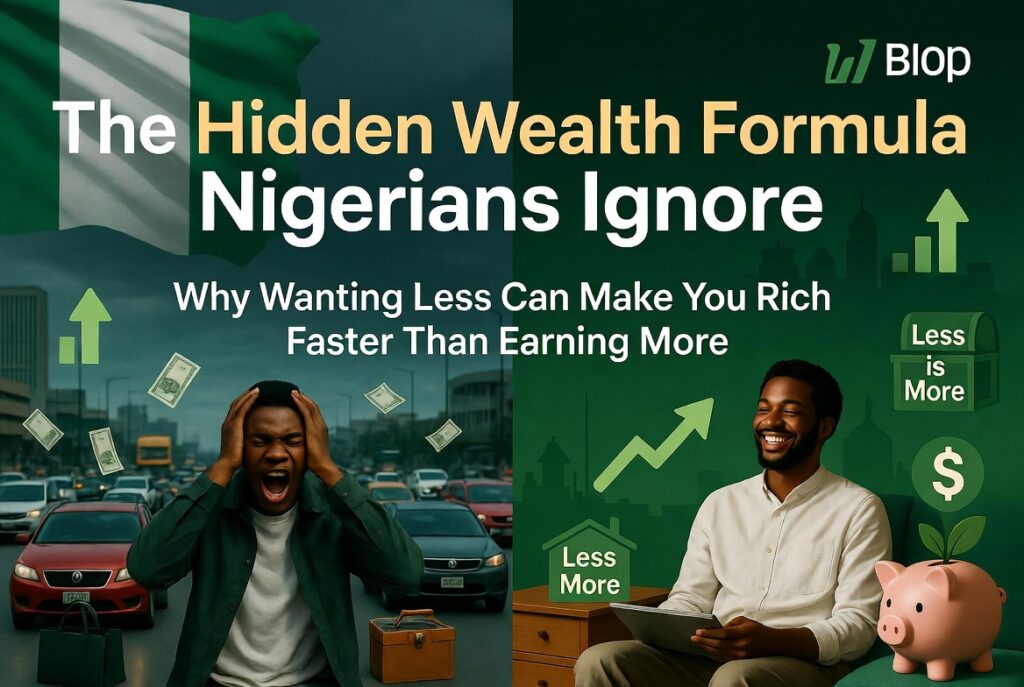
- You Don’t Need More Money First—You Need a Bigger Gap Between What You Earn and What You Crave
Wealth is just the accumulated leftovers after you spend what you earn. That statement may sound too simple to be powerful, but it is one of the most brutal truths in personal finance. It means wealth is not what enters your account. Wealth is what survives your lifestyle. It is what remains after rent, food, transport, school fees, family obligations, social pressure, impulse buying, aso ebi, gadgets, weekend enjoyment, emergency requests, and emotional spending have taken their share.
Many Nigerians think the road to wealth begins only with earning more money. That is partly true, but it is dangerously incomplete. Earning more helps, but if your desires grow at the same speed as your income, your financial life remains trapped. You may look richer, dress better, drive better, eat better, and post better pictures, but your actual wealth may not move. Your income has grown, but your leftovers have not.
That is why one person can earn ₦300,000 monthly and slowly build financial stability, while another person earning ₦3 million monthly is always under pressure. The difference is not income alone. The difference is the gap between what they have and what they want.
This gap is where wealth is born.
Learning to be happy with less money creates a powerful advantage. It gives you breathing room. It reduces financial pressure. It allows you to save without feeling tortured. It gives your money a chance to stay with you long enough to become capital. And in a country like Nigeria, where inflation keeps testing household budgets, that ability to control desire is not ordinary discipline—it is financial survival. The National Bureau of Statistics’ current dashboard shows headline inflation at 15.38% after the CPI rebasing, confirming that prices remain a real pressure point for households and businesses.
But here is the part many people miss: reducing your wants can sometimes create the same financial effect as increasing your income. If you earn ₦1 million and spend ₦950,000, your wealth gap is ₦50,000. If you earn the same ₦1 million but learn to live happily on ₦700,000, your wealth gap becomes ₦300,000. You have effectively increased your financial power without begging for a raise, starting another business, or working extra hours.
That is why lifestyle discipline is one of the most underrated wealth strategies in Nigeria.
People talk about investment, stocks, real estate, crypto, importation, and business, but before any of these can change your life, there must first be leftovers. You cannot invest what your lifestyle has swallowed. You cannot build wealth with money that has already been spent to impress people. You cannot compound capital that never stayed long enough in your hands.
The problem is that modern life teaches people to want too much, too quickly. Social media has turned ordinary living into a competition. Someone’s vacation becomes your pressure. Someone’s new car becomes your insecurity. Someone’s wedding becomes your benchmark. Someone’s designer outfit becomes your silent frustration. Before long, you are no longer spending based on your needs; you are spending based on comparison.
Comparison is a financial disease because it has no end.
There will always be someone ahead of you. Someone will always have a newer phone, a bigger house, a louder party, a finer car, or a more expensive lifestyle. If your happiness depends on matching appearances, your money will never rest. Your income may increase, but your peace will not.
True wealth begins when you stop allowing other people’s lifestyle to define your own financial needs.
More importantly, the value of wealth is relative to what you need. This is a powerful idea. ₦20 million can feel like freedom to one person and feel like nothing to another. Why? Because their needs are different. A person with moderate needs and ₦20 million invested may be more financially secure than a person earning heavily but carrying expensive obligations, family pressure, debt, luxury expectations, and uncontrolled spending.
Wealth is not just a number. Wealth is the relationship between your assets and your needs.
If your needs are small, your wealth becomes powerful. If your needs are uncontrollable, even large income becomes weak. This is why some high-income earners are financially fragile. They are not poor because they lack money; they are poor because their wants are too expensive to maintain.
The goal is not to live a miserable life. The goal is to live an intentional life. There is nothing wrong with comfort. There is nothing wrong with enjoyment. There is nothing wrong with rewarding yourself. The danger begins when every increase in income becomes an automatic increase in lifestyle. That is lifestyle inflation, and it is one of the silent killers of wealth.
If you want to build wealth, you must learn to separate comfort from waste, enjoyment from carelessness, generosity from financial self-destruction, and status from stupidity. Not every invitation deserves your money. Not every trend needs your participation. Not every upgrade is necessary. Not every desire is an instruction.
Financial maturity is the ability to say: “I can afford it, but I choose not to buy it because my future matters more.”
That sentence is powerful because wealth is not built only by what you earn. It is built by what you refuse to waste.
In Nigeria’s current economic environment, where households face pressure from food, transport, energy, rent, and school fees, the ability to control spending is no longer optional. Reuters reported that inflation reached repeated 28-year highs in 2024 after subsidy reforms and naira devaluation, showing how quickly purchasing power can come under pressure.
That is why saving is not old-school. Saving is strategy. Saving is defense. Saving is the first step toward power. It gives you options when others are desperate. It gives you confidence when emergencies come. It gives you capital when opportunities appear. It gives you peace when the economy becomes unstable.
A man who earns more but wants everything is still a slave to income. A woman who earns moderately but controls her desires is already walking toward freedom.
The real question is not only, “How can I make more money?” The deeper question is, “How can I reduce the unnecessary things competing for my money?”
Because once you create that gap between what you have and what you want, everything changes. Savings become easier. Investment becomes possible. Pressure reduces. Peace increases. Your financial future begins to breathe.
Wealth is accumulated leftovers. So protect your leftovers. Grow your leftovers. Invest your leftovers.
Because the person who learns to want wisely may reach freedom faster than the person who earns loudly but spends foolishly.