
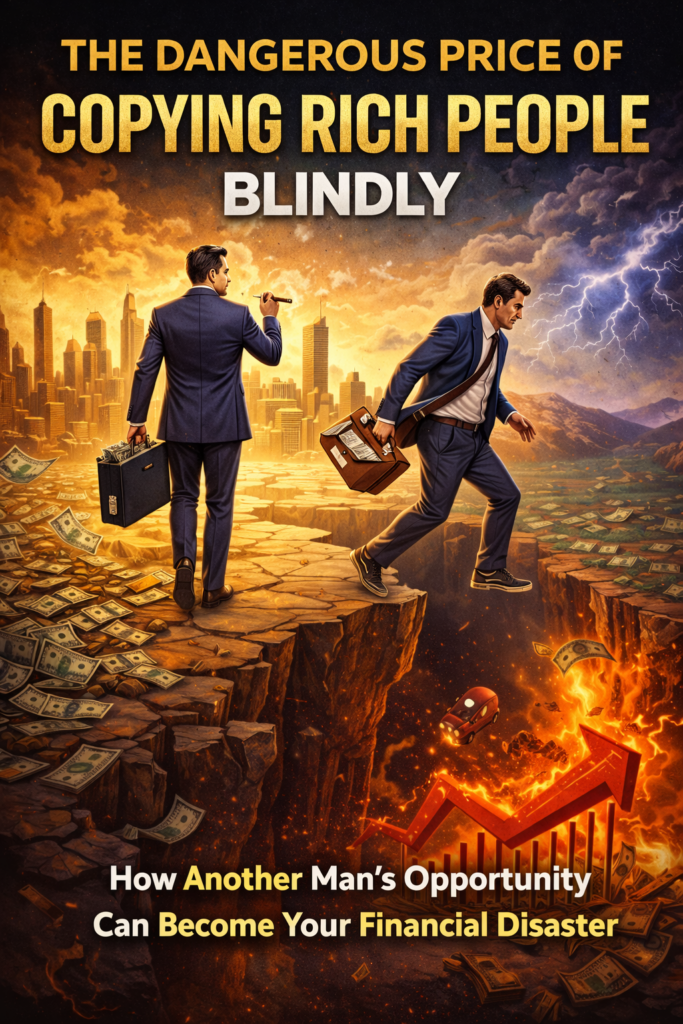
- How Financial Bubbles Are Born When People Stop Thinking and Start Copying the Crowd
- The Crowd Can Be Loud and Wrong: Why Following Successful People Blindly Can Empty Your Pocket Faster Than Poverty
That is one of the most important truths every Nigerian, African, entrepreneur, investor, salary earner, trader, professional, and young person trying to escape poverty must understand. The same investment that makes one man rich can destroy another man. The same land that becomes generational wealth for one family can become a dead asset for another. The same stock that a wealthy investor can hold patiently for ten years can become a nightmare for a salary earner who used emergency money. The same business expansion that makes sense for an experienced operator with cash flow can bury another person who copied it with borrowed funds.
The danger is not always the investment itself.
The danger is copying a decision without understanding the reason behind it.
A rich investor may buy land in a developing area because he can afford to wait ten years. You may copy him with rent money and start crying after six months because there is no buyer, no road, no title perfection, and no immediate cash flow. A business owner may expand because he has customer data, supplier relationships, staff structure, distribution capacity, and working capital. You may copy the expansion because “he is making it,” borrow money, and discover that your own location, market, and margins are completely different.
A celebrity may promote an estate, coin, investment platform, beauty product, agricultural package, or “limited opportunity” because they were paid to influence public attention. A follower may enter because they assume the celebrity is also risking their own money. But influence is not evidence. Fame is not due diligence. A sponsored post is not an investment strategy.
Before you follow anyone financially, ask yourself one question:
Do I understand this opportunity, or am I only following someone who appears successful?
Another Man’s Strategy Can Become Your Financial Trap
People like to copy outcomes, but they rarely copy context.
They see the result, but they do not see the structure behind the result. They see the Range Rover, not the cash flow. They see the new shop, not the debt burden. They see the land purchase, not the legal verification. They see the profit screenshot, not the years of skill behind the trade. They see someone buying stocks, not the portfolio size, risk tolerance, and time horizon behind the decision.
Behind every financial move, there are hidden factors that may not be visible to outsiders.
One person may have a higher income. Another may have stronger liquidity. One may have professional advisers. Another may have insider knowledge of the industry. One may be investing with surplus cash. Another may be investing with money meant for school fees. One may have ten years to wait. Another may need the money in three months. One may survive a 50% loss. Another may collapse from a 10% mistake.
That is why financial wisdom does not only ask, “What did they do?”
Financial wisdom asks, “Why did they do it, what do they know, what can they survive, and is my own situation the same?”
What looks like courage in one person may be recklessness in another. Never copy another person’s courage when you do not have their cushion.
How Bubbles Begin With a Story and End With Tears
Financial bubbles are not born in one day. They usually begin with something real.
A real opportunity appears. Early investors enter. Some make money. Their success becomes a story. The story spreads faster than the facts. More people begin to enter, not because they understand the value, but because they see others making money. Prices rise because of demand, not necessarily because of real worth. Skeptics are mocked. Latecomers rush in emotionally. Borrowed money enters. The crowd becomes louder. The story becomes sweeter. Reality becomes optional.
Then one day, the music stops.
The same crowd that gave people confidence begins to disappear. Those who entered early may have exited quietly. Those who entered late are left holding the pain. The investment that looked like a national breakthrough becomes a private tragedy.
This is how bubbles form.
A bubble is what happens when many people buy what they do not understand because others are buying it.
It has happened in stocks. It has happened in crypto. It has happened in real estate. It has happened in agricultural investment schemes. It has happened in Ponzi platforms. It has happened in imported goods. It has happened in trendy businesses. It has happened in social media-driven investments where people entered because “everybody is talking about it.”
The crowd can make you feel safe while leading you into a burning building.
When FOMO Becomes a Financial Disease
Human beings are social creatures. When we see others making money, something happens inside us. Our brain stops asking deep questions and starts shouting, “Do not be left behind!”
This is called fear of missing out, and it is one of the greatest enemies of financial discipline.
People begin to think:
“If many people are doing it, it must be safe.”
“If rich people are buying it, I should buy too.”
“If my friend made money, I can make money.”
“If I delay, I will miss my chance.”
“If everyone is talking about it, it must be the future.”
“If I ask too many questions, people will think I am afraid.”
This is how the trap tightens.
Social proof replaces research. Greed replaces patience. Envy replaces wisdom. Authority bias makes people trust influencers, celebrities, pastors, mentors, politicians, friends, or colleagues without asking hard questions. Confirmation bias makes them listen only to stories that support their excitement. Narrative bias makes a sweet story sound stronger than ugly facts. Survivorship bias makes people focus on those who made money while ignoring those who lost quietly.
Then there is status anxiety.
Nobody wants to look like the person who missed out. Nobody wants to be the only one not buying land in the “next Lekki.” Nobody wants to be the only one not trading crypto when screenshots are flying around. Nobody wants to be the only one not joining the investment platform when colleagues are talking about withdrawals. Nobody wants to be the “fearful” person in a WhatsApp group where everyone is shouting opportunity.
But let this sink into your spirit: another man’s profit screenshot is not your investment strategy.
Hype Is Not Evidence, and Popularity Is Not Safety
In Nigeria and across Africa, financial pressure makes people vulnerable.
Inflation is squeezing families. Salaries are not keeping pace with the cost of living. Young people are desperate for breakthrough. Business owners are struggling with power, logistics, rent, exchange rates, competition, and shrinking consumer purchasing power. Families are under pressure from school fees, rent, healthcare, ceremonies, and social responsibilities.
In such an environment, any promise of fast money becomes emotionally attractive.
That is why Ponzi schemes spread quickly through friends, church members, colleagues, WhatsApp groups, Telegram groups, and family networks. People do not enter only because they are greedy. Many enter because they are tired. They are tired of being broke. Tired of struggling. Tired of slow progress. Tired of watching others appear successful. So when someone says, “This platform is paying,” they do not hear risk. They hear rescue.
People buy land because “everybody is buying there,” without checking title, drainage, road access, government acquisition, litigation, community disputes, or real demand. Young people enter forex or crypto trading because social media shows profits but hides losses. Business owners copy another person’s business without understanding location, customer base, pricing, supply chain, customer acquisition cost, staff competence, and working capital.
A trader may import goods because someone says, “This product is moving,” without calculating exchange-rate risk, customs cost, shipping delay, storage, competition, damaged goods, advertising cost, delivery failure, and actual margin. A family may spend heavily on a ceremony because others in their social circle did the same, forgetting that applause does not pay debt.
The market does not pity those who confuse popularity with value.
The Rich May Survive What the Poor Cannot Afford to Try
One of the greatest financial errors is copying rich people without understanding that wealth gives them room to be wrong.
A wealthy investor can buy ten plots of land and wait. If nothing happens for five years, his children will still go to school. His house rent will not be threatened. His feeding will not stop. His hospital bills will still be paid. He has cushion.
But a struggling salary earner who puts all savings into one speculative land deal may not have that luxury. If the title has problems, if the location delays, if there is no resale market, if emergency comes, that “investment” becomes a prison.
The rich can sometimes survive illiquidity. The poor often cannot.
The rich can hold through volatility. The poor may panic because the money is needed for survival.
The rich can diversify mistakes. The poor may put everything into one decision and call it faith.
Never copy another person’s portfolio without also copying their income, patience, information, risk tolerance, liquidity, and ability to survive loss.
If You Do Not Know Why You Entered, You Will Not Know When to Exit
Many people enter investments without an exit plan.
They buy because others are buying. They hold because others are holding. They panic when others panic. They sell when the pain becomes unbearable. That is not strategy. That is crowd dependence.
Before you enter any investment, know why you are entering. Know what can go right. Know what can go wrong. Know how long you can wait. Know what evidence would make you exit. Know how much you can afford to lose. Know whether you are investing, speculating, or gambling with financial vocabulary.
A good investment is not good simply because someone else bought it. It must fit your goals, risk capacity, timeline, knowledge, liquidity needs, and financial plan.
Due diligence is not fear. It is financial self-defense.
Risk management is not cowardice. It is wealth protection.
Diversification is not confusion. It is humility in action.
Margin of safety is not pessimism. It is respect for uncertainty.
Position sizing is not small thinking. It is survival strategy.
Liquidity is not laziness. It is readiness.
An investor who understands these principles is harder to manipulate.
Before You Follow the Crowd, Ask These Questions
Before you put your money into any opportunity because others are doing it, pause and ask:
Do I understand this investment?
Why is this person making this decision?
What do they know that I do not know?
What is their risk capacity compared to mine?
Can I survive if this investment fails?
Am I investing because of evidence or excitement?
What is the worst-case scenario?
What is my exit plan?
Who is selling, and why are they selling to me?
Is the price rising because of value or because of hype?
Am I early, or am I the last person entering?
Am I using money I cannot afford to lose?
Am I borrowing to chase a trend?
What facts would make me walk away?
If nobody was talking about this investment, would I still be interested?
These questions are not designed to kill opportunity. They are designed to kill foolishness.
Study before investing. Never invest because of pressure. Avoid using borrowed money for speculative opportunities. Compare every opportunity with your own goals. Ask independent experts. Check the downside before dreaming of the upside. Separate influence from evidence. Write down your reasons before investing. Avoid putting all your money in one trend. Build emergency savings before chasing high returns.
If you enter because of noise, you may exit because of pain.
Learning From Others Is Wise; Copying Others Blindly Is Dangerous
Let us be clear. This is not an argument against learning from successful people.
Learning from others is wisdom. Copying them blindly is danger.
Learning asks, “What principles can I understand and apply to my own situation?”
Copying says, “If it worked for them, it must work for me.”
That difference is everything.
Wealth builders do not merely copy actions. They study reasoning. They study context. They study timing. They study incentives. They study risk. They study liquidity. They study the process behind the result.
If a successful business owner expands to three locations, do not just copy the expansion. Study how they built demand. Study their pricing. Study their staff structure. Study their cost control. Study their cash flow. Study their customer retention. Study their mistakes. Study their supply chain. Study why the expansion worked.
If a rich investor buys stocks, do not just buy the same stock. Ask about valuation, time horizon, dividend policy, earnings quality, sector risk, portfolio size, and exit plan.
If someone buys land, do not just rush to the same area. Investigate the title. Visit the site. Check access road. Ask about drainage. Confirm government acquisition status. Understand liquidity. Compare prices. Ask who is selling and why.
The goal is not to ignore successful people. The goal is to understand before following.
Do not let another person’s confidence become your due diligence.
Great Investors Think Independently
Great investors may listen to people, but they do not surrender their thinking.
They ask better questions. They understand their own goals. They know their risk limits. They avoid emotional crowds. They study downside scenarios. They build plans before trends appear. They stay patient when others panic. They stay cautious when others become greedy. They refuse to worship the crowd.
Independent thinking is not arrogance. It is financial protection.
Sometimes the crowd is right. Sometimes the crowd is early. Sometimes the crowd sees something real. But sometimes the crowd is simply loud, emotional, and late.
The crowd can be loud and wrong at the same time.
Financial maturity begins when you stop mistaking movement for direction.
Just because money is moving into something does not mean wisdom is present. Just because prices are rising does not mean value is increasing. Just because people are testifying does not mean the structure is sustainable. Just because a celebrity is smiling beside a product does not mean they have invested their own future in it.
When everybody is rushing in, wisdom asks why.
Do Not Let Another Person’s Decision Become Your Disaster
At the end of the day, wealth is not built by blind imitation. Wealth is built by clarity, discipline, patience, risk management, and understanding.
There will always be noise. There will always be trends. There will always be a new platform, a new estate, a new coin, a new business model, a new “limited offer,” a new WhatsApp investment, a new importation opportunity, a new agriculture scheme, a new person claiming to have discovered the secret to fast money.
Some opportunities will be real. Some will be exaggerated. Some will be late. Some will be traps. Your job is not to reject everything. Your job is to understand before you commit.
Do not let another person’s decision become your disaster.
Do not let the crowd borrow your brain.
Do not let hype carry your money where wisdom would never go.
Learn from others, but think for yourself.
Build wealth with clarity. Build with discipline. Build with patience. Build with understanding.
A decision can be wisdom for one man and foolishness for another. Make sure that before you copy the move, you understand the man, the motive, the money, the timing, the risk, and the exit.
Final Call-to-Action
Think deeper. Question financial trends. Study before investing. Manage risk wisely. Avoid blind imitation. Protect your capital. Build wealth with discipline. Learn from others without copying blindly. Choose understanding over excitement. Choose wisdom over crowd pressure. Build a financial life guided by truth, not hype.
Because the next financial bubble will not announce itself as a bubble.
It will come dressed as opportunity.
Make sure you are not the last person entering with the money you cannot afford to lose.