
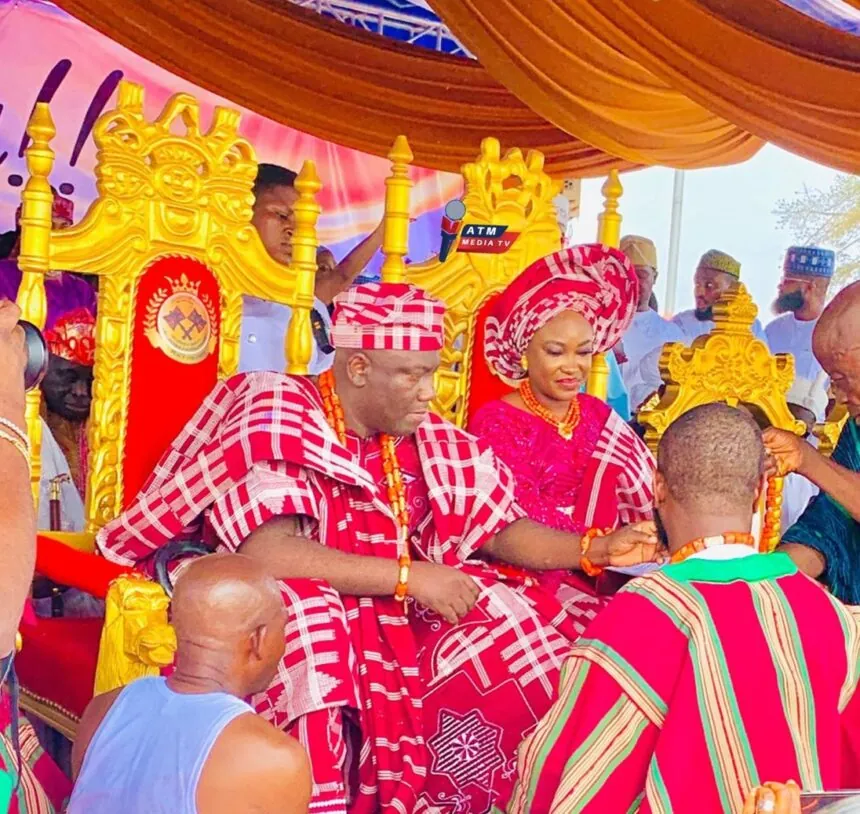
During the installation of former Zamfara State Governor Senator Abdul-Aziz Yari as Obaloyin of Yorubaland and Seyi Tinubu as Okanlomo of Yorubaland on Sunday at the Aganju Forecourt of Oyo Palace, the monarch made this declaration.
According to Owoade, chieftaincy in Yoruba tradition is a grave duty based on authority, service, and history rather than being decorative or bestowed as a favor.
He claims that the Oyo throne has always served as the Yoruba people’s primary coordinating authority, a capacity that was acknowledged during the colonial era and maintained in post-independence government.
He clarified that titles bearing the term “Yorubaland” are collective in nature and do not refer to any particular town or kingdom, but rather to the entire Yoruba nation.
As a result, the monarch declared that any “Yorubaland” title must be granted by a body that has historically had jurisdiction over the entire area.
According to the Alaafin, colonial documents, post-independence councils, academic publications, and court rulings—including those of the Nigerian Supreme Court—all support this viewpoint.
Oba Owoade described the recently established titles as positions of trust and stated that they require bravery, loyalty, and selfless service to the Yoruba people. He added that the purpose of these honors is to promote unity and respect for tradition throughout Yorubaland.
He exhorted the new titleholders to carry out their responsibilities with humility and make sure that their positions uphold the Yoruba people’s dignity, unity, and general well-being.
“We are gathered here today for a purpose that goes beyond celebration,” he declared. We are here to observe history and to assign accountability where tradition has long placed it. In our culture, being a chieftain is not a favor. It’s not ornamentation. It is an obligation that can only be granted when authority, responsibility, and history coincide.
Authority has always been clear since the Yoruba people’s early organization. Our ancestors were aware of structure. Long before modern governance arrived, Yorubaland had stability thanks to this understanding.
In that era, the throne of Oyo developed into a coordinating power through accountability. This reality was encountered and documented by colonial authority, which did not create it. At 14,381 square miles, Oyo Province was the largest province in Southern Nigeria by 1914. It was limited in the north by Ilorin and Kontagora, in the east by Ondo and Ijebu, in the south by Ijebu and Abeokuta, and in the west by French Dahomey. This demonstrated acknowledged leadership in a broad and varied field.
The diverse character of some chieftaincy titles can be explained by this history. “Yorubaland”-named titles are not local titles. These are collective titles. They speak for all Yoruba people, not just one town or one kingdom. As a result, such titles must originate from a body whose jurisdiction encompasses Yorubaland both historically and legally.
“I don’t speak today to start a discussion. To state order, I speak. Authority has never been based on convenience or presumption among the Yoruba. It has always been a question of law, organization, and history. Although all thrones are sacrosanct in dignity, their functions were not formed equally.
The Alaafin of Oyo held a central and coordinating authority from the beginning of Yorubaland’s organization. This authority went beyond Oyo’s walls and into the Yoruba people’s collective political life. It wasn’t self-declared. It was acknowledged, upheld, and maintained for many years. It was recognized in colonial documents. Councils after independence kept it intact. It was recorded by academics.
“I don’t speak today to start a discussion. To state order, I speak. Authority has never been based on convenience or presumption among the Yoruba. It has always been a question of law, organization, and history. Although all thrones are sacrosanct in dignity, their functions were not formed equally.