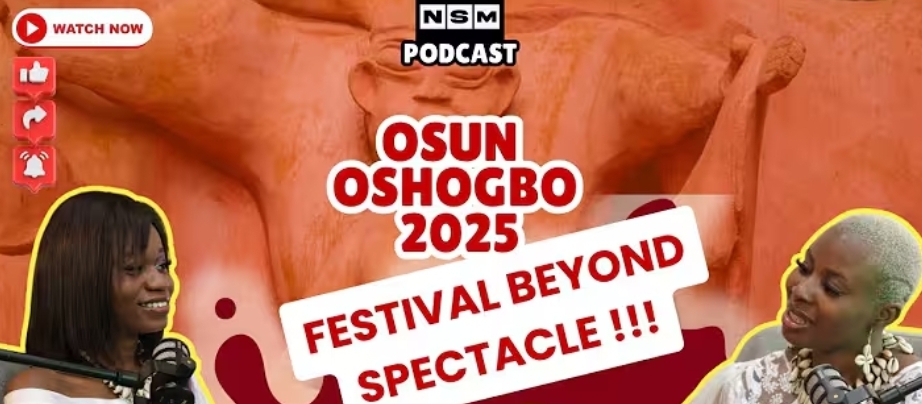
WATCH HERE
Every August, something ancient wakes up in this city.
Not a party. Not a parade. A promise.
“This is not entertainment. This is enforcement.”
— High Priestess Morenike Olaniyan
We’re here: not as outsiders peeking in, but as witnesses. Naija Street Matters is walking the path this festival carves. From market corners to sacred groves, from whispered prayers to thunderous drums, we’re documenting a covenant in real time.
Because this isn’t about culture preserved in glass.
It’s about a living system that still beats.
Before Nigeria had borders or flags, the people of Osogbo had an agreement. When a hunter named Olutimehin disturbed the river, the spirit of Osun didn’t curse him. She offered a pact:
“Honor me yearly, and I will protect your people.”
He accepted. And in that moment, a city was born.
That deal is still active. The Osun-Osogbo Festival isn’t tradition; it’s contract renewal.
Week One: The Clean Slate
It starts with Iwopopo; a city-wide cleansing. Women sweep the streets. Elders chant. The air feels different.
At night, the Sixteen-Point Lamp is lit in the Ataoja’s palace. Each flame? A divine principle. No music. No hype. Just alignment.
You don’t watch this. You feel it.
Week Two: A Walk Between Worlds
Then, she appears: the Arugba.
A teenage girl of royal blood. A virgin. Chosen. She carries the town’s hopes in a sacred calabash, walking through crowds, past drummers, past cameras, towards the sacred grove.
She walks alone. But the city walks with her.
Behind her: the Ataoja (king), priestesses, Egungun, and a crowd that stretches beyond borders, Yoruba descendants from Trinidad to Bahia.
When the Arugba enters the grove, the contract is sealed. Only then do the celebrations begin.
This Is Sacred Order, Not Spectacle
Every role means something.
- Arugba – She carries more than offerings. She carries continuity.
- Ataoja – A king, yes, but also a spiritual anchor.
- Priestesses – Guardians of law, memory, and spirit.
- The People – Not spectators. They are the system.
“The festival isn’t for display. It’s obedience. It’s duty.”
— Chief Priest Adewale Fagbamila
In Brazil, Osun is Oxum. In Cuba, Ochún. In Trinidad, she dances in carnivals and whispers through dreams.
But here in Osogbo, she still receives. Offerings. Songs. Promises.
The Osun-Osogbo Festival is one of the last places where African spirituality isn’t diluted, debated, or dressed up. It is practiced.
Why This Still Matters
- Spiritual healing – People walk barefoot into the grove asking for children, clarity, protection.
- Cultural truth – Yoruba metaphysics isn’t lost. It’s alive.
- Economic flow – Osogbo moves when Osun moves.
- Diaspora reconnection – Black people from across the globe come home here
Naija Street Matters is on ground.
Filming. Listening. Feeling.
We’ll be showing you real stories, no gloss, no gimmicks. Just truth. From the drummers to the shrine maidens. From market chants to silent rituals. Every frame will speak.
This is not a photoshoot.
This is spiritual infrastructure in motion.
Want to Follow Along?
Follow @NaijaStreetMatters on Instagram, TikTok, and YouTube.
Daily dispatches. Behind-the-scenes. As the world forgets, Osogbo remembers.
As people scroll, we stay still.
“If we stop, she stops protecting us.”
— Elder Sade Olatunji, 87
This is not just a festival.
It’s a sacred system, still breathing.