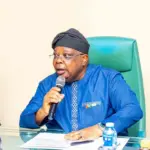
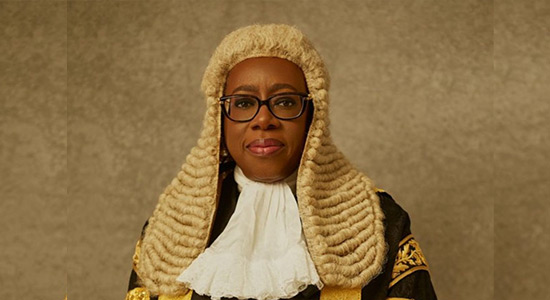
Chief Justice of Nigeria (CJN) Kudirat Motonmori Kekere-Ekun will assume office on August 23.
Olukayode Ariwoola will hand over the baton to her after his retirement on August 22.
The next most senior justice of the supreme court, Justice Kekere-Ekun, was suggested by the National Judicial Council (NJC) to be the Chief Justice of Nigeria.
The suggestion was given to President Bola Tinubu by the NJC during its 106th meeting, which took place in Abuja on August 14 and 15.
It is anticipated that the President would send Justice Kekere-Ekun’s name to the Senate for approval.
She would also take over as the NJC’s next chairman following confirmation.
Justice Ariwoola, the Chief Justice of Nigeria, will formally retire on August 22, 2024, having reached the mandatory 70 years of age for retirement. He spent 26 months in office, with the first female CJN being Justice Aloma Mukhtar. The incoming CJN is 66 and will occupy the office for the next four years, subject to confirmation by the Senate.
Justice Tanko Muhammad, who was CJN between January 25, 2019, and June 27, 2022, voluntarily resigned on health grounds. His predecessor, Justice Walter Onnoghen, served between March 7, 2017 and January 25, 2019, and was accused of failing to declare his assets. Ariwoola faced strident allegations of nepotism and was the attention of social media trolls who believed he would rule in favor of Bola Ahmed Tinubu. However, he was able to cleverly navigate the murky waters of Nigerian politics by declining to sit on any of the appeal panels.
One remarkable achievement under him was when the Supreme Court achieved the full complement of 21 justices on the Bench, following the appointment of 11 justices to the apex bench. A senior lawyer, Chief Mike Ozekhome (SAN), described Justice Ariwoola’s tenure as “a mixture of the good, the bad and the ugly.” He commended the CJN for being able to increase the number of those conferred with the silk rank to about 87 this year, recalling that it was 58 last year.
Senior lawyers have offered suggestions on how Justice Kekere-Ekun could transform the judiciary. Chief Louis Alozie (SAN), Adeyinka Moyosore Kotoye (SAN), Otunba Kunle Kalejaiye (SAN), a leading litigator, Wahab Shittu (SAN), Chairman, Nigerian Bar Association (NBA), Ijebu Ode Branch, Dr. Fassy Yusuf, Executive Director, Crime Victims Foundation of Nigeria (CRIVIFON), Mrs. Gloria Egbuji, and a former Deputy Speaker, Ogun State House of Assembly, Chief Olugbenga Ayo-Odugbesan, have all spoken to The Nation Law.
Chief Alozie listed what he believed the incoming CJN should focus on:
1. Fight corruption. Alozie noted that Justice Kekere-Ekun is coming in at a time when the public perception of the courts is very poor. He noted that the judiciary is said to have gone to bed with politicians both in the executive and legislative arms of Government.
2. Enforce jurisdiction in courts. Alozie noted that at the trial court level, the state High Courts seem to be dancing to the tune of the governors, while the Federal High Courts try very hard to please the Federal Government and its agencies. He noted that most of their judgments on political cases betray the fact that they are serving the interest of some big politicians, and no longer the masses/and the downtrodden.
3. Review mode of appointment of judges. Alozie remarked that the manner of recruitment into the Bench at all levels appeared to have compromised merits for the benefit of the owners of Nigeria. He lamented that electoral jurisprudence is in shambles, and decisions of the courts are now largely unpredictable, even though the facts of the cases notwithstanding.
4. Overhaul court registries. Kotoye said the registry of the courts should be overhauled for effective and efficient service delivery. More emphasis should be placed on online filing of processes, while delivered judgments should be made available on time, both in hard and online copies.
Reposition Judiciary. Kalejaiye stressed the need for the in-coming CJN to reposition the judiciary in a manner contained in the tripartite communique signed by the outgoing CJN, Justice Ariwoola, the Attorney General of the Federation, and the NBA president.
The Nigerian judiciary is facing several challenges, including the congestion of cases at the apex court, ensuring transparency in the judiciary, institutionalizing a culture of efficiency, enforcing the rule of law, prioritizing the welfare of judges, improving infrastructure, and ensuring effective administration. Justice Kekere-Ekun, a disciplined, decent, and incorruptible judge, has been recommended to address these issues and restore public confidence in the judiciary.
Kalejaiye emphasized that the average time it takes for cases to travel through the Nigerian court system is 16 to 18 years, which has eroded public confidence. He suggested that the new CJN should tackle this issue by making the judiciary, especially the federal Judiciary, transparent. He also emphasized the need for an appointment system that is meritocratic and fair, as the appointment of judges to the superior courts has not engendered public confidence.
Shittu, a respected judicial officer, praised Justice Kekere-Ekun’s reputation as a disciplined, decent, and incorruptible judge. He assured that the Judiciary is set to witness unprecedented reforms marked by judicial integrity and adherence to ethical standards. Shittu also urged Justice Kekere-Ekun to institutionalize a culture of the judiciary that works effectively, efficiently, and speedily with dispatch without sacrificing the element of justice.
Shittu encouraged Justice Kekere-Ekun to have zero tolerance for impunity in all spheres of the judicature while prioritising law and order. He expected that His lordship will ensure the rule of law dominates and that government at all levels, including the legislature, are accountable for their actions. He also emphasized the importance of restoring investor confidence by dispatch in the handling of cases.
Prioritizing the welfare of judges and other stakeholders in the justice delivery system was also emphasized. He urged Justice Kekere-Ekun to accord priority to the welfare of judges and other stakeholders in the justice delivery system.
Improving infrastructure and ensuring effective administration were also emphasized. Dr. Yusuf argued that the incoming CJN is qualified to hold the number one position, having been a magistrate, a High Court judge, Justice of the Court of Appeal, and Justice of the apex court for over a decade now. He urged her to address the following issues and ensure that during her own time, we can resolve them and advance the nation’s justice sector.
Dr. Yusuf also urged Justice Kekere-Ekun to speed up non-political cases, use more technology, and stop the appointment of politicians’ spouses or children on the Bench.
Mrs. Egbuji urged Justice Kekere-Ekun to improve the judicial system and restore public confidence in it. She admonished her to enhance judicial independence and strengthen the judiciary’s autonomy by resisting external pressures from the executive and legislative branches. She also urged her to implement measures that would increase transparency in the judicial process, such as publishing court decisions and the rationale behind them, ensuring that cases are heard in a timely manner, and establishing a clear code of conduct for judges and court officials.
Lastly, the activist lawyer advised Justice Kekere-Ekun to initiate and support legislative reforms that would strengthen the legal framework within which the judiciary operates. These include reviewing outdated laws, amending the Constitution where necessary, and advocating for laws that protect judicial independence.
The judiciary in Nigeria is under a strong anti-corruption fight, with the aim of restoring public trust in the system. The incoming Chief Justice (CJN) is tasked with fostering better relationships with anti-corruption agencies, fostering better relationships with key stakeholders, and ensuring transparency in the appointment and discipline of judges. High-profile cases should be handled transparently to demonstrate justice is being served.
Chief Ayo-Odugbesan urged the incoming CJN to restore the dignity and integrity of the Bench at different levels of the court, ensuring transparency in the judiciary’s affairs, including the appointment and discipline of judges and elevations to the Inner Bar. Timely availability of Certified True Copy (C.T.C) of judgments is also a priority.
The incoming CJN must resist the political class’s predilection to do the bidding of the political class, as the judiciary is seen as the last hope of the common man. The judiciary must be cleansed of its ‘Temple of Justice’, which is polluted by the discretions of its ‘priests’. The use of judicial discretion and the enforcement of jurisdiction of courts must be brought sanitized to ensure the integrity of the judiciary.