
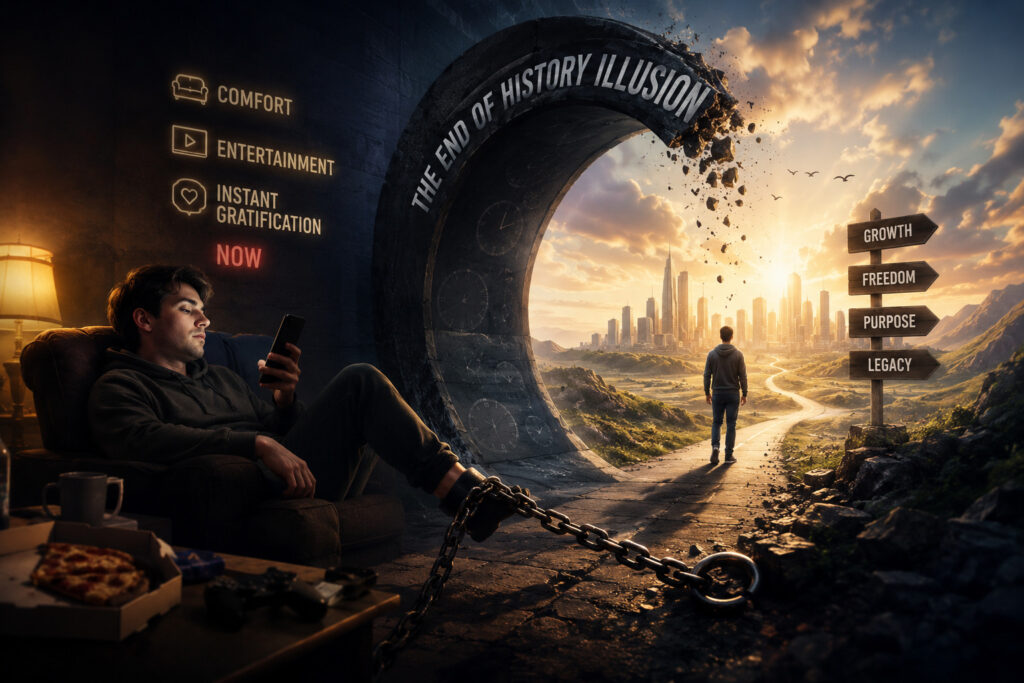
- Trapped in the Past: The Psychological Illusion Forcing Smart Nigerians to Build Businesses They Eventually Hate.
Let have a very uncomfortable conversation about the future.
In Nigeria, we are obsessed with the concept of the “Master Plan.” From the moment we graduate from the university or launch our first startup, we are pressured to map out the next two decades of our lives. We draft meticulous blueprints. We declare exactly where we will be living by age forty, the exact type of car parked in our driveway, the exact amount of money in our accounts, and the precise nature of the business empire we are building.
We write these goals down, laminate them in our minds, and bind our future to them. We pray over them, we fast over them, and we declare them into reality.
But as the Business Apostle, I am here to expose a devastating flaw in this entire system. There is a silent psychological trap that is currently destroying the potential of millions of brilliant Nigerian professionals, entrepreneurs, and e-commerce operators. It is a mental blindspot that guarantees you will eventually feel trapped, unfulfilled, and financially frustrated, even if you achieve every single goal on your vision board. Psychologists call it the End of History Illusion. Understanding this illusion is not just an academic exercise; it is the ultimate cheat code for surviving the brutal, ever-shifting landscape of the Nigerian economy. If you do not grasp this concept, you will spend the next ten years building a prison for a version of yourself that no longer exists.
The Psychology of the Illusion: The Lie Your Brain is Telling You Right Now
To understand the End of History Illusion, we must do a simple mental exercise. I want you to think back to exactly ten years ago. Think about the person you were. What were your deepest desires? Who were your closest friends? What was your ultimate definition of “success”? What kind of business or career did you think would bring you absolute happiness?
If you are being honest, you will admit that the person you were ten years ago is almost a stranger to you today. The things that kept you awake at night back then probably seem trivial now.
The “dream job” you fought so hard for might be the very job you are currently desperate to escape. You are keenly, painfully aware of how much your personality, your goals, your tastes, and your worldview have fundamentally transformed over the past decade. You know you have changed.
But here is where the illusion strikes: When I ask you to look forward to the next ten years, your brain suddenly malfunctions. The End of History Illusion is the psychological tendency for human beings to recognize how much they have changed in the past, but to vastly underestimate how much their personalities, desires, and goals are likely to change in the future.
Right now, as you read this, your brain is tricking you. It is whispering a dangerous lie: “Yes, I changed a lot in my twenties and thirties, but right now? Right now I am fully baked. I have figured it out. The things I want today are the exact things I will want when I am fifty.” We falsely believe that the present moment is a magical endpoint, the “end of history”, where our personal evolution suddenly stops, and we simply execute our current desires for the rest of our lives.
The Nigerian Career and the “Japa” Trap
Why is this illusion so destructive in the Nigerian context? Because we live in a society that severely punishes changing your mind.
Look at the corporate landscape in Lagos or Abuja. You have a young executive who decided at age 21 that they wanted to be a top-tier investment banker. They sacrificed their sleep, their health, and their youth to climb the corporate ladder. Now, at 32, they wake up one morning and realize they despise the banking sector. Their soul is craving creative freedom, perhaps an entrepreneurial venture, or a quiet life far away from the traffic of the Third Mainland Bridge.
But what do they do? They stay. They refuse to pivot. Why? Because they anchored their entire identity to a decision made by a naive 21-year-old version of themselves. They make their 32-year-old self a prisoner to the goals of their past.
We see this same tragedy playing out with the current “Japa” wave—the mass exodus of Nigerians relocating to the UK, Canada, and the US.
Many professionals liquidate their assets, sell their cars, and empty their savings to migrate, driven by a desperate desire for stability and a better passport. And for a season, it serves them well. But the End of History Illusion masks the reality that the person who successfully navigates the snow in Toronto for five years will inevitably develop new desires.
Five years post-relocation, that same individual might suddenly crave the cultural warmth of home, the high-yield, aggressive entrepreneurial opportunities of the African market, or the social capital they left behind.
Yet, because they assumed their desire to leave Nigeria was permanent and final, they burned all their bridges. They failed to build adaptable systems. When their desires change—as human desires mathematically must—they are stuck in a foreign land, realizing they have outgrown the very dream they sacrificed everything to achieve.
The Business Apostle’s Framework: Engineering Adaptable Wealth
This psychological illusion is particularly lethal in the world of business and e-commerce. In my strategic blueprint for the year, The 10 Billion Dollar Code, I emphasize a foundational truth: rigidity is the enemy of generational wealth. If you build your e-commerce operations, your product sourcing lines, and your digital marketing strategies based on the assumption that you will want to sell the exact same products, to the exact same demographic, using the exact same methods ten years from now, you are engineering your own obsolescence.
Let us look at a practical example. You might start out building a highly profitable niche selling trendy consumer electronics on platforms like Naija Commerce.
Today, you love the hustle. You love the fast-paced negotiations with suppliers in Shenzhen, the aggressive Facebook ad campaigns, and the daily grind of fulfilling hundreds of orders. But what happens in six years when you have made your millions? Your personality might shift. You might become a disciple of the Robert Kiyosaki philosophy, craving passive cash flow and quadrant-shifting investments.
You might no longer want the stress of active, high-volume retail. You might suddenly desire to move into high-ticket B2B branding, large-scale commercial real estate, or venture capital. If you locked all your capital into massive, illiquid warehouses full of inventory that require your 24/7 personal supervision, you are trapped. You built a rigid empire for your past self, and your future self is now suffocating inside it.
This is why your business structure must remain fluid. You must build systems that can be delegated, automated, or sold. You must create wealth vehicles that allow you to pivot when your desires inevitably evolve.
The Sunk Cost of Human Identity
The fuel that keeps the End of History Illusion burning is the Sunk Cost Fallacy. We are terrified of letting go of past efforts that cannot be refunded.
We think to ourselves: “I spent six years studying medicine, I cannot become a digital marketer now.” “I spent three years building this boutique brand, I cannot shut it down to start a software company.” “I have been in this unfulfilling relationship for five years, I cannot walk away and start over.”
Listen to me very carefully: The time is already gone. The money is already spent. The effort has already been expended. You cannot get a refund on your past. But you absolutely have control over whether you will continue to pay that same agonizing price into the future. When you stubbornly refuse to change your path because of how much you have already invested, you are committing a violent act of betrayal against your future potential. You are forcing a mature, evolved version of yourself to wear the tight, uncomfortable clothes of an outdated identity.
To thrive in the dynamic, often chaotic Nigerian marketplace, we must come to radically accept the reality of changing our minds. We must normalize the pivot. We must celebrate the courage it takes to look at a thriving business or a prestigious career and say, “This was a great goal for who I was five years ago, but it no longer serves who I am becoming.”
How to Hack the Illusion: Strategies for the Evolving Nigerian
So, how do we protect ourselves from this psychological blindspot? How do we plan for the future when we cannot trust our current desires?
1. Optimize for Options, Not Just Outcomes. When making long-term financial and business decisions, do not just ask, “Will this make me money?” Ask, “Will this give my future self more options, or fewer?” Cash is the ultimate option. Adaptable skills, like copywriting, branding, digital marketing, and sales psychology—are options. When you master the art of selling on platforms like Naija Commerce, you are not just learning how to sell one specific product; you are acquiring an evergreen skill that your future self can apply to any industry they choose.
2. Implement “Soft Commitments” Over Rigid Vows. Instead of declaring, “I will do this exact business for the rest of my life,” adopt the mindset of a strategic explorer. Say, “I am committing to this business model for the next 36 months with absolute intensity. After 36 months, I will audit my desires, the market realities, and my personal growth, and I reserve the absolute right to pivot.” This removes the guilt of changing your mind.
3. Separate Your Identity from Your Current Hustle. You are not your job title. You are not your current business model. You are not your current income bracket. You are an evolving, dynamic intellectual capital generator. If you label yourself permanently as “just an e-commerce vendor” or “just a banker,” a change in career will feel like a death of identity. Label yourself as a problem solver, a value creator, and a wealth builder. That identity survives any pivot.
The Apostle’s Final Verdict: Set Your Future Self Free
The illusion ends today.
You must accept that you are a masterpiece in perpetual motion. The desires you have right now are valid, but they are not final. The goals you are chasing today will likely look completely different by the time the calendar hits 2030. And that is not a tragedy; that is the beautiful, undeniable proof of your human growth.
Do not be afraid to rip up the blueprint. Do not be afraid to change your mind. Do not let the ghost of your past dictate the massive potential of your future. You owe nothing to the person you used to be, but you owe everything to the person you are capable of becoming.
Build wealth, but build it with flexibility. Build businesses, but build them to serve you, not the other way around. Prepare for the future, but leave room for the glorious uncertainty of your own evolving genius.