
Although they haven’t reached the same level of brutality as waves of anti-foreigner attacks in prior years, campaigns by tiny citizen-led groups against unauthorized migrants have intensified in recent months.
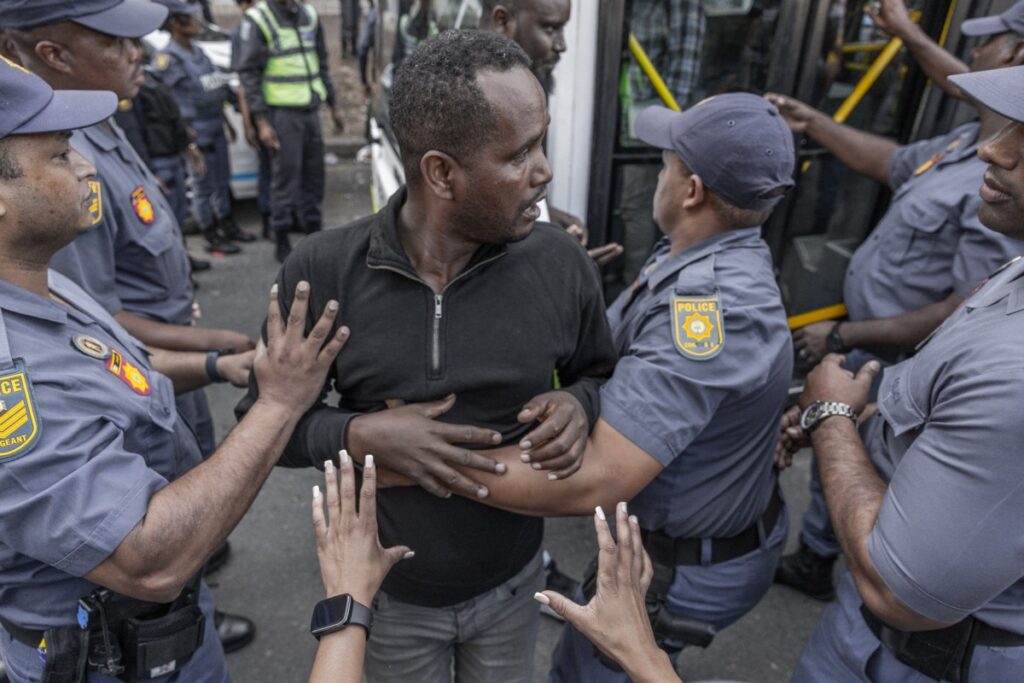
About 400 migrants from the Democratic Republic of the Congo, Ethiopia, Rwanda, and Somalia were herded onto busses by police and taken out of the complex on the east coast city, where some of them had been camping for days.
As the foreign nationals, including women and children, were transported to a government refugee center, local anti-immigrant activists celebrated and screamed, “They must go!”
To demonstrate that they possessed the necessary documentation to be in South Africa, some people pressed identity documents against bus windows.
After anti-immigrant residents went door-to-door telling undocumented foreigners to leave by June 30, several told AFP they had fled their houses out of fear.
Their ultimatum is not supported by the authorities and has no legal weight.
During the evacuation, there were some altercations, with one individual escaping and being pursued by residents until police arrived.
Reporters were informed by anti-immigrant leader Jacinta Ngobese-Zuma that while her group, March & March, condemned violence, all unauthorized foreign immigrants should go.
Analysts claim this is scapegoating because the group holds migrants responsible for social evils such high unemployment and violence.
In the meantime, Ghana announced on Thursday that it intended to withdraw over 800 of its residents from South Africa following uproar sparked by a widely shared video purporting to show an assault on a Ghanaian man.
Since 2008, when thousands of migrants were displaced and dozens of migrants were slain, South Africa has experienced periodic bouts of xenophobic violence.
Similar outbursts occurred in 2015 and 2021, frequently brought on by political mobilization around anti-immigrant rhetoric and economic grievances.