
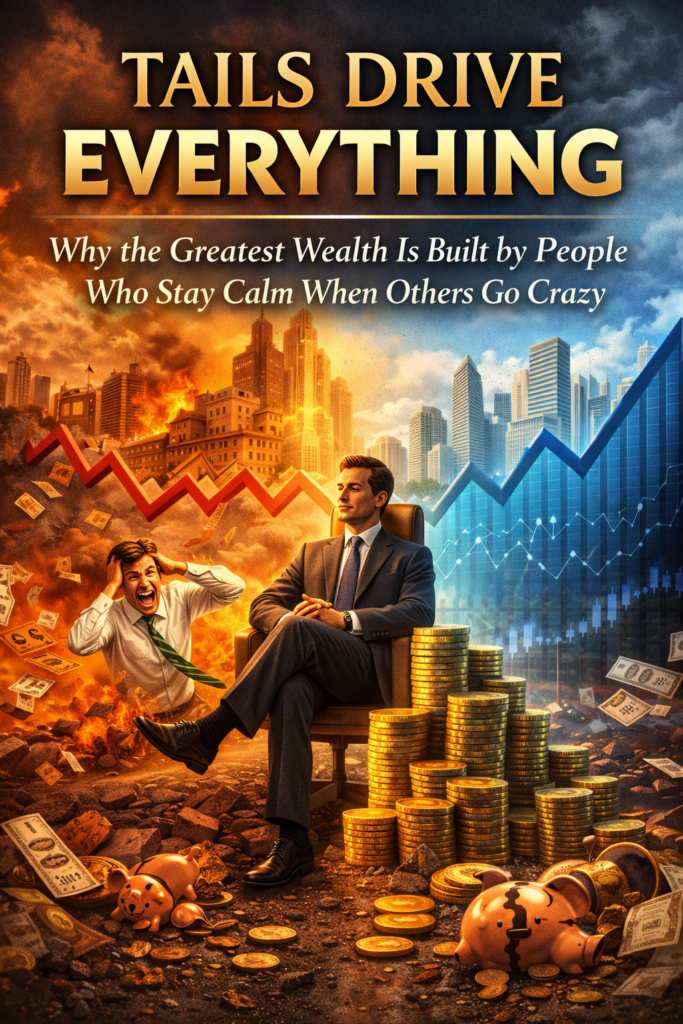
- Why Ordinary Discipline During Market Madness Can Make You Look Like a Genius
- The Tail Event Secret: How Outliers, Panic, and Patience Shape Wealth More Than Daily Effort
The Wealth Game Is Not Won Every Day—It Is Won in the Few Days That Matter Most
Most of life looks ordinary until one rare event changes everything.
A business struggles quietly for years, then one product, one customer, one endorsement, one contract, one market shift, or one viral moment transforms its destiny. An investor patiently holds assets for years, then a few exceptional companies, a few powerful rallies, or a few disciplined decisions during market panic produce most of the long-term wealth. A person builds skills in silence for a decade, then one opportunity arrives and the world calls him an overnight success.
But nothing was overnight.
It was a tail event.
A tail event is an outlier. A one-in-thousands moment. A result so rare, so powerful, and so disproportionate that it bends the entire story. It is the small number of extreme outcomes that control the majority of results.
This is one of the hardest truths in investing, business, entrepreneurship, media, technology, and even human destiny: tails drive everything.
The biggest companies are tail events. The most profitable investments are tail events. The most famous artists, athletes, entrepreneurs, and innovators are tail events. The most influential ideas in history are tail events. Even the existence of intelligent life on Earth, when compared with the vastness of the galaxy, feels like the ultimate tail event.
“The world is not shaped by average outcomes. It is shaken by rare events that most people never saw coming.”
And because tail events drive so much of wealth, the real question is not whether you can predict every outlier. You cannot. The real question is whether you can survive long enough, stay disciplined enough, and remain emotionally stable enough to benefit when rare opportunities appear.
The Core Philosophy: The Average Thing Becomes Genius During Madness
Napoleon once described a military genius as the person who can do the average thing when everyone around him is going crazy.
That is also one of the best definitions of an investing genius.
Not the person who always predicts the market.
Not the person who always picks the hottest stock.
Not the person who speaks the loudest on financial television.
Not the person who claims to know what the dollar, naira, oil price, crypto market, real estate sector, or stock exchange will do next month.
The investing genius is the man or woman who can do the average, rational, disciplined thing when everyone else is losing their mind.
When the market is crashing and people are shouting, “Sell everything,” the genius can breathe.
When prices are rising and people are shouting, “Buy now before it is too late,” the genius can think.
When social media is celebrating fast money, the genius can ask, “What is the risk?”
When fear is contagious, the genius can remain steady.
When greed is fashionable, the genius can remain humble.
This is powerful because most investors do not fail during normal periods. They fail during emotional extremes. They behave well when life is calm, then destroy their plan when terror arrives.
“Your real investing character is not revealed during cruise control. It is revealed during turbulence.”
A portfolio may grow for years, but the decision that defines your future may happen in one week of panic. A business may operate smoothly for ten years, but the crisis that reveals its strength may come in one season of chaos. A career may look stable for decades, but one recession, one industry disruption, one technology shift, or one health challenge may test the foundation.
The average thing becomes heroic when the crowd becomes irrational.
The Psychology: Why Investors Go Mad at the Wrong Time
Human beings are not naturally built for investing. We are built for survival. When danger appears, the body wants to run. When reward appears, the mind wants to chase. These instincts helped humans survive in the forest, but they can damage people in financial markets.
When the market falls sharply, many investors do not see opportunity. They see danger. They imagine losing everything. They remember every bad story they have heard. They panic. They sell. They convert temporary market decline into permanent capital loss.
When the market rises sharply, many investors do not see risk. They see evidence that they are missing out. They imagine others getting rich without them. They feel shame. They rush in late. They buy because everyone is buying. They confuse popularity with safety.
This is why investing is not only a mathematical game. It is a psychological game.
The numbers matter, but your behaviour matters more.
You can have a good investment plan and still ruin it with a bad emotional response. You can own good assets and still lose money if you sell them in panic. You can understand compounding and still destroy it if you interrupt the process during fear. You can know that markets are volatile and still behave as if every downturn is the end of the world.
“The market’s greatest weapon is not volatility. It is your emotional reaction to volatility.”
This is why punctuated moments of terror matter so much. Most years may be boring. Most months may be uneventful. Most days may feel like nothing is happening. Then suddenly, the market falls, the currency weakens, inflation rises, a bank fails, a policy changes, a war begins, a pandemic arrives, a major company disappoints, or an industry collapses.
Those moments separate investors from spectators.
The spectator reacts, the investor prepares.
The spectator panics, the investor reviews the plan.
The spectator follows the crowd, the investor follows principles.
The Nigerian and African Context: Why Tail Events Feel Familiar to Us
If you live in Nigeria or anywhere in Africa, you already understand tail events emotionally, even if you have never used the term.
You have seen exchange rates move in ways that changed business plans overnight. You have seen fuel prices reshape household budgets. You have seen government policies create sudden winners and sudden losers. You have seen importers become rich in one season and trapped in another. You have seen land in forgotten areas become gold because a road, bridge, refinery, university, or estate development changed the story. You have seen a small vendor become known because one video went viral. You have seen a struggling musician become a continental superstar because one song caught fire.
You have also seen the other side.
A business that looked strong suddenly collapsed because of debt, fraud, regulation, insecurity, supply-chain disruption, or poor cash flow. A person who looked rich became financially exposed when income slowed. A company that dominated an industry became irrelevant because technology changed. A comfortable family became vulnerable because one health emergency arrived.
Africa teaches you quickly that the future does not move in a straight line.
That is why wise investing in our environment must combine patience with realism. You must believe in opportunity, but you must respect shocks. You must position yourself for upside, but you must protect yourself from ruin. You must know that one rare event can build wealth, and one rare event can destroy it.
“In Africa, the wise person does not only ask, ‘How can I grow?’ He also asks, ‘What can scatter this growth?’”
This is why tail-event thinking is so important. It teaches humility. It reminds you that a few big outcomes can dominate the story, but you do not always know in advance which ones they will be.
The Mechanics: How Tails Drive Investment Returns
In investing, most assets may perform ordinarily, but a few extraordinary winners can create most of the wealth. A diversified investor may own many companies, but only a handful may become exceptional. Some investments will disappoint. Some will remain average. A few may become life-changing.
This is why patience matters.
If you sell too quickly, you may cut off the tail before it has time to reveal itself. If you panic during downturns, you may abandon the very assets that could later drive your long-term return. If you constantly chase what is hot, you may miss the quiet compounding of truly great businesses.
But here is the important balance: tail-event thinking does not mean reckless gambling. It does not mean you throw all your money into one startup, one stock, one crypto coin, one land speculation, one friend’s business, or one “sure” opportunity hoping for a miracle.
That is not investing. That is financial Russian roulette.
The goal is to position yourself so that rare positive outcomes can help you, while rare negative outcomes cannot destroy you.
This is why diversification remains powerful. Diversification admits that you do not know which specific outcome will become extraordinary. It allows you to own enough opportunities that the few big winners can work, while the losers do not wipe you out.
This is why risk management matters. If you use too much debt, one bad tail event can destroy you before the good tail events arrive. If you invest money you need urgently, you may be forced to sell at the worst time. If you put your whole life into one bet, you are not giving luck many chances; you are giving ruin one invitation.
“The goal is not to predict every tail event. The goal is to survive the bad ones and remain exposed to the good ones.”
That is wealth wisdom.
Entrepreneurs and Tail Events: Why One Product Can Change Everything
Entrepreneurship is also a game of tails.
A business may try ten ideas before one works. A content creator may publish hundreds of videos before one goes viral. A salesperson may speak to many prospects before one customer changes the revenue line. A startup may build for years before one partnership opens the market. A writer may publish for a long time before one article enters the bloodstream of the public.
The danger is that outsiders only see the tail event; they see the breakthrough.
They do not see the failed attempts; they see the viral post.
They do not see the years of ignored content; they see the big contract.
They do not see the proposals that were rejected; they see the bestselling product.
They do not see the inventory mistakes, customer complaints, cash-flow pressure, sleepless nights, and painful experiments that came before it.
This is why envy is often built on incomplete information.
When you see someone become huge, profitable, famous, or influential, remember that the visible result may be the final expression of many invisible attempts. It may also include luck, timing, access, persistence, and rare alignment of conditions.
“Every tail event has a backstage. Do not envy the spotlight until you understand the rehearsal.”
For entrepreneurs, the lesson is not to expect every attempt to succeed. The lesson is to keep experimenting intelligently, learning quickly, cutting losses wisely, and surviving long enough for a rare winning outcome to emerge.
The Danger: Mistaking a Tail Event for a Repeatable Formula
One of the biggest mistakes people make is treating rare outcomes as if they are easily repeatable.
Someone buys a coin before it rises 1,000%, and suddenly he becomes a financial prophet. Someone enters real estate in an area before massive development, and people think he has mastered all land investment. Someone starts a business during a perfect market window, and others copy him after the window has closed. Someone becomes rich from a risky bet, and people mistake luck for universal wisdom.
This is how people lose money: they imitate outcomes without understanding the conditions that produced them. They copy confidence without seeing the risk beneath it, and they repeat the story without understanding the probability behind it. In the end, they focus on the visible winner while ignoring the graveyard of others who tried the same thing and failed.
That is survivorship bias. It is the habit of studying only those who survived and forgetting those who disappeared. It makes rare outcomes look easier than they are.
“A tail event can make a man rich, but it can also make observers foolish.”
This is why you must be careful with testimonies. A testimony can inspire, but it should not replace analysis. Someone else’s success does not remove your need for due diligence. Someone else’s profit does not mean your risk is low. Someone else’s miracle does not mean the opportunity is repeatable.
Respect the story but study the structure.
The Blueprint: How to Invest When Tails Drive Everything
First, accept that you will not make good decisions all the time. No investor does. No entrepreneur does. No leader does. No parent does. No human does. The goal is not perfect decision-making. The goal is to create a system where your mistakes are survivable and your wins have room to grow.
Second, stop trying to predict every big event. You will not always know the next crash, the next boom, the next policy shock, the next technology winner, the next currency swing, or the next market darling. Instead, build a portfolio and a life that can withstand uncertainty.
Third, maintain exposure to opportunity. If you are completely out of the market because you are afraid, you may avoid some pain, but you may also miss the rare moments that create long-term returns. If you never start the business, never publish the idea, never build the skill, never invest, never network, never apply, never try, you reduce your chances of experiencing positive tail events.
Fourth, avoid ruin. This is non-negotiable. Do not use reckless leverage. Do not gamble with money you cannot afford to lose. Do not let one investment decide your entire future. Do not borrow dangerously to chase hype. Do not enter opportunities you do not understand because people are shouting.
Fifth, stay calm during terror. The years of cruise control are not where your destiny is usually decided. Your future may be shaped by what you do when your portfolio is down, when the economy is shaking, when everyone is panicking, when the news is frightening, and when your emotions are screaming. Those are the moments where ordinary discipline becomes genius.
Sixth, give winners time. In investing, business, skill, and reputation, rare winners often need time to become obvious. Do not be so impatient that you cut down the tree before it bears fruit.
Seventh, remember that boring behaviour can produce extraordinary results. Saving consistently, investing patiently, diversifying wisely, controlling debt, avoiding panic, reinvesting profits, learning continuously, and protecting your reputation may look average. But when everyone else is going crazy, average behaviour becomes extraordinary advantage.
“When madness becomes popular, sanity becomes alpha.”
The Benediction: Be Average When the World Goes Insane
You do not need to be a prophet to build wealth. You do not need to predict every crash, spot every hot investment, or make perfect decisions in every season. What matters most is not flawless timing but endurance. You must survive, stay in the game, and resist the kind of emotional self-destruction that ruins good judgment and destroys long-term progress.
You must position yourself for rare good outcomes while protecting yourself from rare bad ones.
You must understand that life is not evenly distributed. Results are not evenly distributed. Wealth is not evenly distributed. Influence is not evenly distributed. A small number of events, people, decisions, companies, products, and moments can shape the entire story.
Tails drive everything, so life must be built with that truth in mind. It calls for humility in moments of success, steadiness when others panic, caution when greed spreads, courage when hope disappears, patience when the world demands speed, and discipline when everyone else is chasing noise.
The world will continue to produce outliers. Some will bless you. Some will test you. Some will shock you. Some will humble you. But the person who can keep doing the average, rational, disciplined thing while the crowd is going mad will often look like a genius after time has finished telling the story.
That is the Business Apostle wisdom: great wealth is not only made by extraordinary predictions; it is often made by ordinary discipline during extraordinary moments.
So do not worship noise or react to volatility with childish fear. Do not run after every trend in desperation, and Do not build a financial life that depends on everything going perfectly. Instead, prepare wisely, diversify your risks, and focus on survival. Stay exposed to opportunity, give time the space to do its work, and let compounding breathe until the rare winners carry the story. And when the world loses its mind, have the discipline to do the ordinary thing—because that may turn out to be the most brilliant move of your life.
Subscribe to Naija Street Matters for regular news update and click on the Whats-app green button below to join our community.