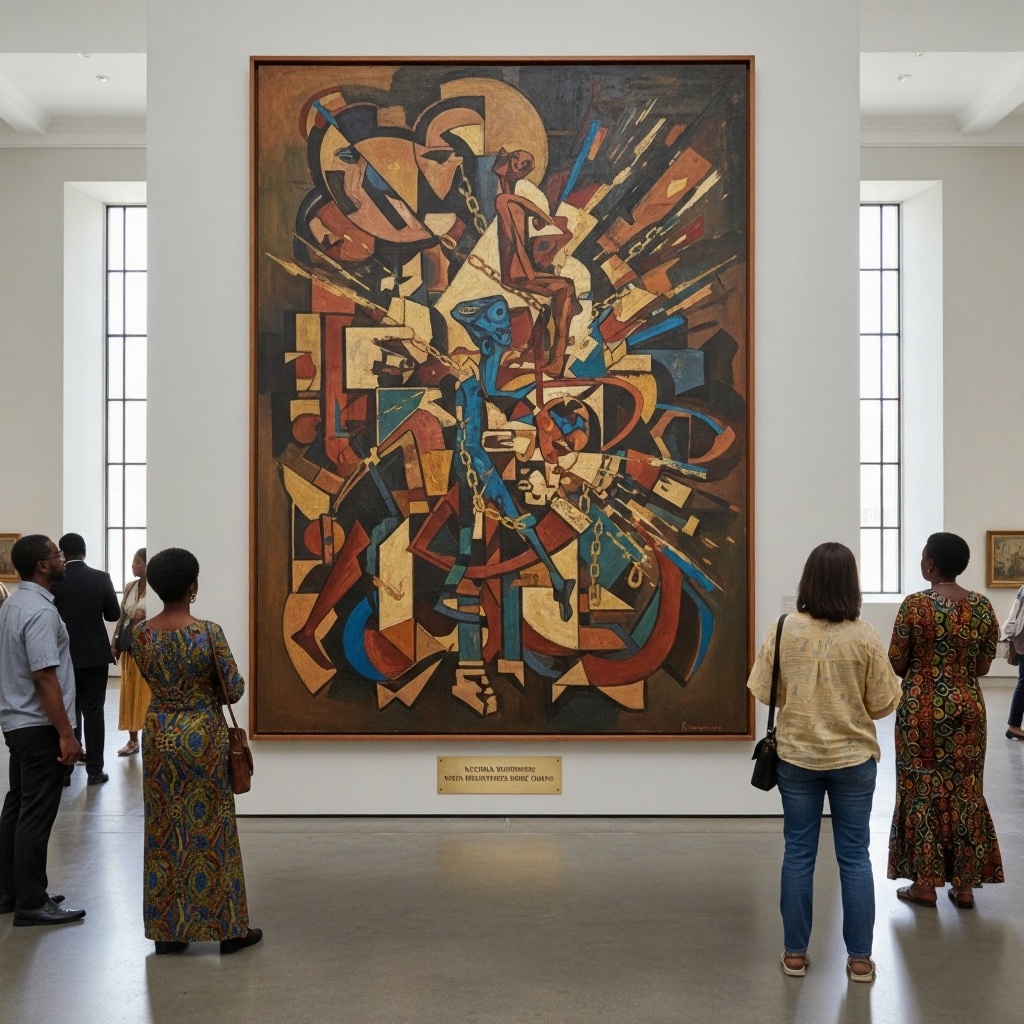
The story of Nigerian Modernism is one of rebellion, resilience, and renaissance. Now spotlighted at the prestigious Tate Modern, this groundbreaking exhibition pulls together decades of artistic evolution, from the dawn of the 1940s to the transformative 1990s. It captures a period when Nigerian artists broke away from colonial art education and began painting, sculpting, and designing a new identity, one that spoke in both the language of tradition and the rhythm of global modernism. For the first time, the world gets to witness the pulse of Nigerian creativity through a timeline where art became not just beauty, but resistance.
The exhibition’s narrative begins with the Zaria Art Society, often called the “Rebels with a Cause.” Founded in the late 1950s by visionary artists like Uche Okeke, Yusuf Grillo, Bruce Onobrakpeya, and Demas Nwoko, they challenged the imposed European academic style and championed the idea of “Natural Synthesis” a fusion of Western techniques with indigenous aesthetics. Through their canvases, lines, and colors, they declared independence long before Nigeria raised its flag in 1960. Their art carried whispers of masquerades, marketplace rhythms, folklore, and cosmology, all while engaging in global artistic dialogue. In a world that sought to define Africa through colonial eyes, these artists painted their own definitions.
By the 1970s and 1980s, the Nigerian art scene had expanded into a multicultural tapestry of diaspora influence and cultural hybridity. Nigerian artists who had traveled abroad began infusing their works with experiences of migration, exile, and belonging. Figures like Ben Enwonwu, who bridged traditional sculpture with Western portraiture, and Susanne Wenger, whose fusion of Yoruba spirituality and Austrian surrealism blurred the lines of origin, contributed to a growing conversation on global African modernity. Art became a transatlantic dialogue, a bridge connecting Lagos to London, Nsukka to New York.
The 1990s marked a new energy, bold, political, and provocative. The post-colonial identity had matured into self-awareness, and artists began tackling issues of governance, inequality, and globalization. El Anatsui’s shimmering metal installations, made from bottle caps and scrap aluminum, redefined what sculpture could mean in an African context. His work symbolized recycling not only of materials but of histories turning the remnants of consumerism into symbols of transformation. Nigerian Modernism at this point had transcended rebellion; it had become revelation.
The Tate Modern’s Nigerian Modernism exhibition is more than a retrospective, it is a recognition of a people’s creative sovereignty. It celebrates how art became both weapon and mirror; how painters, sculptors, and designers turned cultural fragments into frameworks of freedom. In a time when Africa’s contributions are still too often footnotes in global art history, this exhibition stands as a correction and a celebration. It reminds the world that Nigerian art was never merely responding to Western modernism, it was redefining it.