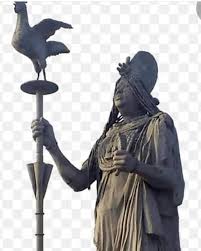
Luwo Gbagida (sometimes spelled Luwo Gbàgìdá) is remembered in Yoruba tradition as the first and only female Olofin Adimula, Oonirisha Ile Ife. She is believed to have reigned around the 10th or 11th century, succeeding Ooni Giesi and later succeeded by Ooni Lumobi. Her lineage was royal, she descended from Oduduwa, and her son, Adekola Telu, later founded the Iwo Kingdom. Her reign remains a profound reminder that female rulership is not a modern invention but part of the deep Yoruba historical fabric. In a patriarchal age, Luwo stood as a ruler, not a regent, proving that authority, intelligence, and vision are not gendered virtues.
Accounts of Luwo’s reign describe her as bold, assertive, and deeply invested in the beauty and order of her city. She reportedly commissioned artistic and infrastructural innovations, decorative pavements and courtyards made from pottery shards, architectural designs that inspired future Yoruba aesthetics. She enforced laws with firmness and expected discipline from her people, traits often admired in male rulers but criticized in women. By instructing her son to establish the Iwo Kingdom, she demonstrated strategic foresight and the power to create legacies beyond her own reign. Her leadership combined creativity, discipline, and vision, qualities that transcend gender and era.
Yet, Luwo’s story reveals how easily women’s power can be misremembered or erased. There are debates over her title some call her the Alaafin, others the Ooni, and disagreements about her historical timeline. Even modern media have misrepresented her, prompting corrections from traditional institutions like the palace of the Oluwo of Iwoland. These inconsistencies mirror a global pattern: women’s histories are often fragmented, under-documented, or distorted through male-centered lenses. But the persistence of her name across centuries proves that even oral traditions protect the memory of greatness. Luwo’s life urges us to recover the lost stories of powerful women, because history without them is incomplete.
Luwo’s throne may have been ancient, but her spirit reigns through today’s women in power. Across Nigeria and beyond, women like Ngozi Okonjo-Iweala, Amina Mohammed, and Chimamanda Adichie embody that same resilience and authority in spaces long defined by men. They lead nations, shape economies, and rewrite narratives, just as Luwo reshaped Ile-Ife. Her story dismantles the notion that women’s leadership is foreign to African tradition. Instead, it reminds us that the Yoruba civilization, and indeed, African societies have long recognized women as capable of sovereignty. Luwo Gbagida’s reign was not an anomaly; it was an ancestral affirmation of women’s power.
From Luwo Gbagida’s life, we learn that power does not ask for permission, it demands purpose. Her leadership teaches representation, courage, and innovation. In every boardroom, political office, or creative space where a woman leads today, she continues Luwo’s story. The task before us is to ensure that the legacy of women like her is not buried in myth but celebrated as fact. For when a society remembers its female rulers, it empowers its daughters to rule without apology. Luwo Gbagida’s voice still echoes across time, urging every woman in power to lead with strength, vision, and grace just as she once did from the sacred heart of Ile-Ife.