
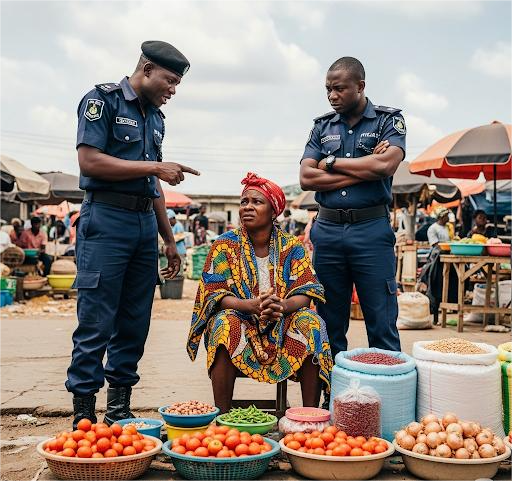
In the bustling markets of Lagos, where voices rise like a symphony of survival, one story stands out, too common, yet too painful. A woman in Ajah market, her hands hardened by years of selling food items, was confronted by a group of tax force officers. They demanded ₦50,100 as levy, a figure so inflated it would swallow her profit for months. With fear in her eyes and sweat dripping down her face, she pleaded for fairness. It was only after heated confrontation and intervention that it was revealed she was meant to pay just ₦10,100. The excess was a calculated attempt to exploit her presumed ignorance.
This is not an isolated incident. Across Nigeria, market women, who form the backbone of our informal economy, are constantly harassed by those in uniforms of authority. Instead of providing protection, some officials prey on them, creating a hostile environment for honest labor. These women, many of whom did not have the privilege of formal education, are often targeted because they are seen as “easy victims.” The assumption is that they will not question figures, receipts, or authority. In reality, their resilience keeps families fed and children in school, yet their sweat is treated as a pool to be siphoned.
Such harassment is a reflection of a broader sickness in society: the belief that power exists to exploit rather than to serve. The tax system, though essential for development, becomes a weapon in the hands of corrupt enforcers when oversight is weak. What should be a civic duty, paying fair dues to the government becomes a nightmare. Imagine the humiliation of being shouted at in public, threatened with seizure of goods, or forced to pay more than required, all because one is perceived as powerless. That humiliation sticks longer than the financial loss.
But the problem is not only about government officials. It cuts deeper into how society often treats the uneducated. Education should never be a tool of oppression, yet it is weaponized daily. Many market women know no arithmetic beyond basic counting, yet they are shrewd managers, capable of sustaining households in the harshest of economies. They deserve respect, dignity, and fair treatment, not exploitation. Every time they are cheated, the ripple touches their children’s schooling, their family’s feeding, and the nation’s economy at large.
The solution lies in accountability and empathy. Government must monitor revenue officers more closely, enforcing strict penalties against exploitation. Civil society must create awareness, teaching market people their rights, and providing them with tools, ike simplified receipts and levies breakdown to protect themselves. Above all, as Nigerians, we must unlearn the culture of leeching off the weak. A society that humiliates its mothers in the market square cannot expect progress. Protecting them is protecting the nation’s backbone.