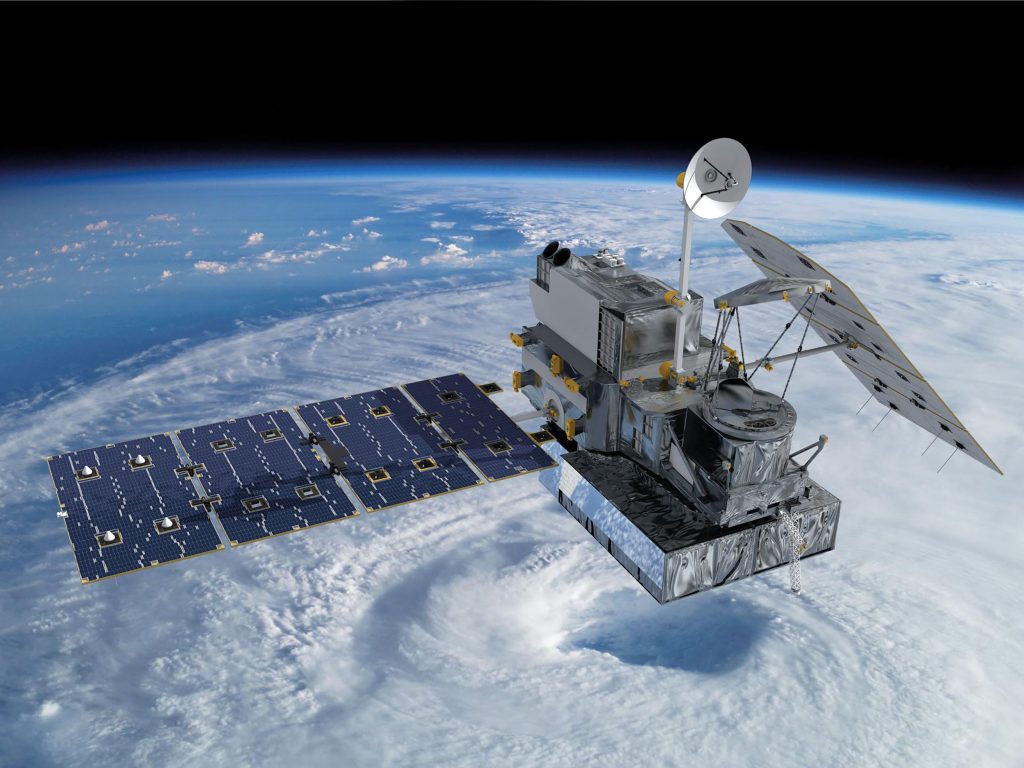
They play a pivotal role in improving the accuracy of weather predictions and enhancing our understanding of global weather patterns. There are two types of advanced weather satellites: Geostationary Satellites (GEO) and Polar-Orbiting Satellites (LEO).
Geostationary satellites orbit the Earth at the same rate as the planet’s rotation, providing continuous monitoring of the same region. For example, the GOES series operated by NASA and NOAA provides real-time imagery of weather patterns, helping in short-term forecasts and early warnings of extreme weather events like hurricanes. Polar-orbiting satellites orbit at a much lower altitude and pass over the poles, giving them global coverage as the Earth rotates.
Advanced technology in modern weather satellites includes high-resolution imaging, hyperspectral sensors, 3D atmospheric sensing, and real-time data transmission through rapid scan technology. These satellites enable meteorologists to track storms, assess precipitation levels, and monitor cloud formations in multiple spectral bands. Additionally, they carry LIDAR and RADAR systems that help create 3D profiles of the atmosphere, improving the accuracy of weather models and severe storm tracking.
The applications of advanced weather satellites include improved accuracy in weather forecasting, climate monitoring, disaster management, early warnings for natural disasters, and post-disaster assessment. Future developments in weather satellites may include next-generation sensors and AI-powered analytical tools, as well as smaller, cheaper satellites like CubeSats and constellations.
In conclusion, advanced weather satellites are essential for providing accurate, timely weather data and improving forecasting capabilities. Their cutting-edge technology and growing capabilities enable governments, businesses, and individuals to prepare for and mitigate the impacts of extreme weather events, ensuring better disaster preparedness and climate resilience. As technology evolves, weather satellites will continue to play a pivotal role in shaping our understanding of the Earth’s atmosphere and improving weather prediction models.