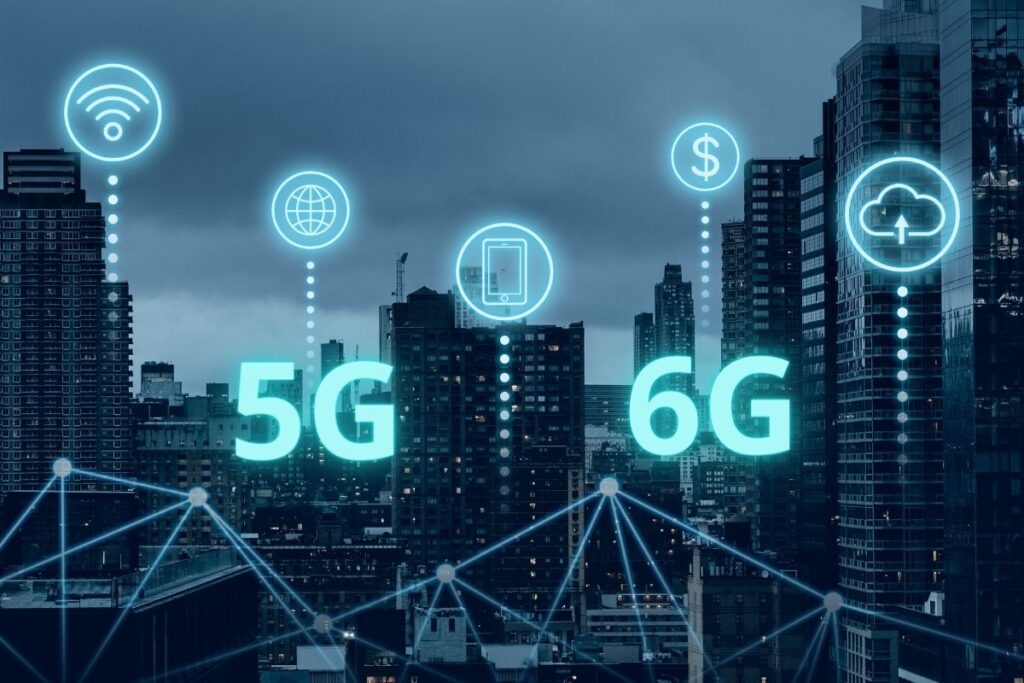
Key features of 5G include faster data speeds, low latency, greater capacity, network slicing, enhanced reliability, and applications such as autonomous vehicles, smart cities, healthcare, and entertainment.
5G’s key features include faster data speeds, low latency, greater capacity, network slicing, and enhanced reliability. Its capabilities enable ultra-fast streaming, quick file downloads, and better performance for bandwidth-heavy applications like augmented reality (AR) and virtual reality (VR). Latency is significantly reduced with 5G, potentially as low as 1 millisecond, making it crucial for applications like autonomous vehicles, remote surgeries, and real-time gaming.
6G, on the other hand, is under development and expected to start rolling out around 2030. It is expected to push the boundaries even further by integrating more advanced technologies and delivering unprecedented data speeds, capacity, and efficiency. Key features of 6G include Terahertz Frequency, ultra-low latency, AI integration, holographic communication, sustainability and efficiency, and fully immersive virtual reality and augmented reality applications.
The potential applications of 6G include fully immersive virtual reality and AR, AI-driven networks, remote healthcare and brain-computer interfaces, and digital twins. Both 5G and 6G have the potential to boost global economies by facilitating new industries, improving efficiency, and enabling cutting-edge technologies like AI and autonomous systems. They could lead to the creation of millions of new jobs and contribute trillions to the global economy.
As 5G continues to roll out, it is expected to revolutionize industries like manufacturing, healthcare, and automotive, while 6G will likely enhance fields that depend on extreme precision, such as quantum computing, advanced robotics, and space exploration. However, there is concern that regions without access to high-speed networks could fall further behind, exacerbating the digital divide between developed and developing areas.
In conclusion, 5G is already reshaping industries with faster speeds, low latency, and greater capacity, while 6G is poised to push the boundaries of innovation even further by integrating AI, advanced robotics, and immersive technologies. Together, these advancements in wireless communication promise to transform the way we live, work, and interact with technology.