- The Billion-Dollar Sellout: Why the Richest Continent on Earth is Breeding the Poorest Citizens.
Today, we must have the most uncomfortable, brutal, and necessary conversation of our generation.
We are living in the third decade of the 21st century. Humanity is launching commercial flights to space, artificial intelligence is revolutionizing global industries, and scientists are curing diseases that once wiped out civilizations. Yet, when you look at the map of global economic progress, Africa remains painfully obscured in the shadows.
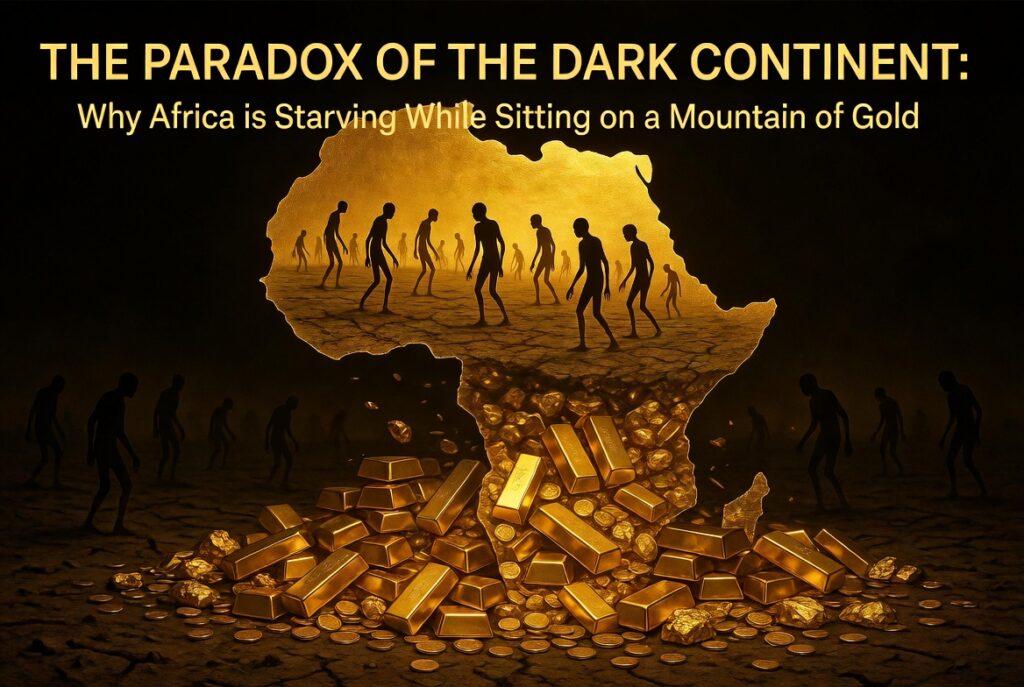
The term “Dark Continent” was historically used as a racist, colonial slur, but today, we must look in the mirror and ask a terrifying question: Have we inadvertently engineered our own darkness?
How does a continent blessed with the most arable land, the youngest population, and the most fiercely coveted natural resources on the planet remain the global headquarters of extreme poverty? Why is Nigeria, a nation of over 200 million deeply intelligent and resilient people, struggling with over 130 million citizens living below the poverty line?
As the Business Apostle, I do not deal in political correctness. I deal in economic realities, structural analysis, and the brutal truth. If we want to escape this cycle, we must dissect the anatomy of our failure. Here is the unvarnished breakdown of why Africa remains trapped, and what we must do to break the chains.
1. The Tragedy of Leadership: The Worst Leading the Best
The most critical problem facing the African continent is a catastrophic failure of leadership. In any functional organization, the brightest, most strategic, and most visionary minds are placed at the helm. In Africa, the exact opposite is the structural norm. We suffer from a systemic tragedy where the worst of us are leading the best of us.
Brilliant Nigerian minds—innovators, doctors, tech founders, and economists—are forced to navigate a hostile environment governed by individuals who lack basic macroeconomic understanding. When leadership is devoid of intellectual rigor, vision, and empathy, policy becomes a weapon of mass impoverishment rather than a tool for national development.
2. The Death of Industrialization and the Rise of the “Miracle” Economy
A nation that does not produce will perish. It is an economic law. Across Nigeria and the wider continent, we have witnessed the systematic dismantling of our industrial base. The bustling textile mills of Kano and Kaduna are dead. The manufacturing hubs have been hollowed out.
But what replaced them? We traded our industries for illusions. The massive warehouses that once housed assembly lines and employed thousands of workers have been converted into mega-churches and miracle centres. Because the state has failed to provide jobs, infrastructure, and security, the desperate, impoverished masses have turned to religion as their only social safety net. We have bred a society where citizens pray for a “miracle job” instead of demanding an industrialized economy that creates actual employment. We are trying to fast and pray our way out of an economic crisis that requires factories, production, and exports.
3. The Power Paradox: A Nation Kept in the Dark
You cannot power a 21st-century economy with 19th-century infrastructure. The electricity crisis in Nigeria is not just an inconvenience; it is economic sabotage. We are a nation of over 200 million people attempting to run an economy on a paltry 5,000 megawatts of electricity. To put that into perspective, cities in the developed world with a fraction of our population consume ten times that amount.
Despite billions of dollars allegedly invested in the power sector over the last two decades, the result is practically invisible. The lack of reliable electricity murders small businesses, chokes e-commerce, drives away foreign direct investment, and forces local entrepreneurs to spend half of their operational budgets on diesel for generators. Darkness is not just our physical reality; it is the deliberate bottleneck strangling our economic potential.
4. The Great Resource Heist and the Foreign Sellout
Africa holds the world’s wealth in its soil. We have the oil and gas of the Niger Delta, the gold of Ghana, the uranium of Niger, the platinum and diamonds of South Africa, and the cobalt of the Congo. Yet, these resources do not develop Africa; they develop Europe, North America, and increasingly, Asia.
Our governments are entirely complicit in this. There is a deeply entrenched connivance with foreign powers to defraud the people of their commonwealth. African leaders routinely sign opaque, lopsided contracts, mortgaging the future resources of their people in exchange for immediate kickbacks and personal wealth. They take predatory loans from foreign powers, trapping entire generations in debt servitude, simply to build vanity projects that do not generate revenue. We are bleeding our wealth dry to build other nations.
5. The Infrastructure Graveyard
If you drive across Nigeria, you will see the landscape littered with the rotting skeletons of abandoned projects. Billions of Naira have been sunk into roads that lead nowhere, hospitals that have no equipment, and dams that generate no power. This dearth of infrastructure is a product of systemic neglect, bureaucratic decay, and the weaponization of government contracts. Contracts are not awarded to build infrastructure; they are awarded to siphon funds. When the money is released, the project is abandoned, leaving the citizens to navigate death-trap highways and collapsing bridges.
6. The Bartered Economy and the Collapsed Middle Class
Nigeria’s macroeconomic indicators read like an autopsy report. We are running a bartered economy characterized by an endlessly plummeting exchange rate and hyperinflation that destroys purchasing power daily.
Look at the numbers: we are borrowing endlessly just to service existing debt, essentially using our credit card to pay the minimum balance on another credit card. Currency fluctuation makes long-term business planning impossible. And the interest rates? They are absolutely punitive. You cannot build a thriving SME sector or a robust e-commerce ecosystem when entrepreneurs are forced to borrow at double-digit interest rates hovering around 25% to 30%. The result? The total collapse of the Nigerian middle class. You are either the ultra-rich political elite, or you belong to the 130 million Nigerians fighting for survival below the poverty line.
7. The Theatre of Elections
How do these leaders stay in power despite such monumental failure? Because our democracy has been hijacked. Elections in many parts of Africa are not a reflection of the people’s will; they are a sophisticated theatre of war. We are battling ballot stuffing, violent voter suppression, and systemic vote-buying where impoverished citizens sell their future for a miserable cup of rice. Add the collusion of electoral umpires and the overwhelming power of incumbency, and you have a system designed to protect the political elite and permanently disenfranchise the masses.
8. The Slavery Mentality: A Crisis of Identity
However, we cannot blame all our woes on the politicians. There is a deep psychological wound we must address: the enduring slavery mentality.
Decades after colonization, we still operate under the subconscious belief that only things done by the white man are good enough. We import our clothes, our food, our media, and our validation. We have neglected indigenous African medicine, relegated African technology to the background, and suffered a massive loss of self-worth. Until we decolonize our minds and take fierce pride in local production, branding, and innovation, we will remain a continent of consumers rather than creators.
9. The Tragedy of a Docile Population
The final, and perhaps most painful, piece of this puzzle is the docility of the population.
Why hasn’t the system changed? Because the people have been beaten into submission. There is a legitimate fear of dying that stalls protest; we have seen what happens to those who raise their voices. But worse than the fear is the Stockholm Syndrome. We have become a people who are drunk with praising our oppressors. We celebrate the very politicians who stole the funds meant for our hospitals simply because they throw a few crumpled Naira notes at us during a campaign rally. A people who cannot aggressively ask for their rights will always be treated like subjects, never like citizens.
The Apostle’s Verdict: Where Lies the Hope of Africa?
If you have read this far, you might feel a crushing sense of despair. But hear me clearly: I do not believe Africa is doomed.
Where lies the hope of Africa, and particularly Nigeria? It lies in the furious, brilliant, and deeply resourceful young, teeming population. We have a demographic advantage that the rest of the aging world would kill for. The hope lies in the collapse of the illusion.
The youth are realizing that the government is not coming to save them. The 130 million living below the poverty line are realizing that the old systems are broken. The hope lies in technology, digital skills, and borderless wealth creation. The hope lies in the young Nigerian who learns high-income skills, builds global software, masters international e-commerce, and creates intellectual property that cannot be taxed or stolen by corrupt local politicians.
We bypass the broken infrastructure by building in the cloud. We must stop waiting for a political messiah. The revolution we need is a revolution of the mind, followed by a fierce, uncompromising pursuit of financial independence and civic education. When the youth build independent wealth, they can no longer be bought with a bag of rice. When the youth are economically empowered, they will fund their own political movements, demand accountability, and forcefully eject the worst among us from the corridors of power.
The Dark Continent is only dark because we have not yet fully ignited the fire of our own potential. It is time to wake up. It is time to build. It is time to demand the future we were promised.