- The Wealth Killer Nobody Warns You About: When Ambition Becomes an Appetite That Destroys Everything
- Before You Risk Your Peace for More Money, Read This: The Brutal Wisdom of Knowing Enough
The Moment More Becomes a Trap
There is a point in a man’s life where ambition stops being fuel and starts becoming fire. At first, he wants to escape poverty. Then he wants comfort. Then he wants recognition. Then he wants to be richer than his friends. Then he wants to silence his enemies. Then he wants to dominate his industry. Then he wants people to mention his name with fear, respect, envy, and trembling admiration.
But somewhere along the way, he forgets the original prayer.
He forgets when all he wanted was rent money, school fees for the children, peace in the home, food on the table, a decent car, a small business that could breathe, and the dignity of not begging.
Now he has those things, but he cannot rest. Why? Because the goalpost has moved again.
This is one of the hardest financial skills in life: getting the goalpost to stop moving.
Many people think the hardest financial skill is making money. No. Making money is difficult, but stopping yourself from destroying your life in pursuit of more money is harder. It takes wisdom to make money. It takes deeper wisdom to know when more money is no longer worth the risk.
“A man who does not know what is enough will eventually sacrifice what is sacred for what is unnecessary.”
There is no reason to risk what you have and need for what you do not have and do not need. Yet this is exactly what many people do every day. They risk their marriage for prestige. They risk their reputation for quick profit. They risk their freedom for illegal money. They risk their health for endless hustle. They risk their peace to impress people who are also secretly unhappy.
This is not wealth. This is sophisticated poverty of the soul.
The Core Philosophy: Enough Is Not Laziness; Enough Is Wisdom
To say “I have enough” does not mean you lack ambition. It does not mean you are weak. It does not mean you should stop growing, investing, creating, expanding, building, or dreaming. Enough simply means you have developed the wisdom to know which risks are no longer worth taking.
Enough is the financial boundary that protects your soul.
Enough is the point where you can say, “This opportunity may be profitable, but it is not worth my peace.”
Enough is when you can say, “This deal may make me richer, but it may also destroy my name.”
Enough is when you can say, “This investment may multiply my money, but if it fails, it can scatter my family.”
Enough is when you can say, “This lifestyle may impress people, but it will enslave my income.”
Enough is not the enemy of success. Enough is the guardian of success.
The problem is that modern life teaches people to confuse contentment with mediocrity. We are told that if you are not chasing more, you are not serious. If you are not expanding, you are falling behind. If you are not richer than your classmates, your destiny is delayed. If you are not driving a certain car, living in a certain estate, wearing a certain watch, sending your children to a certain school, or posting certain vacation pictures, then something is wrong with your life.
This is how envy becomes a financial adviser.
Modern capitalism is powerful. It generates wealth, innovation, opportunity, jobs, businesses, technologies, and markets. But it is also a master at generating envy. It shows you what others have until what you have begins to look small. It puts someone else’s highlight reel beside your private struggles. It makes a man earning ₦2 million a month feel poor because someone else is flying business class to Dubai. It makes a woman with a peaceful family feel inadequate because her friend just bought a house in Lekki Phase 1. It makes a young entrepreneur despise his slow progress because another startup founder is trending on Instagram with a luxury car.
“Comparison is the thief that enters through the eyes and robs the heart of gratitude.”
The Psychology: Happiness Is Results Minus Expectations
There is a simple but powerful way to understand happiness: happiness is results minus expectations.
If your results are rising but your expectations are rising faster, you will still feel poor. If your income doubles but your appetite triples, you will still feel behind. If your business grows but your desire for recognition grows faster, you will still feel empty. If your investments perform well but your envy performs better, you will still be restless.
This is why some people become richer and more miserable at the same time.
Their bank account increases, but their peace decreases.
Their public image expands, but their private joy shrinks.
Their influence grows, but their fear of losing status becomes unbearable.
This is the prison of moving goalposts.
A man says, “Once I make ₦10 million, I will rest.” He makes ₦10 million and says, “No, I need ₦50 million.” He reaches ₦50 million and says, “People in my circle are now talking in hundreds of millions.” He gets there and says, “But I don’t have dollars.” He gets dollars and says, “But I don’t have foreign property.” He buys foreign property and says, “But I am not yet known.” He becomes known and says, “But I am not yet respected by the people above me.”
At what point will the soul sit down?
This is where behavioural economics meets spiritual wisdom. Human beings adapt quickly to improvement. What once looked like a miracle soon becomes normal. The first car feels like breakthrough. The second car feels like upgrade. The third car becomes identity. Then, suddenly, not driving the latest model feels like failure.
This is called hedonic adaptation: the human tendency to return to a baseline level of satisfaction after positive changes. In simple Nigerian English, it means: what made you dance yesterday can become too small to impress you tomorrow.
That is why without discipline, more will never satisfy. It will only increase the size of your hunger.
“Money can buy comfort, but only wisdom can protect contentment.”
The Nigerian and African Context: The Pressure to Prove You Are Not Poor
In Nigeria and many parts of Africa, the pressure to display success is intense. People are not only trying to survive; they are trying to prove something.
They are trying to prove to family members that they did not waste their education.
They are trying to prove to old classmates that life did not defeat them.
They are trying to prove to village people that the city did not swallow them.
They are trying to prove to in-laws that they are worthy.
They are trying to prove to social media that they are not suffering.
They are trying to prove to themselves that the years of hardship meant something.
This pressure is dangerous because it can push people to take foolish risks. A man borrows heavily to host a wedding beyond his means because he wants people to say, “He tried.” A business owner diverts working capital to buy a car because customers must “respect the brand.” A young person enters fraud because legitimate progress feels too slow. A salary earner invests in a suspicious scheme because he wants quick escape from economic frustration. A politician steals because power has become an addiction. A trader refuses to leave a risky deal because he wants to “hammer” before December.
But there are some things money should never be allowed to take from you. It should never purchase your freedom, stain your name, cost you your family, steal your peace, damage your health, or rob you of the ability to sleep without fear. Some prices are simply too high, no matter how attractive the reward may seem. It should never buy your ability to sleep without fear.
“Any money that makes you afraid of your phone ringing at night is not wealth; it is bondage wearing designer clothes.”
The Danger: Risking What You Have and Need for What You Don’t Have and Don’t Need
The tragedy of greed is that it often destroys people who already have enough to live well.
A man with a good business risks everything in a shady deal because he wants to move from comfortable to famous. A civil servant with stable income enters corruption because he wants to build a mansion bigger than his salary can explain. An investor with a healthy portfolio puts everything into one “sure” opportunity because he wants to double his net worth quickly. A family man with peace at home destroys trust because he wants pleasure outside.
The question is simple: why risk what you have and need for what you do not have and do not need?
If you already have food, shelter, family, reputation, reasonable income, peace, and freedom, then the next financial decision must be judged differently. It is no longer only about how much you can gain. It is also about what you can lose.
This is where many successful people fail. Poor people often take risks to survive. Rich people often take risks to satisfy ego. Survival risk can be understandable. Ego risk is dangerous.
A person trying to escape poverty may take a calculated risk because the current situation is already painful. But a person who already has enough and still risks everything for unnecessary excess is playing with fire.
This is why the wealthy must become more disciplined, not less disciplined. The more you have, the more you must protect. The higher you climb, the more careful your steps must become. The more people depend on you, the more your appetite must be governed by wisdom.
“The purpose of wealth is not to keep increasing your hunger; it is to give you the power to choose peace.”
The Mechanics: How to Know When a Risk Is No Longer Worth Taking
Every opportunity must be measured by more than profit. The immature investor asks, “How much can I make?” The wise investor asks, “What can this cost me if it goes wrong?”
That question changes everything because it forces you to measure ambition against cost. It asks whether a deal can stain your reputation, whether a loan can shake your family’s stability, whether a partnership can rob you of peace, whether a shortcut can cost you your freedom, whether a lifestyle can damage your future, whether ambition can injure your health, and whether an investment can take money you cannot afford to lose. And if the honest answer to any of those questions is yes, then wisdom says you should pause.
There are risks worth taking. Starting a business is risk. Investing is risk. Learning a new skill is risk. Changing careers is risk. Relocating is risk. Expanding a company is risk. But intelligent risk has boundaries. It is calculated. It is survivable. It does not destroy the foundation if it fails.
Foolish risk is different. Foolish risk puts sacred things on the table for temporary gain.
Do not put your children’s school fees into a speculative investment. Do not put emergency funds into a locked scheme. Do not borrow money at high interest to impress people. Do not sign documents you do not understand. Do not enter business with people whose character is questionable just because the numbers look sweet. Do not destroy long-term trust for short-term cash.
“If the downside can ruin you, the upside is not attractive enough.”
This is one of the highest laws of financial wisdom.
The Social Comparison Trap: The Ceiling Is Too High
The ceiling of social comparison is so high that no one can hit it. No matter how rich you become, there will always be someone richer. No matter how beautiful your house is, someone has a bigger one. No matter how expensive your car is, someone owns a private jet. No matter how successful your business is, someone has more branches, more influence, more connections, more awards, more visibility, more applause.
If your happiness depends on being above everyone else, you have sentenced yourself to permanent dissatisfaction.
There is no finish line in envy.
This is why social media can be financially poisonous. It does not only show you wealth; it shows you curated wealth. It shows the vacation but not the debt. The mansion but not the pressure. The car but not the unpaid staff. The smile but not the anxiety. The luxury but not the emptiness. The achievement but not the compromise.
When you compare your full life to another person’s edited life, you will always feel behind.
And when you feel behind, you become vulnerable. Vulnerable to scams. Vulnerable to reckless investing. Vulnerable to debt. Vulnerable to fake mentors. Vulnerable to illegal money. Vulnerable to bad partnerships. Vulnerable to spiritual manipulation. Vulnerable to emotional spending.
Contentment is not only a moral virtue. It is a financial defence system.
“A contented man is hard to manipulate because his hunger has boundaries.”
The Blueprint: How to Build the Discipline of Enough
The first step is to define your own financial game. Do not let society write your scoreboard. What kind of life are you trying to build? What level of income gives your family stability? What amount of savings gives you peace? What lifestyle is sustainable? What values are non-negotiable? What risks are forbidden?
If you do not define enough for yourself, the world will keep redefining more for you.
The second step is to separate ambition from envy. Ambition says, “I want to grow because I have purpose.” Envy says, “I want to grow because someone else is ahead.” Ambition can be healthy. Envy is slavery. Ambition builds. Envy compares. Ambition is rooted in vision. Envy is rooted in insecurity.
The third step is to protect sacred assets. Reputation, freedom, family, friends, health, peace, and happiness are not ordinary assets. They are not easily replaced. You can recover from a failed investment. It is harder to recover from a destroyed name. You can rebuild a business. It is harder to rebuild a broken family. You can make money again. It is harder to regain freedom after criminal compromise.
The fourth step is to create rules before temptation arrives. Decide in advance what you will never do for money. Decide the percentage of your capital you can risk. Decide the kind of people you will never partner with. Decide the debt level you will not cross. Decide the lifestyle pressure you will not obey. Decide the line you will not cross even if everyone else is crossing it.
The fifth step is to practice gratitude without killing growth. Gratitude does not mean you stop dreaming. It means you stop despising what you already have. You can want a better house and still be grateful for your current roof. You can want a bigger business and still honour the customers you have now. You can desire financial growth and still sleep peacefully without hating your present season.
The sixth step is to measure wealth correctly. Wealth is not only net worth. Wealth is also control over your time. Wealth is the ability to say no. Wealth is peace at home. Wealth is a good name. Wealth is a body that still functions. Wealth is children who know you beyond bank transfers. Wealth is friends who love you without transaction. Wealth is the freedom to sleep without fear.
“The richest man is not the man who can buy everything; it is the man who knows what not to sell.”
The Benediction: May You Never Become So Hungry That You Eat Your Own Peace
May you succeed, but may success never turn you into a slave.
May you make money, but may money never become your master.
May your business grow, but may growth never cost you your home.
May your investments multiply, but may greed never blind your judgment.
May your name become respected, but may prestige never push you into shame.
May you rise, but may you not forget why you started climbing.
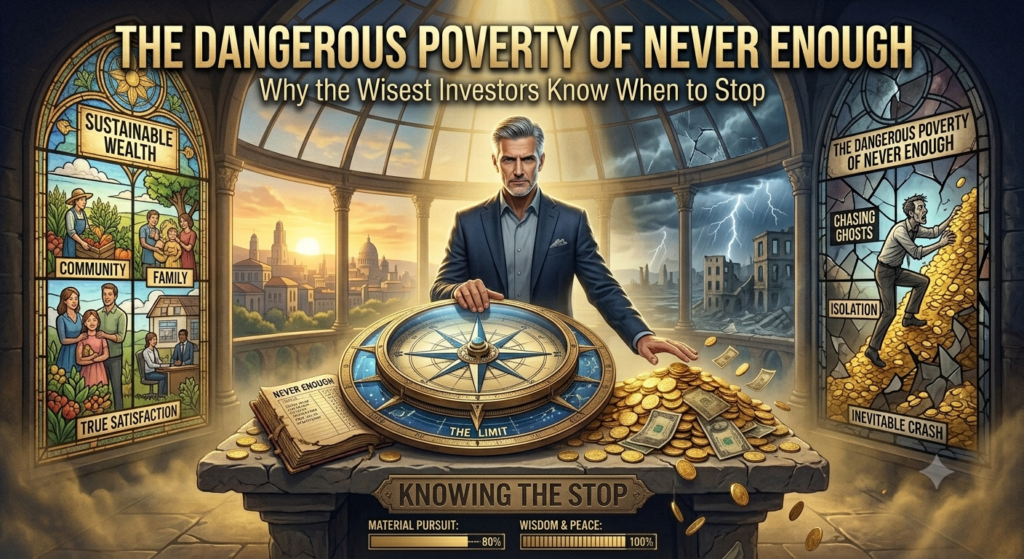
There is a kind of poverty that money cannot cure. It is the poverty of endless appetite. It is the poverty of always needing more applause, more validation, more possessions, more superiority, more control. That poverty can live inside a mansion. It can wear designer clothes. It can sit in first class. It can own companies. It can trend online. But it is still poverty.
True wealth is not only in having more. True wealth is needing less of what does not matter.
At some point, wisdom must speak louder than appetite. At some point, peace must become more attractive than applause. At some point, family must matter more than status. At some point, your name must matter more than a deal. At some point, your freedom must matter more than fast money. At some point, you must look at life and say, “This is worth protecting.”
That point is called enough. There comes a point in life called enough, and enough is not the death of ambition but its maturity. It is the moment ambition bows to wisdom, when wealth begins to grow a soul, and when a person finally understands that not everything profitable is worth pursuing. It is the point where you stop risking what is priceless for what is merely profitable. So build, invest, dream, expand, work, learn, and take intelligent risks—but never forget that some things should never be sacrificed on the altar of more: your reputation, your freedom, your family, your friends, your happiness, and your peace. Real wisdom lies in knowing when to stop, when to say no, when the next opportunity is not a blessing but a disguised trap, and when you already have enough.
Because the man who knows enough may not own everything, but he has something many rich people are still begging for: rest.
Subscribe to Naija Street Matters for regular news update and click on the Whats-app green button below to join our community.