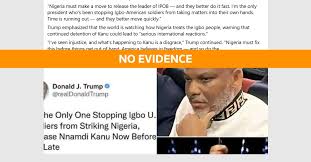
In the past 24 hours, social media platforms across Nigeria have been flooded with a viral screenshot claiming that former U.S. President Donald Trump demanded the release of Nnamdi Kanu, the detained leader of the Indigenous People of Biafra (IPOB). The alleged statement, shared widely on X (formerly Twitter) and Facebook, purportedly shows Trump expressing support for Kanu’s “unjust imprisonment.” However, after careful verification, no credible evidence supports this claim. Reuters and other international fact-checking outlets have confirmed that Trump never made such a statement, and there is no record of it on any of his verified social media pages or official press releases.
The viral post, which appeared to mimic the format of Trump’s official campaign account, included his signature tone and phrasing, leading many users to believe it was authentic. Yet, a deeper look reveals multiple red flags: the typography does not match Trump’s official posts, the screenshot lacked timestamps, and there was no corresponding announcement on his verified channels such as Truth Social or Trump Save America. Fact-checkers traced the first appearance of the image to a Nigerian-based Facebook page known for political satire and misinformation. From there, it spread rapidly across WhatsApp groups and pro-Biafra forums.
The situation underscores the growing challenge of disinformation in Nigeria’s digital space, particularly regarding sensitive political topics like Biafra and the detention of its leader. Nnamdi Kanu’s case has long stirred strong emotions, and rumours surrounding international involvement often gain quick traction among his supporters. But such unverified stories can heighten ethnic tension and fuel distrust in legitimate legal and diplomatic processes. Analysts warn that misinformation of this kind not only distorts public perception but also undermines serious advocacy efforts for human rights and political reform.
It is worth noting that Donald Trump has made no recent official comment about Nigeria or Biafra. His public statements and campaign agenda remain focused on U.S. domestic issues ahead of the 2026 midterm elections. The U.S. Department of State has also issued no statement supporting or condemning Nigeria’s handling of the IPOB leader. This confirms that the viral screenshot is fabricated content, part of a growing trend of politically charged digital manipulation aimed at stirring online engagement and division.
This fact-check serves as a reminder of the importance of media literacy in the age of social media virality. Nigerians are encouraged to verify any politically sensitive news from reputable outlets such as Reuters, AFP, or Premium Times before sharing. As the election season approaches, false narratives will only multiply, and it is up to both media professionals and citizens to guard against them. Truth, not trend, must lead the conversation.