- How Smart People Win in Life, Business, and Investing Without Gambling Blindly
- The Dangerous Difference Between Risk and Recklessness: Why Your Financial Future Depends on Knowing the Odds
Every major decision in life is a bet.
Choosing a career is a bet. Starting a business is a bet. Saving money is a bet. Investing is a bet. Borrowing money is a bet. Marrying someone is a bet. Relocating to another city or country is a bet. Even doing nothing is a bet—because while you are waiting, inflation, time, competition, and opportunity are moving. The problem is not that life is full of risks.
The problem is that many people are playing the game of life without understanding the odds.
Some people call it luck when others succeed. But many times, what looks like luck is actually positioning. What looks like sudden breakthrough is often years of preparation meeting one calculated opportunity. What looks like courage may be disciplined risk-taking. What looks like wealth may be the reward of someone who understood the downside, measured the upside, and moved before the crowd became comfortable.
Life is about playing the odds, but we all think about odds differently. The fearful person sees risk and avoids action. The reckless person sees reward and ignores danger. The wise investor sees both risk and reward, then calculates before acting. The poor thinker waits for certainty. The wealthy thinker moves with informed probability.
That is the difference.
Playing the odds does not mean gambling blindly. It does not mean throwing your money into every investment because someone shouted “opportunity.” It does not mean borrowing money to chase hype. It does not mean believing every “double your money” promise because your condition is hard and your hope is hungry.
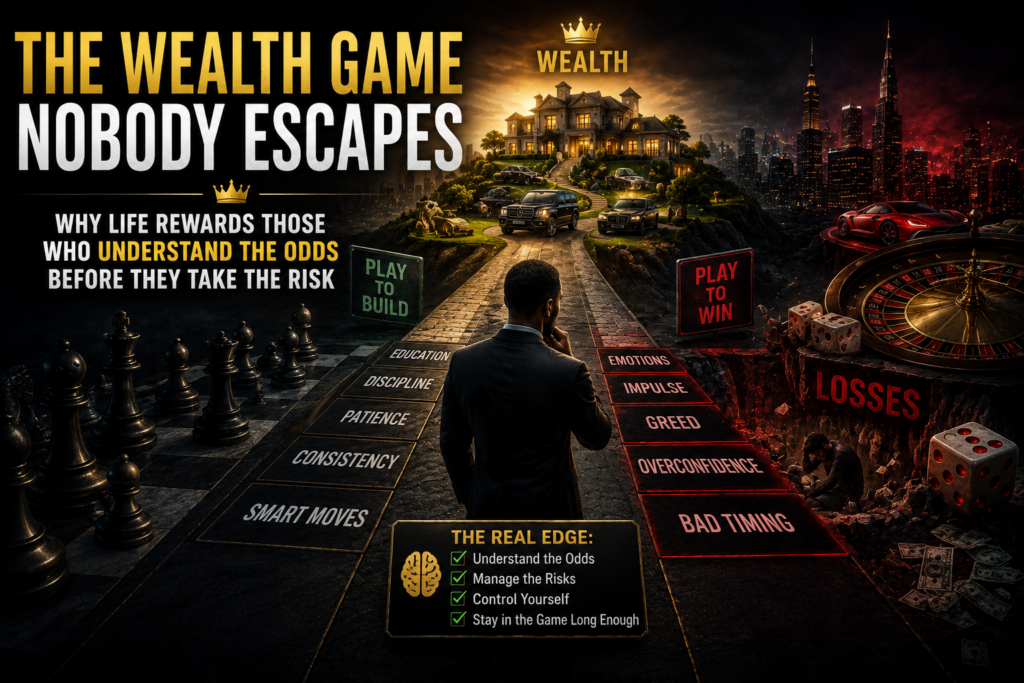
Playing the odds means making decisions based on probability, preparation, information, timing, discipline, and risk control.
It means asking: What can I lose? What can I gain? What is the probability of success? What happens if I am wrong? Can I survive the downside? Is this decision based on wisdom or emotion?
Those questions are not just financial questions. They are life questions.
A man who keeps all his money in a savings account because he is afraid of investing may feel safe, but he may not understand the odds. If inflation is rising faster than his interest, his money is not standing still; it is quietly losing purchasing power. He may not see the loss as an alert on his phone, but the loss is happening every time food, transport, rent, school fees, and building materials become more expensive.
That is why safety without understanding can become another form of risk.
On the other hand, a woman who puts all her savings into a business she has not studied is not brave. She is exposed. If she starts selling products without understanding customer demand, pricing, logistics, cash flow, competition, and marketing cost, she is not playing the odds intelligently. She is hoping emotion will do the work of research.
Hope is not a strategy.
Faith is powerful, but faith must not be confused with financial carelessness. Optimism is good, but optimism without planning is dangerous. Courage is admirable, but courage without risk control is recklessness wearing fine clothes.
The richest people do not avoid risk. They understand risk. They price risk. They reduce risk. They distribute risk.
That is why serious investors diversify. They do not put everything into one stock, one land deal, one agricultural scheme, one digital business, one currency, or one friend’s promise. They spread risk because they understand that even good opportunities can go wrong. A good company can have a bad year. A real estate location can delay in development. A business can suffer from regulation. A tenant can default. A crop can fail. A market can turn against you.
Diversification is not fear. Diversification is wisdom.
But diversification alone is not enough. The wise investor also studies expected value. Expected value simply means asking: If I take this kind of decision many times under similar conditions, will I likely come out ahead?
That is a powerful way to think.
If someone offers you an investment promising 30% monthly return with no risk, your emotions may get excited, but your brain must wake up. Ask: Where is the profit coming from? What business produces that return consistently? Is it regulated? Can I withdraw? Who has verified it? What happens if new investors stop coming in?
Many Ponzi schemes look attractive because they present sweet odds. They show reward loudly and hide risk quietly. They use testimonials, urgency, greed, and social pressure to weaken judgment. They tell people what their poverty wants to hear: “This is your chance.” But when the scheme collapses, the same people who ignored probability begin to shout betrayal.
The truth is bitter: when promised returns look too good to be true, the odds are usually not in your favour.
Compounding is another place where people misunderstand odds. Many Nigerians want fast money, but wealth often grows slowly before it grows suddenly. A person who saves and invests consistently may look slow in the beginning. But time rewards discipline. Small gains reinvested over years can become powerful because money starts producing more money.
Compounding is boring at the start and beautiful at the end.
This is why patience is not weakness in investing. Patience is a profit multiplier. The investor who understands compounding does not panic because the result is not immediate. They know wealth has seasons. There is planting, watering, waiting, and harvesting. The person who uproots the seed every week to check growth will never build a forest.
In business, odds also matter. Before you open a shop, ask: Are customers already buying this product? Can I reach them? What is my margin after logistics, rent, packaging, staff, power, and marketing? Can I survive three slow months? What makes me different? What happens if competitors reduce price?
A business owner who asks these questions is not negative. He is intelligent.
In investing, risk versus reward must be understood clearly. Not every risk is worth taking. A risk is attractive when the upside is meaningfully larger than the downside and when you can survive being wrong. This is called asymmetric opportunity.
For example, investing a small, controlled amount in a promising digital business after research may be reasonable if the upside is large and the loss will not destroy you. But borrowing heavily to enter the same business because someone else is making money is dangerous. The opportunity may be real, but your structure may be foolish.
The same applies to borrowing. Borrowing money for consumption is different from borrowing money to build assets. Borrowing to buy status can enslave you. Borrowing to fund a carefully studied productive asset may increase your capacity. The question is not merely “Can I borrow?” The question is: “Will this debt create income or consume income?”
That is how wealthy thinkers reason.
Poverty often trains people to fear risk. This is understandable. When you have suffered lack, every loss feels dangerous. You become protective of the little you have. You avoid decisions that may expose you. You wait for certainty because you cannot afford another wound.
But here is the tragedy: waiting for certainty can keep people permanently small.
Wealth, on the other hand, often teaches people to manage risk. A wealthy thinker does not ask, “How can I avoid all risk?” He asks, “Which risks are worth taking, how do I reduce the downside, and how do I position for the upside?”
That is a different mind.
No investment is 100% certain. Treasury bills have risk. Stocks have risk. Land has risk. Business has risk. Agriculture has risk. Cash has risk. Even doing nothing has risk. The goal is not to find a risk-free life. The goal is to build a risk-wise life.
Ignorance is usually more dangerous than calculated risk.
When you do not understand money, every opportunity looks either too dangerous or too sweet. When you understand money, you begin to separate noise from signal. You know when to say yes. You know when to say no. You know when to start small. You know when to scale. You know when to protect liquidity.
Liquidity simply means having access to cash when you need it. Many people are asset-rich but cash-poor. They own things, but they cannot respond to emergencies or opportunities. A wise investor does not lock every naira away. He keeps some liquidity because opportunity often respects the prepared.
Emotional discipline is the final battlefield.
People lose money not only because they lack information, but because they cannot control fear and greed. Fear makes them avoid good opportunities. Greed makes them enter bad ones. Pride makes them refuse advice. Shame makes them hide mistakes. Impatience makes them abandon process.
The market, business, and life all punish emotional foolishness.
Before any major financial decision, pause and interrogate yourself. Am I acting because I understand the odds or because I am desperate? Am I investing because I have researched or because people are making noise? Am I borrowing because this will build capacity or because I want to appear successful? Am I saving because I fear the future or because I respect it? Am I taking this risk because it is wise or because I want fast escape?
Those who build wealth intentionally do not wait for perfect certainty. They gather information, prepare themselves, manage the downside, and move with informed probability.
That is how life works.
The farmer who plants does not control the rain, but he understands the season. The trader who imports does not control exchange rate, but he studies demand. The investor who buys stocks does not control the market, but he studies value, timing, diversification, and patience. The entrepreneur does not control customers, but she tests offers, listens to feedback, and improves.
Nobody controls everything. Winners simply control more of what can be controlled. So stop waiting for a world where every outcome is guaranteed. That world does not exist. Stop calling every risk dangerous when your current condition is already risky. Stop confusing prayer with preparation. Stop confusing courage with carelessness. Stop confusing optimism with financial blindness.
Life is about playing the odds.
The poor remain trapped when they fear every risk or chase every promise. The reckless crash because they see only reward. The wise rise because they study risk, respect consequences, and position themselves where the upside is greater than the downside.
Your future will not be shaped only by what you desire. It will be shaped by the odds you understand, the risks you manage, the emotions you control, and the opportunities you are prepared to take.
The next level of your life may not require a miracle. It may require better judgment.
Powerful Call to Action
Think before you move. Learn before you invest. Save before you speculate. Diversify before you overcommit. Manage risk before you chase reward. Build wealth intentionally, not emotionally. The odds will never be perfect.
But with wisdom, discipline, preparation, and patience, you can make better decisions, take better risks, and position your life where possibility begins to work in your favour.