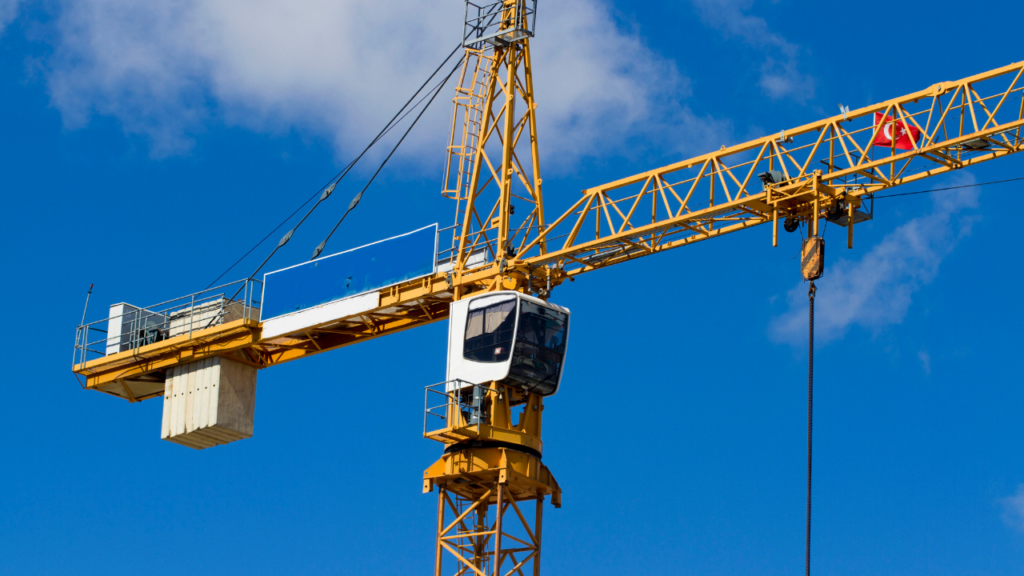
Companies prefer to use building structures and elements assembled elsewhere, such as concrete, for smaller projects that require high volumes of concrete. Transportation equipment, such as concrete pumps, earthmovers, cranes, lifts, hoists, and material handlers, is crucial for productivity. Cranes are the only conspicuous equipment during the actual construction process, as they play a significant role in vertical and horizontal transportation processes.
In urban spaces, there is usually not much space for production equipment, so cranes provide the ability and flexibility of accessing smaller sites and occupying a limited stationary area. Cranes also reduce the time it takes to transport materials from one point to another, as they can lift materials and deposit them on the other side without wasting time trying to navigate around barriers.
There are several types of cranes, each depending on the work they are meant to do
Crawler cranes are full revolving cranes mounted on an undercarriage with continuous parallel tracks, providing mobility and stability. They can move on site, require little setup, and reinforce stability. However, their heavy weight makes them expensive to transport and disassemble for transport. Hydraulic truck cranes are vehicle-mounted cranes with three control and power arrangements, making them mobile and suitable for short periods of time.
Lattice-boom cranes are similar to hydraulic cranes but have a suspended cable acting as a compression component rather than a bending component. They are lightweight, have additional capacity for lifting, and can be used for short periods. However, they take longer to assemble and disassemble for transport and are expensive to assemble and disassemble since they need the aid of another crane.
Rough-terrain cranes are mounted on an undercarriage with four large rubber tires, designed to pick and carry loads on rough terrain. They operate at a lower cost but are slow due to their large size. All-terrain cranes have an undercarriage that allows them to travel on all terrains and at a higher speed. They have four wheel-drive, steer, and higher ground clearance, with two cabs each with different functions.
Floating cranes are mounted on barges or pontoons and bear similarities to cranes mounted on undercarriages. They are mostly used in the construction of bridges and ports, transporting bridge sections and recovering sunken ships. However, they can only be used in offshore projects due to their operation on water.
Railroad cranes are mounted on undercarriage cars with rail wheels, used for train recovery, loading goods, and maintenance work. The advantage of these cranes is that the train’s wheels can be removed, and the crane mounted on a static crane is easier to maintain. However, they have limitations, such as a free standing height requirement and cannot be used for maintenance work on specific tracks.
Criteria for choosing a crane for construction work
- Construction type – A crane should be chosen according to the construction type. For example, tower cranes are more appropriate in the construction of tall buildings while a floating crane is more suitable for offshore projects.
- Time – A crane which will carry a heavier load at a faster time rate.
- Stability – Since the crane will be moving large loads constantly, a stable crane should be chosen.
- Multiple uses – Cranes that can be sued for multiple purposes should be selected so as to reduce the cost of hiring more cranes.
- Cost – Cost of cranes should be considered. For example, if a company has multiple projects in different terrains they should employ the use of an all terrain crane instead of a rough terrain crane