Think of a streaming service they want many people to subscribe and stay subscribed. One trick they use is default settings: when you sign up, you’re automatically set to renew your subscription unless you opt out. Many won’t turn off auto-renew they don’t want to think about it.
Their power comes from scarcity and urgency people hate missing out. feeling a product might run out makes us decide faster, sometimes with less thought. For many businesses, this tactic raises conversion (number of people who buy) significantly.
Inside companies, behavioral economics shapes decisions too, imagine a tech startup with a failing project.
The leader is hesitant to kill it, even though data show it’s draining resources and customers don’t want it. Why? Because of loss aversion. The pain of admitting “this was a bad bet” weighs more heavily than the potential gain from redirecting resources. So the project lingers, costing more and more. Businesses that recognize this bias build checkpoints—review points where continuation of projects requires fresh data and justification. That helps avoid holding on to sunk costs.
Or anchoring: a company sets a high sales target early on, maybe based on optimism or a few good months. That number becomes the benchmark. Even when reality shifts market slows, competition increases everyone still compares to that original anchor. Budgets and resource allocation get stretched to chase that initial goal. Businesses that train leaders to question anchors, to regularly update them, tend to respond more flexibly to change.
Some businesses design product tiers in ways people can’t resist. For example: Basic, Standard, Premium. Basic is too light, Premium is too pricey, Standard is “just right.” Because Standard seems balanced, many pick it. But the tier layout is intentional; the contrasts are designed to push people toward a middle option, which is often more profitable than selling mostly premium or mostly basic.
Then there’s social proof. If you see “Most popular choice,” or “Top seller,” you’ll tend to follow the crowd. Etsy, Amazon, music services all highlight what others are buying, or what’s trending. Human beings don’t like feeling they’re missing what everyone else sees as good.
What this means: business strategy isn’t just “what’s the logical best move?” It’s “how will people feel about options? What will they compare to? What fears or habits might block choices? What settings will they ignore or accept by default?” Companies that understand these subtle forces build pricing, design, marketing, and internal decision processes that align with how people really think.
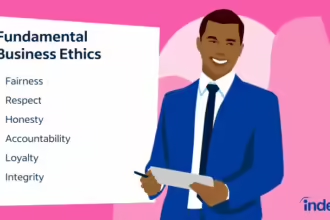
But there’s a caution: use these insights with respect. People resent feeling manipulated. If urgency or defaults are overdone, trust erodes. Internal fairness matters if employees feel bias or pressure built around psychological tricks rather than merit, morale suffers.
In the end, behavioral economics reminds us: humans are messy decision-makers. Not because they’re dumb, but because thinking perfectly rational is hard. Businesses succeed when they don’t fight that reality. They succeed when they build systems, choices, options that work with human nature—instead of pretending it doesn’t exist.