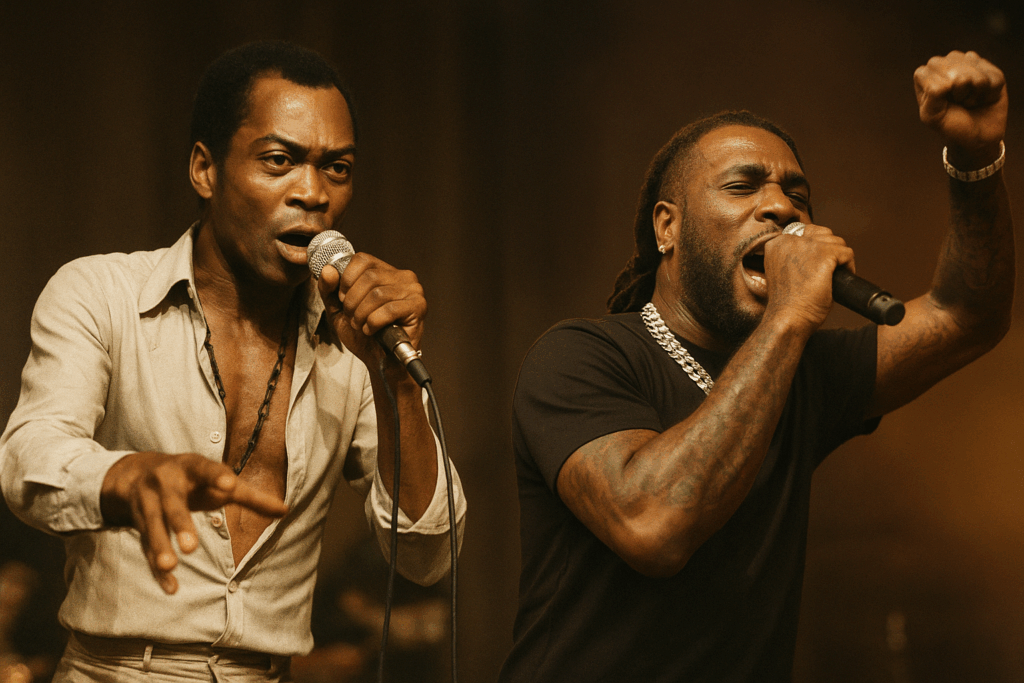
For Africans, music has never just been about rhythm or entertainment. It has always doubled as a weapon, a protest banner, and a mirror of identity. From Fela Kuti’s firebrand activism in the 1970s to Burna Boy’s Grammy-winning global reach today, the stage has often been less about applause and more about accountability.
Fela, the godfather of Afrobeat, wasn’t just a musician, he was a movement. His records, from Zombie to Coffin for Head of State, mocked dictatorships, exposed corruption, and challenged the wreckage of colonial rule. The Kalakuta Republic, his self-declared commune, wasn’t merely a home; it was a living act of defiance against Nigeria’s oppressive system.
Decades later, Burna Boy carries that torch in a different world. His Afrofusion doesn’t only light up clubs and playlists; it sharpens political memory. Tracks like Another Story revisit Nigeria’s colonial scars, while Monsters You Made points a finger at global and local systems of oppression. And when movements like #EndSARS erupted, Burna’s voice wasn’t just in the music, it was in the streets, on stages, and in the conversations shaping a generation.
The thread between the two is courage. Fela put his life and freedom on the line to speak for the voiceless. Burna, navigating fame in a digital and global era, continues to channel the raw frustrations of young Africans demanding change.
Their stories prove a simple truth: in Africa, music is never just background noise. It is protest, power, and prophecy; a beat too loud for authority to ignore, whether in Lagos, London, Accra, or Atlanta.