
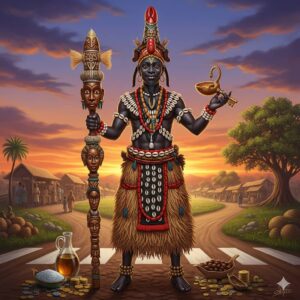
Èsù is not a myth, and certainly not a mystery. Before we rush to call him this or that, we need to pause and ask: what does his very name mean? Because in Yoruba cosmology, names are not just labels, they are definitions, essences, truths.
According to Yoruba pantheology, the central verb in the name Èsù is “sù” it means to round, to mould, to give a spherical form. Think of the Yoruba words òsùpá (moon), òsùkà (anthill), òsù (month). Wherever you find “sù,” there is the idea of something circular, something shaped. So when we say Èsù, we are speaking of one who moulds, who balances, who rounds off rough edges. He is the deity who shapes humans, beating down excesses until balance is restored. ò má tọ́wọ́ ọmọ ẹ́ bo aṣọ. Èsù is balance itself. If you ever try to disrupt the harmony of the universe, it is Èsù who curbs your hand and moulds you back into line.
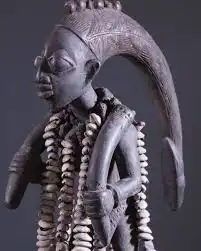
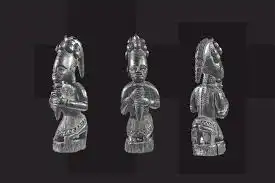
Another name for him is Èlégbàrà it means the one whom Olódùmarè entrusted with power to maintain law and order. Picture him as a law enforcement agent, a police officer, a lawyer, and a judge combined. He delivers the outcome of people’s actions, whether good or bad.
Now, Yoruba cosmology tells us that Èsù performs many roles, but for clarity’s sake, let us focus on three major ones:
- Èsù enforces law and order.
- Èsù carries people’s prayers to Olódùmarè.
- Èsù interprets and enforces the verdict of Ifá divination.
1. The Enforcer of Law and Order
When it comes to justice, Èsù does not play. That is why he is eulogized:
“Oba elẹ́kùn sunkún kerú, ó bá elẹ́kùn…
Elẹ́kùn sunkún, Láróyè ń sù ẹ̀jẹ̀…”
Take this example: someone hurts you, you cry for two hours and report to Èsù. Because you cried, he doesn’t just shed tears, he sheds blood for twenty-one days on your behalf until you beg him to stop. He is deeply empathetic and cannot stand injustice. But after crying with you, he investigates. If he finds the offender guilty, ò ti tán fún ẹeni na ooo. If Èsù judges you guilty, no god, not even Olódùmarè will save you, because Èsù’s authority comes directly from Him.
Èsù is impartial. He punishes his own devotees when they err, without favoritism. That is why his shrine is never kept inside a house; Èsù is nobody’s best friend. He cannot be bribed, cannot be silenced, cannot be framed. He is too transparent to keep secrets, a divine whistleblower. Hence the saying: Èsù kò ní ìwà, a kò ìlé rè síta. Bring him into your home, clothe him, feed him, the day you commit adultery, your secret will scatter across the marketplace. That’s Èsù: he bro-codes with no one when balance is broken.

This is also why he is called Onílè Òrìtà it means the Lord of the Crossroads. At every turning point in life, every decision-making moment, Èsù is present. Whether you choose to do good or evil, he witnesses it and ensures consequences follow. The Yoruba say: Ìyàn ogun ọdún a máa jó ni l’ówó tẹ́fẹ́-tẹ́fẹ́, the consequences may delay, but they will come. That is Èsù in action.
If Èsù were alive today, he would probably be a journalist or blogger as a side hustle, because he documents everything, he is the internet that never forgets.
2. Carrier of Prayers
Another major duty of Èsù is carrying prayers and sacrifices to Olódùmarè. Because of this, he is in cordial relationship with all other deities. Every prayer to Òrìṣà passes through him. Think of the Òṣun-Òṣogbo Festival, thousands gather to pray. Èsù must be present to deliver those petitions. Without him, prayers would hang unanswered. This alone shows he cannot be Satan. Satan in Christian theology opposes God, but Èsù works directly with Olódùmarè to ensure humans connect with the divine.
3. Interpreter of Ifá
Èsù also interprets and enforces the verdict of Ifá divination. Without him, divination does not manifest. He carries and empowers the èbó that aligns people with their destinies. Every Babaláwo knows this: Èsù is the enforcer, the indispensable messenger. His role is too central to human existence for him to be reduced to “the devil.”
And let’s be honest, if there is any deity in Yoruba cosmology with dark tendencies, it is not Èsù. Ògún, god of iron and war, rejoices at the sound of battle. To us, war means death and destruction; to Ògún, it is glory. Ṣàngó, god of thunder, burns with rage so much that his body heats up and produces fire that can burn an entire village to ruins in seconds. Even Òlókùn is no-nonsense god, like a deity with divine OCD: don’t soil my waters, don’t stain my white cloth. Every deity has flaws. Èsù’s own flaw is that he is a tester, a jester, but never the devil.
How Did Èsù Become Satan?
This is where history comes in. The demonisation of Èsù is largely tied to the 19th-century Bible translation by Bishop Samuel Ajayi Crowther. In seeking a Yoruba equivalent for the Christian concept of Satan, he chose “Èsù.” It was a tragic mistranslation. Satan has no equivalent in Yoruba cosmology, none at all. The same way you cannot rename Òrúnmìla, Ṣàngó, Oya, Sanpona, Oba, Osun, you cannot equate Èsù with Satan.
Think about it: nobody translates pizza into Yoruba, or calls spaghetti a Yoruba name. Yet, our own deities were forcefully given foreign identities. Colonial religion had to demonise our gods to replace them, making our ancestors believe their ways were evil. Ajayi Crowther’s work was brilliant in many ways, but this part left a wound that still confuses millions today.
The only real similarity between Èsù and Satan is that both punish wrongdoers. But their intentions differ: Èsù punishes to restore balance, to mould people back into shape. Satan punishes to destroy, to condemn eternally. Èsù rewards goodness as well as punishing evil. Satan, on the other hand, has no relationship with the upright. Satan rules hell, Esu rules with Olodumare.
It is time we wake up from colonial slumber. Èsù is not Satan. He is balance. He is justice. He is the divine messenger who ensures that the universe stays in shape.