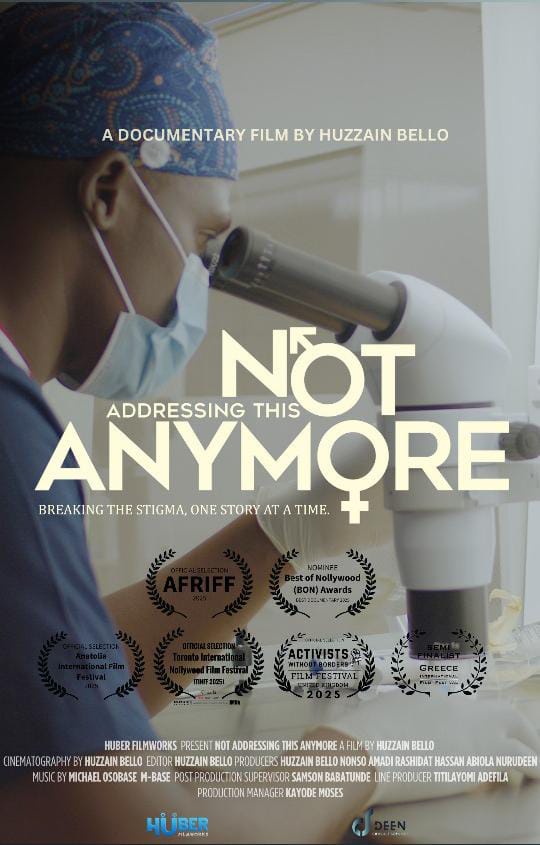
In a continent where motherhood is often equated with womanhood, and fertility is seen as a divine measure of worth, the silence surrounding infertility has become deafening. Through his groundbreaking documentary, Not Addressing This Anymore, Nigerian filmmaker Huzzain Bello breaks that silence; boldly, beautifully, and compassionately.
This compelling film, which made its Nigerian debut at the African International Film Festival (AFRIFF), has continued to travel across continents, earning international recognition following screenings in Toronto, Greece, and Turkey. Beyond its visual brilliance and storytelling depth, the documentary stands as a mirror to society, urging audiences to confront the complex realities of infertility and the untold pain it inflicts on millions of families.
A Story Rooted in Loss, Told with Love
The heart of Not Addressing This Anymore beats with a deeply personal rhythm. Huzzain Bello’s motivation for this work stems from tragedy ; the loss of his sister-in-law eight years ago, a woman who longed for motherhood but never held her own child. Her passing became the seed of a story too heavy to remain unspoken. Huzzain, wearing the hats of producer, director, and cinematographer, channels that grief into purpose, crafting a film that not only mourns a life lost but also advocates for countless others enduring silent suffering.
“This documentary is not just a film,” Huzzain says. “It’s a reflection of reality, of the voices we ignore, the emotions we dismiss, and the stories that deserve to be told. Infertility tests the body, but it’s society that tests the soul.”
Beyond Biology: A Pan-African Examination of Infertility
Infertility is not a one-dimensional issue, and Huzzain ensures that his film reflects that complexity. Not Addressing This Anymore moves beyond medical definitions to explore the spiritual, emotional, mental, financial, and social implications of infertility within African society.
From quiet hospital rooms to spiritual altars and family gatherings, the documentary captures a wide emotional spectrum, the pain of waiting, the humiliation of judgment, and the heavy silence that follows repeated loss.
Each frame tells a story, of women blamed for what biology denies, of men burdened by cultural expectations, and of communities that weaponize motherhood as a standard for respect.
1. The Medical Reality
Doctors and fertility specialists interviewed in the documentary demystify infertility, revealing causes ranging from hormonal imbalance to reproductive health complications. Yet, access to care remains a luxury few can afford, a reflection of the continent’s wider health inequality.
2. The Emotional and Mental Toll
Viewers witness the psychological scars left by years of stigma, social isolation, and self-blame. Huzzain paints a raw portrait of grief, depression, and anxiety that often go unacknowledged in discussions about reproductive health.
3. The Spiritual and Cultural Burden
In many African communities, infertility is still interpreted as a curse, spiritual punishment, or ancestral retribution. The documentary confronts these perceptions head-on, giving voice to women and men who have endured both religious manipulation and cultural condemnation.
4. The Financial Cost
The film exposes another layer of suffering, the financial strain of fertility treatments, herbal remedies, and endless consultations that drain family savings in the pursuit of conception.
A Moment of Recognition: AFRIFF and Beyond
When Not Addressing This Anymore premiered at AFRIFF 2025 at Landmark film cinema, the screening hall was filled with emotion. Audiences wept, applauded, and reflected. Among the distinguished guests in attendance were:
James Amuta – Filmmaker; Mrs. Maureen Emelie – Fertility Advocate and Author (who briefly shared her own story of longing for the fruit of the womb and the challenges she faced before becoming a mother of four); Sola Schullz Mogaji – Veteran Broadcaster and Music Connoisseur; Stephen Solademi author of Success on search and Olori Ambassador Dr. Omolara Fashola MacGregor – Diplomat and Humanitarian. Their presence underscored the film’s cultural and emotional relevance, bridging art, advocacy, and social consciousness.
The film’s international journey continues to attract accolades. It has screened at TINFF (Toronto International Nollywood Film Festival) and AFRIFF, was a Semi-Finalist at the Greece International Film Festival, officially selected at the Anatolia Film Festival in Turkey, and has been recently nominated for Best Documentary at the Best of Nollywood Awards. Additionally, it was shortlisted for the Social Impact Award at Activists Without Borders (UK), further solidifying its status as one of Africa’s most important advocacy-driven documentaries of the decade.
Following its screenings, international audiences have praised the film’s sensitivity, truth, and humanity, while local viewers describe it as “a much-needed cultural awakening.”
Cinematic Brilliance and Visual Poise
As a cinematographer, Huzzain’s visual storytelling shines through. His use of lighting, silence, and perspective evokes deep empathy without sensationalism. The camera lingers on faces, sometimes defiant, sometimes broken, allowing the audience to sit with the truth of their pain.
Through his lens, infertility becomes not just a subject but a character, one that haunts, questions, and ultimately humanizes. The score, minimalist yet haunting, enhances the intimacy of each testimony, guiding viewers gently through moments of despair and resilience.
Breaking the Stigma, Beginning the Conversation
Not Addressing This Anymore is not just a film, it is a movement. It challenges cultural assumptions that define womanhood by childbirth, urges healthcare institutions to provide better support, and invites society to replace ridicule with compassion.
The documentary dares to ask uncomfortable questions:
- Why is infertility still treated as a woman’s failure?
- Why is seeking medical help still seen as shameful?
- Why are families broken over something that should inspire unity and empathy?
These questions echo long after the credits roll.
The Legacy of the film
In confronting a theme many prefer to ignore, Huzzain Bello has created one of the most emotionally potent African documentaries in recent years; a women story told from the lens of a man. His storytelling bridges the personal and the universal, the spiritual and the scientific, reminding viewers that the measure of humanity lies not in procreation but in compassion.
As Not Addressing This Anymore continues its international festival journey, it reaffirms the power of film, not just to entertain, but to heal, to educate, and to spark social transformation.
“Some stories hurt too much to tell. But the silence hurts even more.”
— Not Addressing This Anymore