
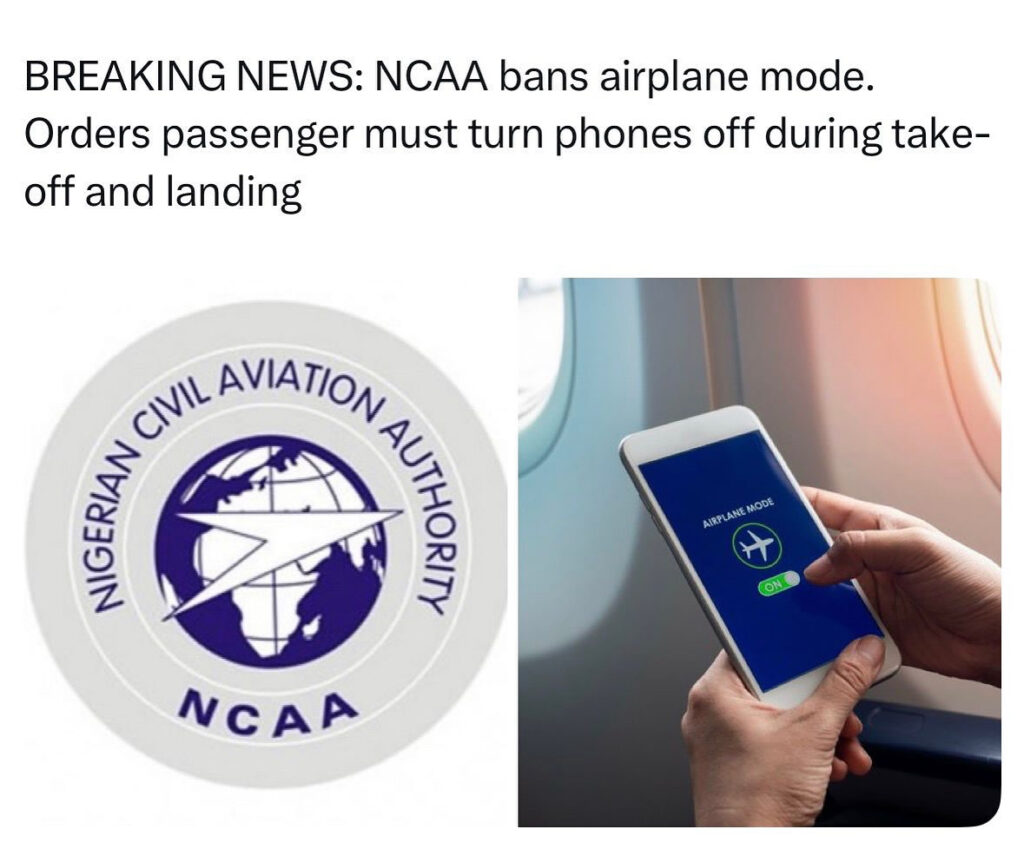
Nigeria’s Civil Aviation Authority (NCAA) has introduced sweeping new rules on the use of electronic devices during flights, announcing that passengers will no longer be allowed to keep their phones in airplane mode during takeoff and landing. Instead, all devices must be completely switched off.
The directive, announced Tuesday by NCAA Director General Capt. Chris Najomo, marks a significant departure from long-standing global practice, where airplane mode has been widely considered safe.
“This is about safety and standardization,” Najomo said in a statement. “The era of business as usual is over. Passengers must fully comply with the rule or face sanctions.”
Airlines Ordered to Update Manuals
Under the new regulation, Nigerian airlines are required to revise their security and operations manuals to reflect the ban on flight mode. Carriers must also seek NCAA approval for any prior variations to safety procedures.
The NCAA has pledged strict enforcement, warning that both airlines and passengers could face penalties for non-compliance.
Public Education Campaign
To raise awareness, the agency said it will roll out public service messages on radio and television, alongside mock emergency drills in Lagos and Abuja. Airlines will also be required to enhance staff training, particularly in passenger conflict management.
A Controversial Move
The move comes less than two weeks after a passenger incident involving Comfort Emmanson aboard an Ibom Air flight, where her refusal to switch off her phone in airplane mode sparked confrontation. That incident drew widespread media coverage and renewed concerns about passenger behavior and aviation safety in Nigeria.
Aviation experts, however, have questioned whether a total ban on airplane mode is necessary. Globally, most aviation regulators, including the U.S. Federal Aviation Administration (FAA) and the European Union Aviation Safety Agency (EASA), allow phones to remain on in flight mode.
What It Means for Passengers
For travelers in Nigeria, the new rules mean stricter compliance at boarding and during safety checks. Failure to power down devices during takeoff and landing could result in penalties.
The NCAA insists the measure is designed to reduce risks and ensure uniformity in the country’s airspace. Still, the decision is likely to ignite debate over whether Nigeria is moving in step—or against—the direction of international aviation standards.