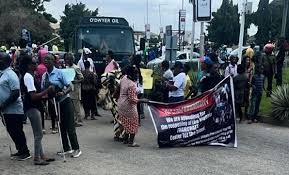
The morning rush to Murtala Muhammed International Airport (MMIA) is often a frantic dance of car horns, suitcases, and last-minute goodbyes. But on this day, it was different. The familiar blare of traffic was replaced by a stillness broken only by the sound of footsteps, slow, steady, and deliberate. A group of visually impaired men and women, canes tapping the tarmac, had taken to the access road, blocking it completely. Their mission was simple in words but weighty in truth: to demand the reopening of their school, a lifeline that had been shut down without a future in sight.
As the sun climbed, the air filled with the tension of two worlds colliding, the urgency of travelers desperate to catch flights and the determination of protesters who could not afford to be invisible any longer. Cars idled in long, frustrated lines. Some passengers, luggage in tow, abandoned their vehicles entirely, walking the dusty stretch toward the terminal. It wasn’t just a traffic jam; it was a human bottleneck where frustration, sympathy, and curiosity met.
For the protesters, this wasn’t about making people late, it was about being heard in a city where the disadvantaged are often spoken over. Without their school, they were not just losing a place of learning; they were losing a space of belonging, dignity, and hope. In a society that already marginalizes the differently abled, the closure felt like yet another reminder that their struggles could be swept aside without consequence. Standing there on the road, they turned their absence from the school into an undeniable presence on Lagos’ busiest travel artery.
The confrontation didn’t end in chaos. A government minister eventually arrived, meeting the protesters face-to-face. Promises were made, discussions opened, and the crowd began to disperse. But whether this marked the beginning of real change or just another chapter in a cycle of neglect remained to be seen. For many in the crowd, hope was cautious, tethered to the reality that words on the roadside often take far too long to become action.
In the end, the protest was more than a disruption, it was a reminder of the invisible battles fought daily in Nigeria. It forced strangers to witness, if only for a few hours, the determination of those who navigate life without sight but with a vision for justice. And perhaps, for some stranded travelers that day, it was a quiet education in the fact that sometimes the road to where you’re going must be paused to clear the path for someone else’s journey.