
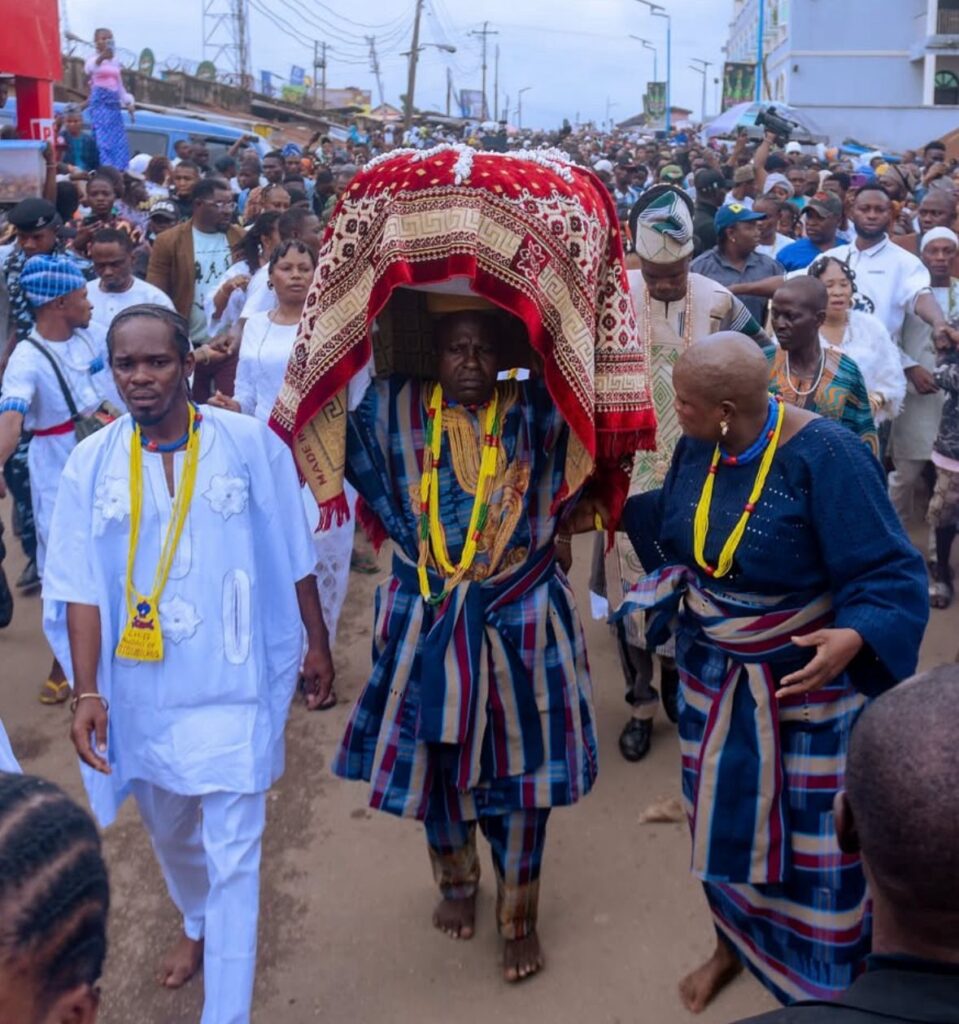
On the 8th of August, during this year’s Osun Osogbo Festival, a moment unfolded that drew a collective breath from the crowd. The Arugba Osun’s sacred carrier had been fasting for days, her young body prepared for the spiritual honor of bearing the Igbaaye, the revered calabash of offerings, from the palace of the Ataoja to the Osun Sacred Grove. But this year’s Arugba, began to falter under the weight of her duty both the physical burden and the spiritual gravity. Then, quietly but decisively, Baba Orisha also known as baba Osun, the grove’s spiritual custodian stepped forward. Without fanfare, he took the calabash into his hands and carried it the rest of the way.
To a casual onlooker, it may have seemed like nothing more than kindness. But for those steeped in the tradition, it was a deeply symbolic act as it is customary for the Baba Orisha to help the Arugba with her first carrying as she grows fully into her duties as the vessel of the Gods. The Arugba’s role sacred, feminine, and steeped in centuries of ritual is not one to be casually interrupted. Baba Orisha did not take her place; he preserved her honor. His gesture came from a place of cultural responsibility, the quiet understanding that in African tradition, “a child belongs to the whole village.” He showed that in a ceremony led by women, a man can offer strength without stealing the moment, supporting rather than overshadowing.
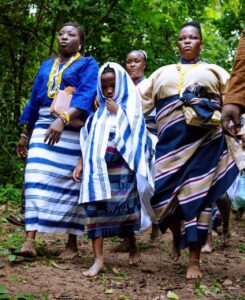
In truth, this was about more than festival protocol it was about fatherhood in its purest form. Not the kind defined only by blood, but by presence, protection, and discernment. Baba Orisha’s act modeled a kind of masculinity that is too often forgotten: the ability to notice when someone is struggling, to step in without ego, and to carry the load until they are ready again. In times where gender conversations can feel like battle lines, his example reminded us that in Yoruba culture, masculine and feminine forces were never meant to compete they were designed to complete each other.
The Osun-Osogbo Festival itself is a celebration of feminine power rooted in the worship of Osun, goddess of fertility, love, and flowing rivers. Women’s leadership is at its heart, yet its survival has always depended on both women and men. Baba Orisha’s simple act underscored this truth. For the young Arugba, this will not just be the year she completed her sacred duty it will be the year she learned that leadership does not mean carrying everything alone. That memory will follow her into womanhood: the image of a man who honored her space, yet stepped in when her strength waned.
Long after the drumming fades and the festival colors blur into memory, the image of Baba Orisha carrying the Igbaaye will remain. It will live on as a cultural parable a reminder that support is not weakness, and presence is power. It will speak to every father, elder, and leader: you are not diminished when you help carry the weight; you are elevated. And in a world where too many young shoulders bend under too much too soon, perhaps the most sacred thing any of us can do is notice, step forward, and bear the load just long enough for them to stand tall again.