
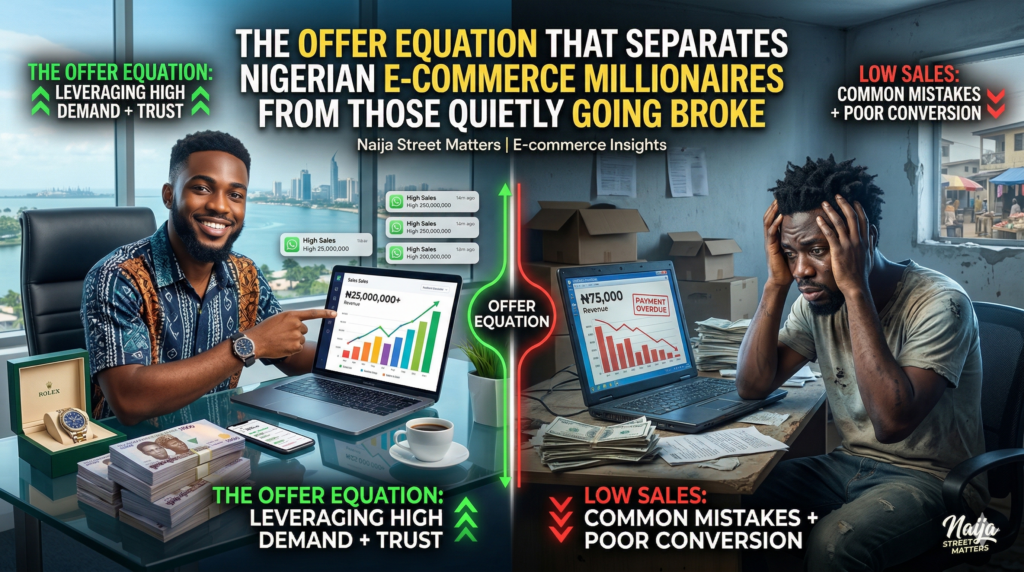
- Perceived Value vs Perceived Cost: The Brutal Truth Behind Every Successful (or Failing) E-commerce Offer in Nigeria
You launch your online store in Nigeria with high hopes. The product looks decent. You run some ads on Instagram and Facebook. Orders start coming in. On paper, it seems profitable.
Then the reality hits hard.
After paying for ads, delivery riders in Lagos traffic, packaging, returns, payment gateway fees, and the constant naira fluctuations, you discover you’re barely breaking even — or worse, quietly losing money on every single sale.
This silent bleeding is happening to thousands of Nigerian e-commerce businesses right now. The painful part? Most sellers don’t even realize it’s happening until their capital is gone and they’re forced to scale down or shut down completely.
The root cause is almost always the same: they created a weak or dead offer without understanding the most important equation in business.
It’s called The Offer Equation.
And once you understand it, everything changes.
Perceived Value must be significantly greater than Perceived Cost for people to buy.
If this equation is out of balance, no amount of beautiful photos, catchy captions, or desperate discounts will save your business. You will keep leaking money.
But when you get it right, customers buy fast, happily, and repeatedly — often telling their friends about you.
This is the difference between struggling and scaling in Nigerian e-commerce.
Let me break it down for you in clear, practical terms so you can audit your own offers today.
The 4 Drivers of Perceived Value
Perceived Value is not what the product actually is. It’s what the customer feels they are getting.
There are four powerful drivers:
1. Dream Outcome This is the transformation the customer believes they will receive. A woman buying the Monaloy Croc-Embossed Top Handle Handbag isn’t just buying leather and hardware. She is buying confidence, elegance, and the feeling of walking into any room and commanding respect. A young professional buying wireless earbuds isn’t buying plastic and wires. He is buying freedom from tangled cables, premium sound during long Lagos commutes, and the status of owning something that feels expensive.
2. Certainty How sure is the buyer that they will actually get the result? This is where trust comes in. Nigerian buyers are naturally skeptical because of past disappointments. Strong reviews, clear photos, video demonstrations, and social proof dramatically increase certainty.
3. Speed How fast will they get the result? In Nigeria, where patience is low and traffic is high, fast delivery is a massive value driver. Promising and delivering within 48–72 hours in Lagos and major cities can make your offer irresistible.
4. Ease How effortless is the entire process? From ordering to receiving to using the product — every extra step or complication reduces perceived value. Simple checkout, clear tracking, and easy returns increase ease.
When these four are strong, the customer feels they are getting an amazing deal.
The 4 Hidden Costs Buyers Feel
Perceived Cost is everything the buyer gives up or risks:
1. Price – The actual money 2. Time – Waiting for delivery, learning how to use it 3. Effort – Researching, comparing, ordering, following up 4. Risk of Failure – “What if it’s fake? What if it doesn’t fit? What if I waste my money?”
In Nigeria, the Risk of Failure feels especially heavy because money is hard-earned and trust is low.
The 3 Types of Offers
Based on the relationship between Perceived Value and Perceived Cost, every offer falls into one of three categories:
Dead Offer (Perceived Value < Perceived Cost) The customer scrolls past in less than one second. Example: A generic “fashion bag” sold for ₦18,000 with no clear photos, no reviews, no guarantee, slow delivery promise, and poor packaging. The buyer sees high risk and low value. They move on and you wasted ad money.
Weak Offer (Perceived Value = Perceived Cost) The buyer hesitates, asks for discount, or leaves the product in cart. Example: The same Monaloy handbag sold at ₦28,000 with decent photos but no bonuses, no strong guarantee, and average delivery time. The buyer thinks “It’s okay” but feels no urgency or excitement. Sales are slow and inconsistent.
Irresistible Offer (Perceived Value >> Perceived Cost) The buyer feels they would be stupid not to buy. They act fast. Example: The Monaloy Croc-Embossed Top Handle Handbag priced at ₦28,000 but presented with:
- Dream Outcome (elegance + confidence)
- High Certainty (real customer photos + reviews)
- Fast Speed (2–3 days delivery in Lagos/Abuja)
- Maximum Ease (simple checkout + tracking)
- Strong Guarantee (7-day money-back)
- Bonuses (dust bag + free monogramming)
- Urgency (limited stock at this price)
Suddenly ₦28,000 feels like an absolute steal. Customers buy quickly and happily.
The same principle applies to gadgets. A pair of wireless earbuds becomes irresistible when the offer stacks massive value against minimal perceived cost.
Small Changes, Massive Results
The beauty of the Offer Equation is that improving just one component can dramatically shift buyer behaviour.
Increase certainty with better photos and reviews — sales jump. Add a bold guarantee — returns drop and conversions rise. Create real urgency — people stop “thinking about it” and buy now.
In Nigeria’s tough economy, where customers are careful with every naira, getting this equation right is the difference between surviving and thriving.
Your Next Move
Go to your current offers today and audit them honestly against this equation.
Ask yourself:
- Is my Perceived Value clearly much higher than the cost?
- Which component is my weakest link?
- Am I accidentally creating dead or weak offers?
Fix it. Stack more value. Reduce perceived risk. Create urgency.
The sellers who master the Offer Equation in 2026 will be the ones building real empires while others quietly fade away.
Stop leaking money. Start building irresistible offers.
Your breakthrough is one well-structured offer away.
Ready to build offers that actually sell? Audit your current products using this framework today and watch your business transform.
Share your biggest “leaking money” struggle in the comments — I read every one.
For more no-fluff strategies like this, subscribe to Naija Street Matters.
Let’s build wealth that lasts.
— Business Apostle
Visit Naija Commerce for your fashion needs and everyday home items, Click on Shop Now!