
- They Can See Your Struggle, But They Cannot See Your Assignment
- Believe Again: Why Quiet Faith Is Often Greater Intelligence Than Loud Advice
The heaviest burden you will ever carry in this life is not the weight of your circumstances, but the weight of a borrowed doubt that was never meant to be yours.
If you are reading these words today with a heavy heart—downcast financially, discouraged in your business, confused about your investment decisions, rejected by your closest friends, misunderstood by your family, and tired in your relationships—listen to me closely. If you are frustrated by the relentless economic hardship of our time and you are standing on the very edge of abandoning your dreams because someone you deeply respect looked at you and said, “You cannot win,” “Don’t waste your time,” “Look for something else,” or “This thing will not work,” this message was written for your exact season of life.
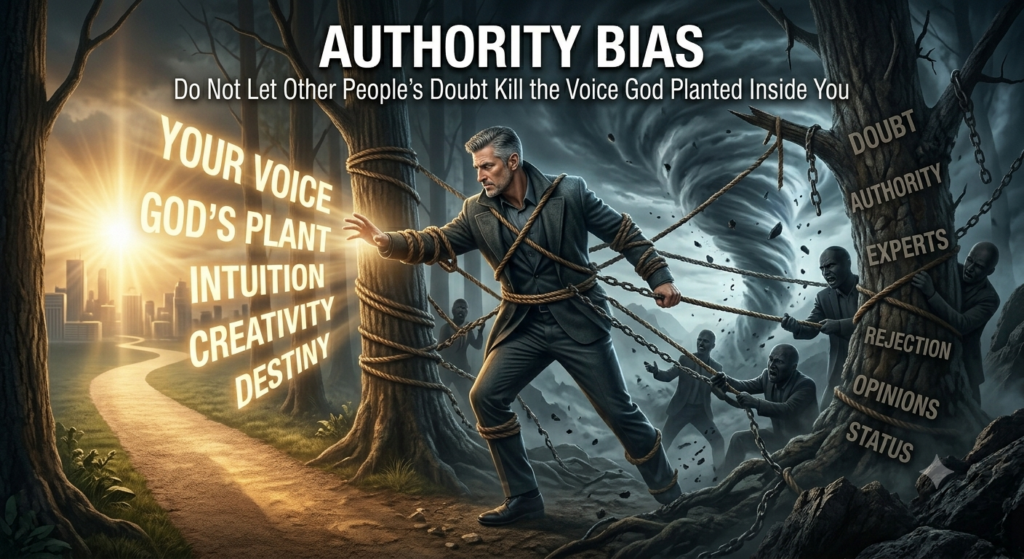
As we navigate the harsh realities of survival and ambition, there is a silent psychological trap that destroys more destinies than actual failure. It is called Authority Bias.
Authority bias is the profound human tendency to give too much weight to the opinion of someone perceived as more powerful, educated, experienced, successful, popular, spiritual, wealthy, or socially accepted. Because of another person’s opinion—because of the car they drive, the title they hold, or the age they have attained—you may slowly begin to doubt your own decision, your own lived experience, your own vision, and even the quiet conviction God has placed inside you.
Let us be very clear: advice is not evil. Counsel is incredibly important. Mentorship is deeply valuable, and true wisdom always listens. But the danger begins when a person’s external authority becomes louder than your internal clarity. The danger begins when someone who can only see your situation from the outside convinces you to abandon something you have carried in prayer, pain, preparation, sacrifice, and unbreakable conviction.
Only You Know What Is Truly Happening in Your Life
The fundamental flaw of human judgment is that people judge mostly by what is visible at the present moment. They look at your life and see your lack of money, your failed attempt, your small beginning, your current struggle, your temporary delay, your rejected proposal, your broken relationship, your low sales, or your seemingly unanswered prayer.
What they do not see is your full story. They do not see your private preparation, your hidden discipline, your spiritual conviction, your inner hunger, or the tears that have watered your sleepless nights. They do not see the seed God has planted in your spirit. Always remember this truth: “People can see your struggle, but they cannot always see your assignment.”
Current Evidence vs. Future Possibility
People will often advise you based strictly on your current evidence, not your future possibility. Most people speak only from what their natural eyes can see. If you are a young entrepreneur whose family is telling you to abandon your business because profit has not come quickly, they are judging your harvest season while you are still in your planting season. If your investment is temporarily down and your colleagues mock your plan because they do not understand long-term discipline, they are reacting to a moment while you are building a monument.
When a woman’s friends tell her she cannot rebuild after heartbreak, or when a married couple is judged by outsiders who only see the conflict but not the commitment, it is because human beings are wired to react to the storm. But the wise person must learn that today’s appearance is not always tomorrow’s reality. “A small beginning is not proof of a small destiny.”
Not Every Respected Voice is the Voice of Destiny
We must learn to separate respect from absolute surrender. Some people may be highly educated but entirely lack vision. Some may be massively successful in one area of life but completely blind in another. Some may love you sincerely—like a parent or a spouse—but advise you fearfully, wanting to protect you from pain. Some may have years of experience but absolutely lack faith.
When a worker is told by a manager not to apply for a higher role because “people like you don’t get there,” or when a student is discouraged by a teacher’s careless comment but still pushes forward, they are encountering this reality. Some people speak confidently but still fundamentally misunderstand your assignment. You must respect people, but you must never surrender your destiny to every confident opinion. “Not every confident voice carries wisdom for your journey.”
The Betrayal of Conviction
Authority bias can make you commit the ultimate betrayal: abandoning yourself. It is heartbreaking to watch brilliant people abandon businesses, stop writing books, leave school, end salvageable relationships, quit ministries, sell investments too early, reject life-changing opportunities, or bury their talents simply because someone they respect made them feel foolish.
The greatest tragedy is not that people doubt you. The tragedy is when their doubt becomes your own belief. “Do not borrow doubt from people who never paid the price of your dream.”
The Intelligence of Quiet Faith
We have been conditioned to believe that intelligence is loud. We think intelligence is noise, argument, debate, reaction, or public defense. But sometimes, real intelligence is quiet movement. Sometimes wisdom is hearing negative opinions, feeling the sting of rejection, and still continuing with absolute humility.
Sometimes strength is not proving people wrong with your mouth, but allowing time, discipline, prayer, strategy, and consistency to speak on your behalf. “Sometimes, faith in God and faith in your assignment is the highest form of intelligence.
You Do Not Need to React to Every Negative Opinion
When people tell you that you cannot win or that you are wasting your time, you do not need to fight them. You do not need to insult them. You do not need to sit down and explain your entire journey to people who have already judged the chapter they are currently seeing.
Silence is not weakness. Quiet progress is not confusion. “They may know the road, but only God knows your destination.” The best answer to doubt is not an argument; the best answer to doubt is disciplined, undeniable action. “You do not need to win arguments; you need to keep moving.”
Wise Counsel vs. Destiny-Killing Discouragement
You must develop the spiritual and psychological maturity to distinguish between correction that helps you improve and discouragement that drains your courage.
Wise counsel is a light; it gives clarity, asks probing questions, points out legitimate risks, suggests better strategies, and still entirely respects your agency. Destructive opinion, however, operates like a shadow. It shames you, frightens you, mocks your small beginning, kills your confidence, and pressures you to abandon your path without taking the time to understand your full story.
The Projection of Fear
Understand this deeply: the people who discourage you may simply be speaking from fear, not truth. When a person from a poor background is told to accept survival instead of pursuing greatness, that advice is often rooted in trauma.
People advise you from their own failures, their own disappointments, their poverty mindsets, their social conditioning, and sometimes, their jealousy and insecurity. They may not be wicked people. They may simply be projecting their limitations onto your possibilities. Their fear is completely real to them, but it does not have to become your prison. “Some people advise you from fear and call it wisdom.”
Many Great Destinies Looked Foolish at the Beginning
History is littered with the stories of people who looked foolish before they became formidable. The student who looked weak but later became excellent. The small trader who endured the mockery of the market and became a business mogul. The rejected lover who healed and built a beautiful, secure life. The entrepreneur who failed three times before striking gold. The investor who stayed disciplined when the masses panicked.
Early evidence can wildly deceive people. “The fact that they cannot see it does not mean God did not show it.”
Quiet Movement is a Powerful Form of Wisdom
When you are building something deeply meaningful, you must actively reduce your psychological need for public approval. Move quietly. Learn quietly. Pray quietly. Improve quietly. Save quietly. Invest quietly. Build quietly. Heal quietly. Let your results eventually make the loud announcement. “Do not let a loud opinion silence a quiet conviction.”
How to Recognize Authority Bias in Your Life
If you are wondering whether authority bias is currently hijacking your destiny, look for these critical signs:
- You abandon decisions immediately after someone important disagrees.You have no root in your own convictions.
- You trust another person’s opinion more than your own lived experience.You allow their theory to invalidate your reality.
- You feel guilty for believing in something others cannot see.You apologize for your own vision.
- You keep seeking permission from people who do not understand your path.You want a blessing from someone who cannot even see the road.
- You confuse confidence with wisdom.You assume that because someone speaks loudly and with certainty, they must be right.
- You silence your inner conviction because of someone’s title, money, age, popularity, education, or social status.* You allow fear-based advice to overrule prayer, preparation, facts, and personal clarity.
- You constantly explain your dream to people who are committed to misunderstanding it.
How to Listen to Advice Without Losing Yourself
You do not have to become arrogant or unteachable to survive authority bias. You simply need a filter. Here is how you navigate the counsel of others while protecting your own soul:
- Respect people, but do not worship their opinions.Honor their position, but guard your heart.
- Listen carefully, but test every counsel.Do not swallow advice whole.
- Ask: “Is this person informed about my full situation?”If they only know 10% of the facts, their advice is 90% assumption.
- Ask: “Is this advice coming from wisdom, fear, jealousy, love, or limitation?”Identify the emotional root of their words.
- Ask: “Does this counsel help me improve, or does it only make me afraid?”
- Seek guidance from people with both experience and understanding.Look for those who have navigated the storm, not just read about the rain.
- Pray for discernment.Let your spirit guide your mind.
- Study the facts.Let data inform your emotions.
- Improve your strategy where necessary.Use criticism to sharpen your sword, not to fall on it.
- Do not react to discouragement.Keep your emotional energy for building.
- Move quietly with faith, patience, discipline, and courage.
- Let time reveal what argument cannot prove.
Being doubted does not mean you are defeated. Being misunderstood by the people you love does not mean you are wrong. Being delayed in your business or your finances does not mean you are denied. Being small today does not mean you will be small forever.
People will always have opinions. Some will speak from a place of deep, protective love. Some will speak from crippling fear. Some will speak only from what their eyes can see right now. Some will speak from the bitter memory of what they failed to become.
But only you know the full, heavy weight of what God has placed in your heart.
Do not reject wise counsel, but absolutely refuse to surrender your destiny to every external voice that demands your attention. Listen, learn, pray, think, adjust your sails, and keep moving. Sometimes, the most profound real intelligence is not found in arguing with your doubters, but in having unshakeable faith in yourself, having unwavering faith in God, and quietly taking the very next step.
Protect your conviction. Test every opinion. Stop over-explaining your journey to those who refuse to see it. It is time to wipe your tears, block out the noise, and continue moving forward with faith, wisdom, humility, and fierce courage. Your future is too important to be abandoned at the altar of someone else’s doubt.