- The 'Safe Money' Illusion: Why Avoiding Market Volatility Will Guarantee Your Financial Ruin in Nigeria.
Today, we must confront the most deeply misunderstood concept in the entire Nigerian financial ecosystem. It is a concept that separates the street-smart billionaires from the millions of hardworking citizens who grind away for decades, only to retire in abject poverty.
If you ask the average Nigerian on the streets of Lagos, Abuja, or Port Harcourt what the secret to wealth is, they will give you a list of mechanical answers. They will tell you to save your money, start a business, invest in real estate, or buy stocks. They will talk about finding the perfect product to sell, mastering the algorithm, or securing a high-paying corporate job. But almost no one talks about the invoice.
We live in a physical world where the laws of commerce are universally understood. If you walk into a luxury car dealership on Victoria Island to buy a brand-new Mercedes-Benz G-Wagon, you already know there is a price attached. You do not argue with the dealer. You do not throw a tantrum when the invoice is printed. You understand that the luxury, the status, the safety, and the horsepower require a massive transfer of capital.
Yet, when it comes to the business of building a multi-million Naira investment portfolio or scaling a massive enterprise, we suddenly lose our collective minds. We want the financial equivalent of a G-Wagon, but we want it for free. We want the peace of mind that comes with generational wealth, the passive income that pays for our children’s education abroad, and the freedom to travel the world—but we refuse to look at the price tag.
As the Business Apostle, I am here to hand you the invoice.
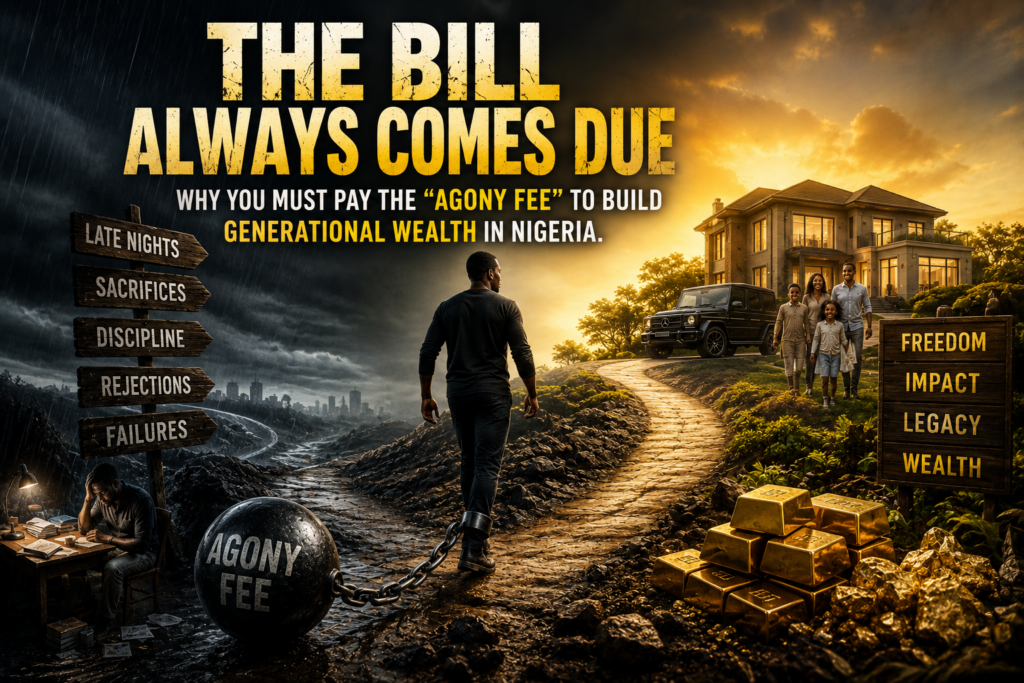
In investing, and in building any formidable business empire, you must aggressively identify the price of success. You must look it dead in the eye. That price is not paid in Naira, Dollars, or Pounds. The price of success is paid in the cold, hard currency of volatility, periodic loss, fear, and uncertainty, all playing out against the long backdrop of growth. If you are not willing to pay this exact price, the marketplace will aggressively reject you.
The “Safe Money” Trap: The Illusion of Avoiding the Toll Gate
Let us dissect the psychology of the modern Nigerian investor. We are a people traumatized by our economic environment. We have watched the Naira fluctuate wildly, we have seen banks collapse in past decades, and we have witnessed inflation ruthlessly eat away at the purchasing power of the middle class. Because of this trauma, the overarching financial goal for most Nigerians is “peace of mind.” We desperately seek investments that promise zero volatility. We want a guaranteed 10% monthly return with absolutely no risk. We want “sure odds.”
This psychological desperation is exactly why the Nigerian landscape is historically littered with the corpses of devastating Ponzi schemes and “get-rich-quick” frauds. The architects of these schemes understand human psychology perfectly. They know that you are terrified of volatility. So, they sell you a beautiful, impossible lie: wealth without the emotional price tag. They promise you a straight, upward line of profits without a single day of loss.
When you fall for these traps, or when you simply hide all your capital in a low-yield savings account to keep it “safe,” you are essentially trying to sneak into the amusement park without buying a ticket.
But the market is a ruthless enforcer of its own laws. If you refuse to pay the volatility fee upfront by investing in solid, fluctuating assets, the economy will force you to pay the “Inflation Penalty” on the back end. Your money might sit safely in a vault, never dropping in numerical value, but its actual buying power will bleed to death. You avoid the sudden 20% drop of a stock market correction, but you suffer the agonizing, slow death of a 30% annual inflation rate. There is no escaping the toll gate. You either pay the price of admission to grow your wealth, or you pay the penalty for hiding it.
Redefining the Pain: Volatility is a Fee, Not a Fine
To survive the Nigerian marketplace, you must undergo a radical paradigm shift. You must change the way your brain interprets financial pain.
When you are driving on the expressway and a LASTMA official pulls you over for beating a traffic light, you are issued a fine. A fine is a punishment for an infraction. It means you did something wrong. You are supposed to feel guilty, angry, and determined never to make that mistake again.
When you drive up to the Lekki-Ikoyi Link Bridge, you pay a toll fee. You are not being punished. You have done nothing wrong. You are simply paying the required cost of admission to access a faster, smoother, and more efficient route to your destination.
Most novice investors treat market volatility like a fine. When they invest capital into the stock market, crypto, or a massive inventory restock, and the market immediately takes a downturn, they panic. If their portfolio drops by 15% in a week, they feel a sickening drop in their stomachs. They assume they have made a terrible mistake. They assume the universe is punishing them. In their panic, they sell their assets at a devastating loss, internalizing the dip as a personal failure.
The wealthy—the true 1% of operators who command the market—look at that exact same 15% drop and see a fee.
When a seasoned investor experiences a market crash, they do not panic because they already read the terms and conditions of wealth creation. They know that the historical price of doubling your money over a decade involves living through multiple heart-stopping market corrections.
Volatility is not the market punishing you; it is the market charging you the price of admission for future returns. If you want the massive upside of owning equity in great companies, or the explosive profit margins of dominating a sector, you must pay the daily, weekly, and monthly fee of uncertainty.
The Trenches of Commerce: Volatility in the Real World
This principle does not just apply to Wall Street or the Nigerian Stock Exchange; it is the fundamental law of daily commerce.
Take a look at the e-commerce landscape. When you are building a formidable digital retail brand on platforms like Naija Commerce, you are stepping into a highly volatile arena. You source premium goods—perhaps high-end consumer electronics or luxury fashion accessories. You calculate your margins. You set up your logistics framework. Then, the volatility hits.
Your Facebook ad account gets inexplicably disabled right before a massive Black Friday campaign. The exchange rate spikes by 15% while your goods are still on the water, destroying your initial profit projections. A dispatch rider disappears with a high-ticket package. A competitor attempts to undercut your pricing with inferior, fake products.
The amateur entrepreneur views these events as catastrophic fines. They complain bitterly on social media that the Nigerian business environment is “cursed.” They pack up their inventory, shut down their websites, and retreat to the perceived safety of a monthly salary, convinced that business is just too risky.
The master operator understands that this chaos is simply the invoice being delivered.
The sleepless nights spent restructuring a supply chain, the capital lost on a failed marketing test, the frustration of dealing with difficult clients—this is the currency of the marketplace. When you pay this price without flinching, you purchase market share, operational resilience, and eventual dominance. You refine your copywriting to attract better customers. You build robust logistics networks that your competitors are too lazy to construct. You pay the price in blood, sweat, and lost capital, and in return, the market grants you the crown.
The Long Backdrop of Growth: Zooming Out of the Chaos
Why are we willing to pay such a steep, agonizing price? Because of the grand, overarching reality of human progress: the long backdrop of growth.
If you look at the economic history of the world, and indeed the history of Nigeria, the short-term view is always terrifying. We have survived civil wars, brutal military dictatorships, massive currency devaluations, global recessions, and global health pandemics. If you look at any specific one-year or two-year window, it often looks like the world is ending.
The volatility is blinding, but when you zoom out and look at the 10-year, 20-year, or 50-year charts, a completely different picture emerges. Despite the chaos, the crashes, and the fear, the overarching trajectory of human innovation, market value, and economic expansion is aggressively upward.
Real estate values in prime commercial hubs compound massively. Solid, value-producing businesses scale and multiply their revenues. Equity markets recover and push to all-time highs.
The secret of the Robert Kiyosaki investment philosophy, and the core truth of the wealth-builder’s mindset, is that you must anchor your emotions to the long backdrop of growth, not the short-term noise of volatility. When you know that the long-term trajectory is upward, the short-term drops lose their psychological power over you. You stop trying to time the market perfectly.
You stop trying to guess what the exchange rate will do next Tuesday. You recognize that the only way to capture the massive rewards of that long-term growth is to stay in the game, hold your position, and calmly pay the daily price of uncertainty.
The Ultimate Transaction: Signing the Contract
We must stop romanticizing the journey to wealth. It is not a soft, peaceful stroll on a beach. It is a brutal, calculated transaction.
Before you launch your next venture, before you buy your next piece of real estate, and before you allocate your capital into the financial markets, you must have a meeting with yourself. You must pull out a mental contract and read the fine print.
The contract states: “In exchange for financial freedom, generational wealth, and market dominance, I agree to endure sudden losses. I agree to stomach terrifying volatility. I agree to look like a fool in the short term while the market corrects. I agree to operate through fear, and I agree never to liquidate my long-term assets due to short-term panic.”
If you cannot sign that contract, keep your money in the bank. Accept the slow decay of inflation, and settle for the illusion of safety.
But if you are ready to build an empire, you must embrace the toll gate. You must look at the invoice of success, pull out your checkbook of resilience, and pay it in full. The market does not negotiate, but it always rewards those who endure.