
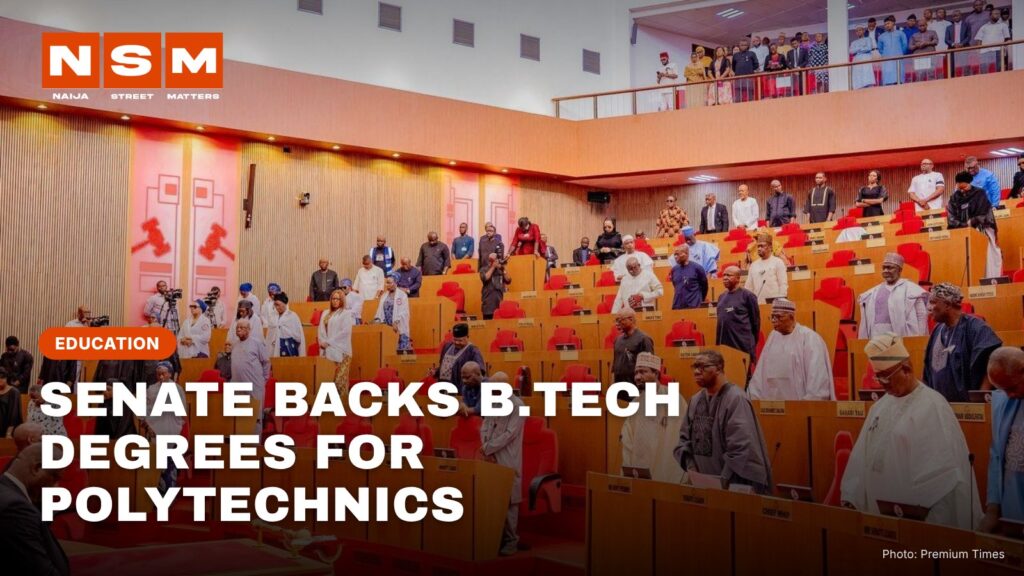
- Senate amends Federal Polytechnics Act to allow B.Tech (Hons) degrees
- ND, HND and PGD holders are eligible, subject to NUC accreditation
- Change still needs to complete the law-making process and presidential assent
For years, HND holders have complained of being treated like second-class graduates. On Thursday, the Senate took a step that could change that story. Senators voted to let federal polytechnics award Bachelor of Technology (B.Tech) degrees.
What the Senate did
During plenary on 15 October 2026, the Senate amended the Federal Polytechnics Act. The move was led by Senate Leader Opeyemi Bamidele (APC, Ekiti Central), who asked that the Act be sent back to the Committee of the Whole because some sections needed another look.
The amendment changes the Senate’s earlier position, which kept polytechnics limited to National Diploma (ND) and Higher National Diploma (HND) certificates. Under the new provision:
- Federal polytechnics may award B.Tech (Hons) degrees in science, engineering and technology courses.
- Holders of ND, HND or a Postgraduate Diploma are eligible.
- Every programme must first be accredited by the National Universities Commission (NUC) and other relevant regulators.
- A rector will serve an initial five-year term, renewable once for four years.
No senator opposed the changes. Senate President Godswill Akpabio put them to a voice vote and the “ayes” carried the day.
Why students and graduates care
The so-called HND vs BSc dichotomy has followed polytechnic graduates for decades. HND holders have often faced lower entry levels, slower promotions and limits on which positions they can hold in some public and private organisations. Even after a 2018 federal circular allowed HND holders to enter the civil service at Grade Level 08, moving beyond certain levels still came with extra conditions.
A B.Tech degree from a polytechnic would put graduates on a more equal footing with university graduates on paper. For polytechnic students and alumni, that could mean better job prospects and fairer pay. In 2023, the House of Representatives also raised concerns about promotion gaps between HND and degree holders in the NSCDC.
The fine print
The NUC accreditation condition is the big one. Polytechnics will need the right facilities, staff and curriculum before they can award degrees. The amendment also still has to complete the legislative process and receive presidential assent before it becomes law.
And even with the law in place, the real impact will depend on employers: whether they accept the new degrees, and whether recruitment rules and schemes of service are updated to match.
THE NSM PERSPECTIVE
A certificate opens the door; skill keeps you in the room. This reform, if it becomes law, is a long-overdue correction, because a nation that looks down on its technicians will import its technology forever. But students should not wait for the law to change their lives. The polytechnic graduate who can design, build, fix and sell will always beat the certificate collector, degree or no degree.
For school owners and investors, there is opportunity here: laboratories, workshops and industry partnerships will be in high demand once accreditation begins. For employers, the lesson is simple: hire for competence, not for the name on the paper. History rewards nations that respect hands-on knowledge. Nigeria has finally started that conversation; the next step is to finish it.