- When Your Investment Becomes Your Religion: The Dangerous Moment Money Stops Being Logic and Becomes Identity
- How Your Financial Opinion Can Hold You Hostage: Why Wealth Builders Must Choose Evidence Over Ego
Money is never just about money.
Money is memory. Money is hope. Money is fear. Money is pride. Money is status. Money is survival. Money is identity.
That is why two people can look at the same investment opportunity and see two completely different worlds. One sees danger. Another sees freedom. One sees a scam. Another sees destiny. One sees a stock. Another sees the bridge out of poverty. One sees real estate. Another sees generational wealth. One sees crypto. Another sees the future of money. One sees a government policy. Another sees either national rescue or national collapse.
This is where the trouble begins.
People often believe they are making financial decisions from reason, research, facts, and numbers. But many times, they are not following evidence. They are defending a tribe.
Once a person chooses a financial side, something subtle happens. The investment is no longer just an investment. The opinion is no longer just an opinion. The strategy is no longer just a strategy. It becomes personal. It becomes emotional. It becomes attached to ego, hope, reputation, dreams, public statements, social belonging, and the desire to be right.
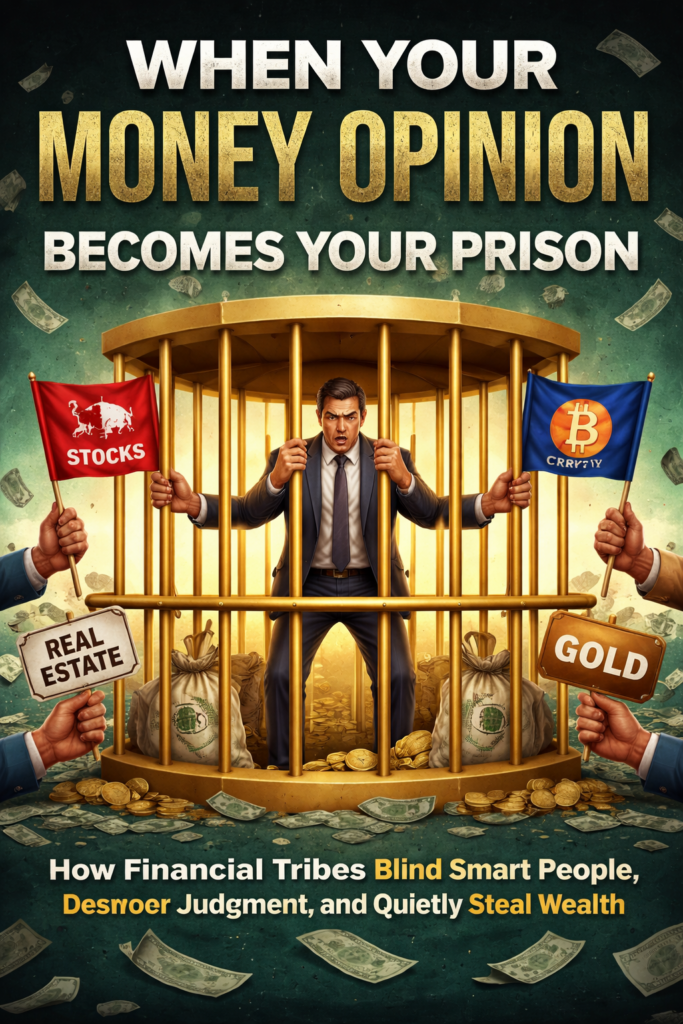
At that point, the person is no longer merely holding an opinion. The opinion has started holding them.
A man buys a stock and says, “This share will make me rich.” From that day, every positive news becomes proof, and every negative news becomes noise. A woman buys land in a developing area because “everybody is buying there,” and even when warning signs appear, she refuses to reconsider because admitting doubt feels like weakness. A young person joins a crypto group where every criticism is treated as ignorance, jealousy, or fear. A business owner keeps pouring money into a failing venture because shutting it down would feel like public disgrace. A salary earner keeps borrowing to maintain a lifestyle because his social circle has already accepted him as “doing well.”
This is not just finance. This is psychology wearing financial clothes.
And every serious wealth builder must ask one dangerous question:
Am I following evidence, or am I protecting my ego?
The Moment Your Opinion Becomes Your Identity
There is nothing wrong with having financial opinions. In fact, every investor needs opinions. You need an opinion before you buy a stock, start a business, purchase land, invest in agriculture, join a cooperative, build an e-commerce platform, or move money into treasury bills. Without opinion, there is no decision.
The problem begins when your opinion becomes your identity.
The moment you say, “Real estate is the only safe investment,” you may begin to ignore the risks of bad title, poor location, government acquisition, land disputes, liquidity problems, and slow appreciation. The moment you say, “Crypto is the future,” you may start dismissing every warning as fear from people who do not understand technology. The moment you say, “This stock must rise,” you may ignore bad management, weak earnings, debt pressure, poor governance, or market changes. The moment you say, “This business cannot fail,” you may continue funding losses long after the market has rejected the idea.
Why?
Because now you are not only protecting your money. You are protecting your pride.
People do not invest only cash into financial beliefs. They invest ego. They invest reputation. They invest public declarations. They invest late-night dreams. They invest the story they told their spouse. They invest the confidence they showed their friends. They invest the hope that this one decision will finally change their life.
So when evidence changes, changing their mind becomes painful.
This is why many people would rather lose money quietly than admit publicly that they were wrong.
But wealth does not care about your pride.
A stock does not know you love it. A market does not know you believe in it. A business does not care that you suffered to start it. Land does not appreciate because you announced it as “the next Lekki.” Crypto does not rise because your Telegram group has faith. A Ponzi scheme does not become legitimate because your pastor, friend, colleague, or uncle joined it.
The market does not reward loyalty to opinions. It rewards discipline, patience, evidence, timing, risk management, and truth.
When Investors Stop Looking for Truth and Start Looking for Confirmation
One of the most dangerous forces in personal finance is confirmation bias.
Confirmation bias is the tendency to search for, accept, and celebrate information that supports what you already believe while ignoring or attacking information that challenges it. In simple language, it means many people do not ask, “Is this true?” They ask, “Does this support what I already believe?”
This is how financial tribes are formed.
A stock investor joins groups where everyone is praising the same stock. Any negative analysis is dismissed as hatred. Any warning is called fear. Any critic is labeled ignorant. Soon, the investor is no longer doing research; he is attending a financial church where everyone is singing the same hymn.
A crypto believer follows only influencers who predict massive price explosions. Every caution is treated as backward thinking. Every crash is called a temporary shakeout. Every failed project is explained away. Instead of studying risk, the tribe manufactures confidence.
A real estate buyer hears that land in a certain area will soon appreciate because “development is coming.” Agents repeat it. Friends repeat it. Social media repeats it. The buyer stops checking documents, drainage, access roads, disputes, and resale demand. The story becomes stronger than due diligence.
A business owner continues a failing business because friends once praised the idea. He has spent money, time, emotion, and reputation. So instead of asking, “Is this business model working?” he asks, “How do I prove people wrong?”
That is not strategy. That is ego management.
And ego is expensive.
Why Smart People Defend Bad Investments
It is easy to assume that only ignorant people fall into financial traps. That assumption is false.
Smart people defend bad investments every day because intelligence does not automatically defeat emotion. Education does not cancel greed. Experience does not remove pride. Exposure does not immunize a person against social pressure.
There are behavioural forces that pull people into financial tribalism.
There is motivated reasoning, where people use intelligence not to find truth, but to defend what they want to believe. There is herd mentality, where people assume something is safe because many people are doing it. There is loss aversion, where the pain of admitting loss feels stronger than the logic of cutting loss. There is sunk cost fallacy, where people continue a bad decision because they have already spent too much money, time, or emotion on it. There is overconfidence, where people believe they understand more than they actually do. There is fear of embarrassment, where people stay trapped because they do not want others to say, “I told you.”
Then there is the big one: social proof.
If enough people around you believe something, your brain starts relaxing. If your WhatsApp group is excited, your skepticism weakens. If your friends are investing, you feel left behind. If your church members are joining, you assume it must be safe. If your favourite influencer is promoting it, you start treating popularity as credibility.
But popularity is not safety.
Many Nigerians have entered investment platforms not because they understood the business model, but because “people are cashing out.” Many have bought land not because they verified the title, but because “everybody is buying there.” Many have borrowed for lifestyle not because they had financial capacity, but because their social circle expects them to look successful. Many have defended political economic policies not because they understood inflation, exchange rates, productivity, or debt, but because their party loyalty shaped their interpretation of facts.
When money and identity mix, objectivity becomes difficult.
When your investment becomes your identity, every warning begins to sound like an insult.
Your Financial Tribe May Be Costing You More Than You Think
Financial tribes are not always obvious. They do not always wear uniforms. They exist around stocks, crypto, forex trading, real estate, agriculture investments, cooperative savings, importation business, network marketing, political economic beliefs, religious prosperity promises, and social media investment influencers.
Some tribes sound intelligent. Some sound spiritual. Some sound revolutionary. Some sound patriotic. Some sound youthful and tech-driven. Some sound like “old money wisdom.” But the danger is the same: once the tribe rewards loyalty more than truth, your money is in danger.
A financial tribe becomes dangerous when criticism is treated as betrayal. It becomes dangerous when every risk is minimized. It becomes dangerous when members are encouraged to “believe” rather than investigate. It becomes dangerous when people who ask questions are mocked. It becomes dangerous when the leader of the tribe benefits whether members win or lose.
This happens in many places.
In some forex groups, every loss is blamed on the student’s lack of discipline, while the mentor keeps selling courses. In some crypto communities, every crash is explained as manipulation, while nobody discusses risk exposure. In some real estate circles, every land is “fast appreciating,” but nobody talks about liquidity, documentation, or disputes. In some religious prosperity environments, people are told to give their last money for breakthrough, while nobody teaches budgeting, investing, skill-building, or financial planning.
Your tribe may clap for your conviction while your money quietly disappears.
And the most painful part is this: the longer you stay, the harder it becomes to leave.
Because leaving may require admitting that you were wrong.
The Market Does Not Care About Your Ego
One of the greatest marks of financial maturity is the ability to separate yourself from your investment.
You are not your stock. You are not your business. You are not your land. You are not your crypto wallet. You are not your political forecast. You are not your past financial mistake.
A good investor must be willing to say, “I was wrong.”
Those three words can save your future.
“I was wrong about this stock.”
“I was wrong about this business model.”
“I was wrong about this land location.”
“I was wrong about this platform.”
“I was wrong about this person’s advice.”
“I was wrong about my spending habits.”
“I was wrong about the risk.”
This is not weakness. This is wisdom.
In finance, humility is risk management.
The person who cannot change his mind may eventually lose his money. The person who sees every correction as shame may remain trapped in bad decisions. The person who sees every warning as hatred may walk confidently into financial disaster.
The market does not care that you are intelligent. It does not care that you have defended your opinion online. It does not care that your friends believe you are a sharp investor. It does not care that you have spent years promoting a particular strategy. When facts change, the market moves. If you refuse to adjust, the market will not apologize.
A wise investor does not worship assets. He examines them.
Conviction Is Not Stubbornness
Some people confuse conviction with stubbornness.
They say, “I believe in this investment,” when what they really mean is, “I cannot emotionally afford to admit that I may be wrong.”
Conviction is powerful. Every wealth builder needs conviction. You cannot build a business, buy assets, hold investments, or pursue financial freedom without some level of belief. But conviction must be disciplined by evidence.
Conviction says: “I have studied this deeply, I understand the risks, I know my time horizon, and I know what evidence would prove me wrong.”
Stubbornness says: “I do not care what the evidence says; I must be right.”
Conviction has a plan. Stubbornness has pride.
Conviction manages risk. Stubbornness ignores it.
Conviction listens to opposing views. Stubbornness attacks them.
Conviction protects capital. Stubbornness protects ego.
This difference is critical. Many people think they are strong because they refuse to change their minds. But sometimes the ability to change your mind is the real strength. When evidence changes, your position must be reviewed. When risk increases, your exposure must be questioned. When your assumptions fail, your strategy must be adjusted.
The goal is not to have no opinion. The goal is to have flexible opinions guided by truth.
How Wise Investors Protect Themselves From Financial Tribalism
Disciplined investors are not loyal to opinions. They are loyal to process.
They use risk management. They diversify. They insist on margin of safety. They think about asset allocation. They conduct due diligence. They maintain liquidity. They size positions carefully. They rebalance. They think independently. They practice patience. They protect capital before chasing returns.
Most importantly, they separate speculation from investing.
Speculation says, “This thing may explode, let me enter before others.”
Investing says, “What is the value, risk, evidence, time horizon, and downside?”
Speculation is not always bad if you know it is speculation and size it properly. The danger is when people call speculation “investment” because the word investment makes them feel safe.
Wise investors also know that not every opportunity deserves equal capital. Position sizing matters. If an opportunity is uncertain, your exposure should reflect that uncertainty. If the downside can destroy you, the position is too large. If you cannot sleep because of an investment, you may have invested beyond your emotional and financial capacity.
Diversification also protects you from your own overconfidence. It reminds you that you can be wrong. It prevents one financial tribe from controlling your entire future.
Liquidity matters too. If all your money is locked in one asset, you may be forced to sell at the wrong time or miss better opportunities.
A serious investor does not marry investments. He monitors them.
Before You Defend That Investment, Ask These Questions
Before you argue, defend, double down, borrow more, average down, or insult critics, pause and ask yourself:
- What evidence would make me change my mind?
- Am I defending this because it is true or because I want it to be true?
- Have I become emotionally attached to this investment?
- Am I listening only to people who agree with me?
- What are the strongest arguments against my position?
- What facts am I ignoring?
- What risks am I minimizing?
- Am I afraid of being wrong publicly?
- If I had no money in this investment today, would I still buy it?
- If a stranger presented this opportunity to me today, would I still trust it?
- Can I survive if this belief turns out to be wrong?
- Am I investing based on evidence, ego, pressure, or hope?
These questions can save you from financial self-deception.
They force you to step outside the tribe and return to truth.
Great Investors Change Their Minds
Changing your mind is not failure. It is maturity.
The best investors, entrepreneurs, and wealth builders are willing to update their beliefs when facts change. They understand that financial life is not a courtroom where you must defend your old statements forever. It is a battlefield where survival requires adaptation.
There are times when the wise thing to say is:
“The facts have changed.”
“The risk is now higher than I thought.”
“This opportunity no longer fits my plan.”
“I need to protect my capital.”
“My ego must not destroy my future.”
“I was wrong.”
Those words may hurt your pride, but they can rescue your money.
Many people lose money not because they made one bad decision, but because they turned that bad decision into a permanent identity. They refused to adjust. They borrowed to defend it. They averaged down blindly. They ignored red flags. They attacked critics. They waited until the damage became too big to hide.
The most expensive financial mistake is not being wrong; it is refusing to admit you are wrong.
Before You Protect Your Opinion, Protect Your Future
Your future is more important than your tribe.
Your capital is more important than your ego.
Your financial freedom is more important than winning an argument.
Do not let your tribe think for you. Do not let your ego invest for you. Do not let your opinion become more important than your future.
Money rewards those who can think independently, question their assumptions, manage risk, and remain humble enough to change direction when evidence demands it. Wealth is not built by defending every old belief. Wealth is built by learning, adjusting, protecting capital, and moving with wisdom.
So before you fall in love with a stock, examine it. Before you worship a coin, understand it. Before you defend a business, measure it. Before you trust an influencer, verify them. Before you buy land because others are buying, investigate it. Before you borrow to maintain status, calculate the cost. Before you join an investment tribe, ask who benefits from your belief.
The world is full of financial opinions. Some will make you rich. Some will make you poor. Some will educate you. Some will manipulate you. Some will sound wise but hide danger. Some will give you confidence while quietly weakening your judgment.
Your responsibility is to choose truth over tribe.
Final Call to Action
Think deeper. Question your financial beliefs. Test your investment assumptions. Listen to opposing evidence. Manage risk wisely. Protect your capital. Stop defending bad decisions. Learn before investing. Build wealth with discipline, not emotion.
The goal is not to be right at all costs.
The goal is to become financially free.
And sometimes, the door to financial freedom opens the moment you are humble enough to say:
“I may be wrong. Let me check the evidence.”