
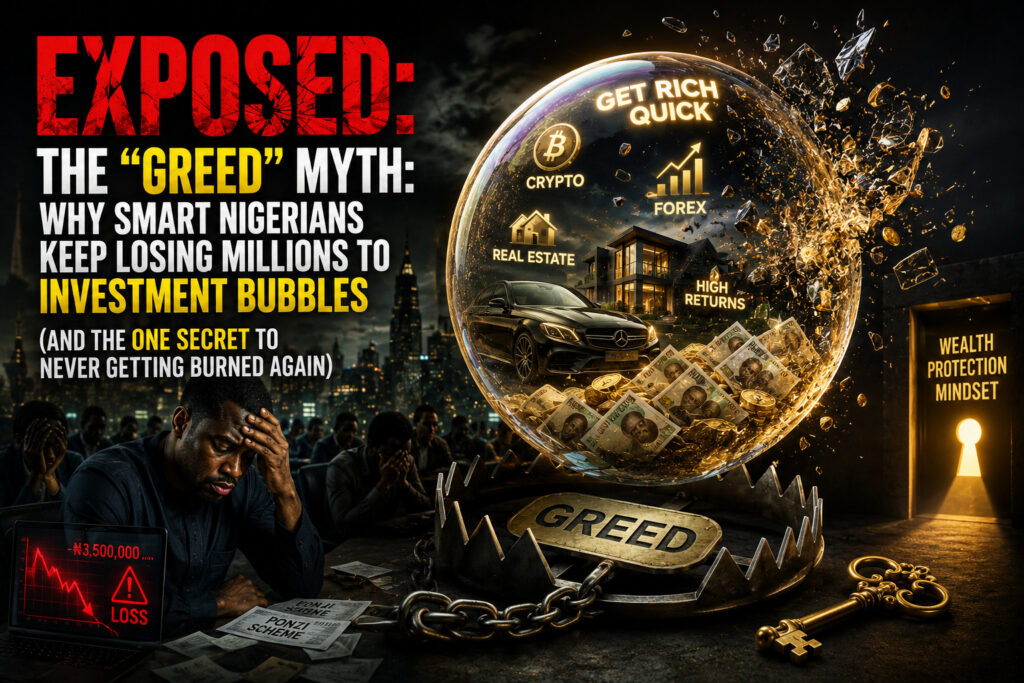
- The one Fatal Identity Crisis That Bankrupts Smart Nigerian Investors (Without Them Even Realizing It).
Today, we need to have a very sobering conversation about the destruction of wealth. We need to talk about the tears, the unpaid rents, the broken marriages, and the shattered dreams that follow a financial crash.
If you have lived in Nigeria for the past decade, you have seen it firsthand. It is hard to overstate just how socially devastating financial bubbles can be. They do not just cause a temporary dip in a bank account; they ruin lives. They wipe out generational progress. They turn respected community members into debtors dodging phone calls. From the infamous MMM crash that swept through the country, to unregulated forex trading schemes, to the wild, unregulated pumps and dumps of obscure cryptocurrency tokens, we have watched the same horror movie play out over and over again.
Why do these things happen? Why do they keep happening with such alarming regularity? And most importantly, why can’t we, as incredibly intelligent and resilient people, seem to learn our lessons?
As the Business Apostle, I have analyzed the mechanics of the Nigerian marketplace for years. I have watched brilliant businessmen, doctors, lawyers, and seasoned civil servants lose everything to market bubbles. And I can tell you right now that the financial experts on television are giving you the wrong diagnosis.
The Lazy Diagnosis: The Myth of Uncontrollable Greed
When a bubble bursts and billions of Naira evaporate into thin air, the common answer from financial pundits and commentators is always the same: “People are just greedy, and greed is an indelible feature of human nature.” They point fingers at the victims and laugh. They say it is the “Ojukokoro” (greed) that killed them. They tell you that if people were just satisfied with their salaries or normal business profits, they would never have fallen for the trap.
However, blaming financial bubbles entirely on greed and stopping the analysis right there—4misses the most important, structural lessons about how wealth is actually destroyed. It is a lazy explanation that prevents us from understanding human psychology. More importantly, it prevents us from seeing how and why completely rational, intelligent people rationalize what, in hindsight, look like incredibly greedy decisions.
In a hyper-inflationary economy like ours, where the purchasing power of your money is constantly under attack, looking for high-yield investments is not always driven by pure greed. Often, it is driven by panic. It is driven by the very logical desire to protect your family’s future. When a father sees the cost of school fees doubling, and someone offers him an investment vehicle that outpaces inflation, his initial interest is survival, not gluttony.
But then, something shifts in the market. A psychological phenomenon takes over, and this is where the true anatomy of a bubble begins.
The Gravity of Momentum: Why the Madness Feels So Rational
To understand a bubble, you must understand the intoxicating power of momentum.
Imagine an asset—it could be a piece of real estate in a developing area of Lagos, a specific stock on the exchange, or a new digital currency. Initially, a few smart, analytical investors buy into it because they see genuine, long-term fundamental value. The price goes up slightly. Then, the momentum begins. Other people notice the price going up. They don’t necessarily care about the fundamental value; they just see that the asset is trending upward. So, they buy in. This new influx of money pushes the price up even higher, and even faster.
This momentum attracts short-term traders in a completely reasonable way. If you are a trader whose job is to capture price movements, it is entirely rational to jump on a moving train. You buy today with the sole intention of selling tomorrow to someone else for a higher price. You are not buying the asset because you believe in its 10-year potential; you are buying it because it is moving right now.
For a window of time, this strategy works perfectly. The short-term traders make massive, quick profits. They buy the new cars. They post the screenshots of their bank alerts on WhatsApp statuses and Instagram stories.
And this is exactly where the rationalization of madness occurs.
You are sitting at your desk, working your 9-to-5 job or running your legitimate business, earning a respectable but slow profit. You watch your neighbor, who has zero financial education, flip an asset in three days and make what you make in six months.
Your brain begins to rationalize the situation. It tells you, “If I don’t get in on this, I am being foolish. The momentum is undeniable.” You are not being purely greedy; you are reacting to overwhelming social and financial proof that the momentum is feeding on itself. You rationally move toward short-term trading to capture a piece of that momentum before it disappears.
The Hijacking of the Market: How the Bubble Forms
A bubble does not form just because prices are high. A bubble forms when the structural foundation of the market is completely hijacked.
A bubble forms when the momentum of short-term returns attracts so much money that the entire makeup of the investors shifts. The market transforms from being dominated by mostly long-term investors (who care about true value, dividends, and sustainable growth) to being dominated by mostly short-term speculators (who only care about riding the momentum wave).
Think of it like a game of musical chairs. The long-term investors are people who brought their own chairs to the party.
They are sitting down, comfortable, regardless of the music. But when the momentum starts, thousands of short-term players rush into the room to play the game. They don’t have chairs. They are just dancing as fast as they can, relying entirely on the hope that when the music eventually stops, they will be able to snatch a seat from someone else.
The formation of bubbles is so much about this precise moment: people somewhat rationally moving toward short-term trading to capture momentum that has been feeding on itself.
The tragedy strikes when the momentum eventually exhausts itself. When there is no more “new money” rushing in to push the price higher, the short-term traders instantly try to cash out. But because the entire market is now made up of short-term traders, everyone rushes for the exit door at the exact same second. Panic ensues. Prices plummet. The bubble bursts violently.
And who gets hurt the most? The people who did not understand the game they were playing.
The Apostle’s Framework: What Game Are You Playing?
This brings us to the ultimate defense mechanism against financial ruin. If you want to survive the Nigerian economic landscape and build unbreakable generational wealth, you must cure your financial identity crisis.
The main thing I recommend—the absolute most critical step you must take before you transfer a single Naira into any investment vehicle—is going out of your way to identify exactly what game you are playing.
Are you a passive investor, an active short-term trader, or somewhere in between?
1. The Game of the Passive, Long-Term Investor If you are a wealth builder, your game is compounding. You buy high quality assets, like solid real estate, index funds, or equity in cash-flowing businesses—and you hold them for decades. Your currency is patience. You do not care if the asset drops by 20% next month because you are not planning to sell it next month.
If this is your game, you must put on blinders. When a short-term momentum bubble starts inflating, you must ignore the noise. You cannot take financial cues from a 22-year-old day trader who is playing a completely different game than you are. If you try to apply short-term momentum tactics to a long-term wealth strategy, you will destroy your portfolio.
2. The Game of the Active, Short-Term Trader If you choose to be an active trader, your game is momentum and risk management. You must accept that you are playing a high-stakes game of musical chairs. Your entire strategy relies on getting in early and getting out before the music stops.
If this is your game, you cannot afford to fall in love with the assets you buy. You cannot hold onto a crashing asset hoping it will “recover its fundamental value” because momentum assets often have no fundamental value. You must have strict, ruthless stop-loss rules.
3. The Danger of the “In-Between” The people who get utterly destroyed in financial bubbles are those who mix up their games.
They are the people who buy into a highly volatile, short-term momentum bubble, but they tell themselves they are “long-term investors.” When the bubble bursts and the asset loses 90% of its value, instead of cutting their losses like a smart short-term trader, they suddenly adopt the language of a long-term passive investor. They say, “I will just hold it for ten years; it will bounce back.” No, it will not. You bought a momentum asset, and the momentum is dead. You played the wrong game, and now you are holding the bag.
The Final Verdict: Command Your Financial Destiny
Do not let the financial commentators dismiss your losses as mere “greed.” You are a human being navigating a complex, highly volatile economic environment. It is natural to be drawn to the gravity of momentum. It is natural to want to escape the crushing weight of inflation.
But you are no longer allowed to be a victim of your own rationalizations.
You must separate yourself from the herd. Before you make your next financial move, sit down in a quiet room and interrogate your motives. Ask yourself: Why am I buying this? What is my exit strategy? Am I investing for the next ten years, or am I just trying to ride the wave for the next ten days?
When you clearly define your game, the flashy alerts of the momentum traders will no longer trigger your FOMO (Fear Of Missing Out). You will watch bubbles inflate and burst with the calm, detached precision of a true market master. You will protect your capital, guard your peace of mind, and steadily build an empire that cannot be shaken by the chaotic noise of the crowd.
It is time to stop playing someone else’s game. Decide who you are in the marketplace, and master your own rules.