
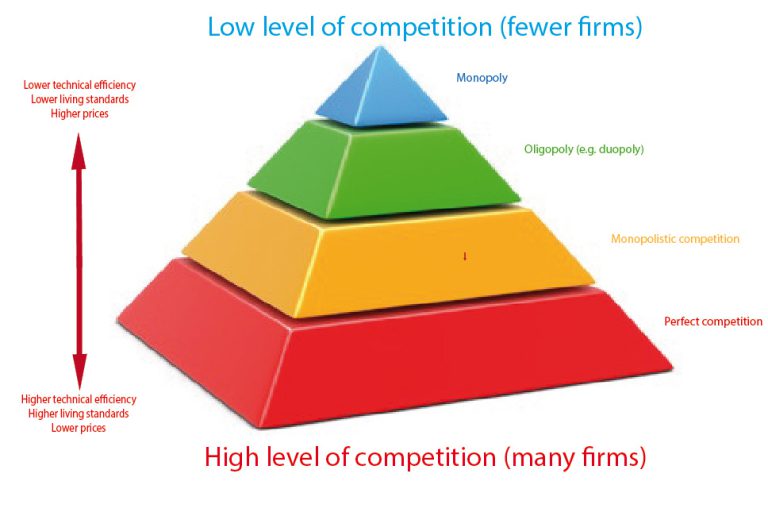
That little tomato market is a good mirror for how competition shapes market efficiency — how well resources are used, and how well the things people want are produced.
When many vendors sell tomatoes, no one stall can simply fix a high price without risking empty baskets at day’s end. Buyers will walk away. Vendors who use rotten produce or overprice will lose customers. So each stall is pushed, by the silent force of competition, to sharpen what they do: source better tomatoes, minimize spoilage, maintain fair prices, and figure out how many baskets to bring so none go to waste.
That pressure moves the market toward productive efficiency — doing things at the lowest cost. A stall that wastes water, uses too much packaging, or overstaffs will fall behind. If it can’t streamline, it either closes or changes how it operates. Only those who manage resources well survive in the long run.
At the same time, competition nudges the market toward allocative efficiency — producing what people actually want, in the right proportions. Some customers prefer small tomatoes, others large; some want really cheap ones, some more premium. Vendors experiment: one sells tiny “snack” tomatoes, another focuses on organic ones, yet another offers mixed baskets. The result is a richer, more responsive market. The mix of what’s supplied shifts toward what people demand.
Without competition, things can stagnate. If only one tomato stall existed, it might charge more and slack on quality. Because buyers have no alternative, they endure. Resources get misused, and the goods produced may not reflect what people truly value.
In ideal economic theory, there is something called perfect competition, where many sellers offer identical products, information is freely available, and entry into the market is easy. In that world, markets reach a state where price equals marginal cost — meaning the next unit of tomato costs exactly what buyers are willing to pay for it. That balance is considered perfectly efficient in both production and allocation. But this is an ideal — real markets rarely (if ever) reach it.
Still, competition remains essential. It makes firms fight inefficiency, adopt better methods, offer better choices. Even when markets are imperfect — when stalls differ, when information is incomplete, when barriers to entry exist — the pressure from competition helps pull the market toward more efficient outcomes than would occur in its absence.
So in the humble tomato market, competition is the invisible engine. It drives stalls to improve, to adapt, to offer what people want, to squeeze out waste. And so, the neighborhood ends up with better tomatoes, fairer prices, less waste — a marketplace that works closer to how people wish it would.