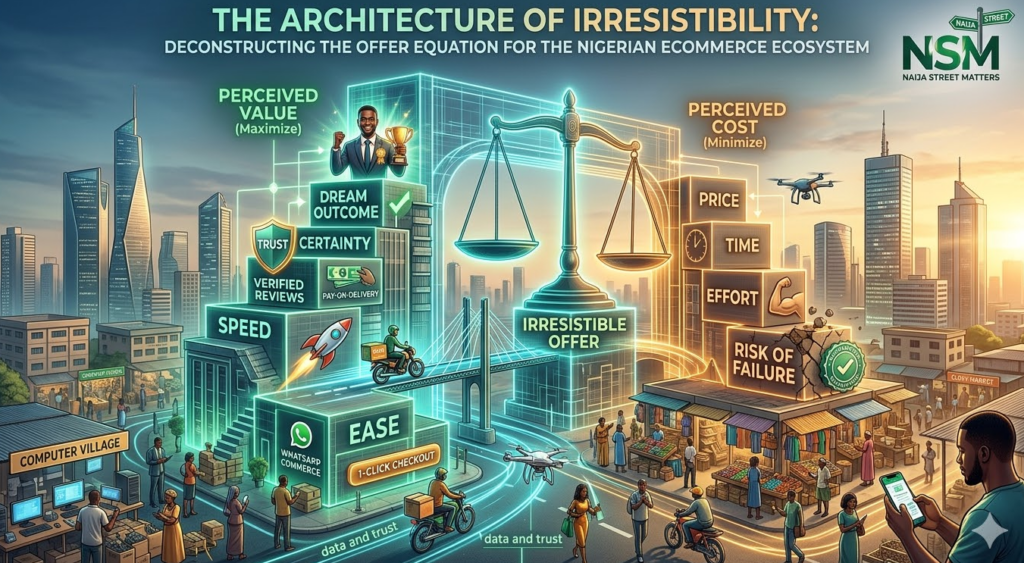
The success of a digital commerce enterprise within the Nigerian macroeconomic landscape is fundamentally predicated on the strategic manipulation of perceived value against perceived cost. While traditional economic theory often prioritizes the objective price of a commodity, contemporary ecommerce psychology suggests that the decision-making process of the consumer is governed by a more complex heuristic known as the Offer Equation. In an environment characterized by a significant trust deficit and structural logistical challenges, the ability of a merchant to engineer an offer where the perceived value vastly outweighs the perceived cost is not merely a competitive advantage but a prerequisite for survival. The Nigerian market, projected to reach a valuation of approximately $8.53 billion by 2025, presents a unique set of variables where mobile-first behavior, inflationary pressures, and communal purchasing habits redefine the standard definitions of value.
Clarifying Framework for Strategic Content Development
Before the deep analytical exposition of the Offer Equation, it is necessary to establish the parameters of engagement for the subsequent article intended for Naija Street Matters. The following targeted questions are designed to refine the strategic focus:
-
Audience Stratification: While the primary target is online business owners, does the focus skew toward the “solopreneur” utilizing social commerce (Instagram/WhatsApp) or the established enterprise founder managing complex logistics and multi-channel operations?
-
Industry Specificity: Should the examples prioritize high-turnover consumer goods (fashion/electronics) or high-ticket service-based digital products, given that the “Dream Outcome” and “Risk of Failure” variables manifest differently in these niches?
-
Tonal Nuance: Should the tone be authoritative and academic to establish deep credibility, or should it adopt a “street-smart” professional style that mirrors the grit and resilience of the Nigerian business landscape?
-
Growth Stage Focus: Is the article intended as a foundational guide for market entrants or a scaling manual for businesses already doing seven figures in monthly revenue?
| Strategic Element | Proposed Focus for Naija Street Matters | Rationalization |
| Tone | Street-Smart Professional | Balances expert-level insight with local market relatability. |
| Niche | Mixed (Fashion, Tech, Logistics) |
Covers the most active segments of the Nigerian digital economy. |
| Core Objective | Conversion Optimization |
Addresses the high cart abandonment rates prevalent in the region. |
| Platform Bias | Mobile-First/Omnichannel |
Reflects the 80%+ mobile usage rate among Nigerian shoppers. |
The Mathematical Foundation of Value: The Hormozi Framework
The Offer Equation, frequently articulated by business analysts such as Alex Hormozi, provides a mathematical lens through which value can be engineered. The equation is represented as:
In this LaTeX-formulated paradigm, the merchant’s objective is to maximize the numerator while ruthlessly minimizing the denominator. In Nigeria, the variables are often distorted by external factors. For instance, the “Perceived Likelihood of Achievement” is naturally suppressed by a national trust index where only 31% of the population trusts online payment systems. Conversely, “Effort and Sacrifice” are inflated by poor internet connectivity and the lack of standardized addressing systems, which increase the friction of every transaction.
The Value Multipliers: Maximizing the Numerator
The numerator of the equation represents the “carrots” that draw a consumer toward a purchase. In the Nigerian context, these are not just functional benefits but deeply emotional and status-driven desires.
The Dream Outcome: Beyond Utility to Transformation
The “Dream Outcome” is the ultimate result the customer desires—it is the gap between their current reality and their idealized state. For the Nigerian consumer, this often transcends the product itself. A consumer purchasing a high-end generator is not buying a machine; they are buying the dream outcome of “Uninterrupted Productivity” and “Social Status” in a neighborhood characterized by power instability. Data indicates that 67% of purchases in Nigeria are influenced by a desire for convenience and status signaling.
To maximize this variable, marketing narrative must shift from features to the “conduit desires” of beauty, power, respect, and love. The dream outcome must be framed as a life-changing transformation. For instance, an ecommerce store selling fashion is not selling fabric; it is selling the “jaw-dropping entrance” at a wedding or the “unshakable confidence” in a boardroom. When the dream outcome is articulated with specificity, the perceived value of the offer increases, allowing the merchant to move away from the “vicious cycle” of price-cutting and toward premium positioning.
Perceived Likelihood of Achievement: The Certainty Lever
Even the most desirable dream outcome is worthless if the consumer does not believe the merchant can deliver it. This variable is the “Certainty” factor. In Nigeria, where “What I ordered vs. What I got” is a pervasive cultural meme, the perceived likelihood of achievement is the primary bottleneck to conversion.
The evidence suggests that certainty is built through trust signals that are culturally resonant. This includes high-fidelity product visualization, unedited video demonstrations, and the liberal use of social proof. Furthermore, the Nigerian consumer places a high premium on “Street Cred”—testimonials that come from real people in recognizable local contexts (e.g., video reviews in Pidgin or local dialects) are more effective than polished, Western-style corporate endorsements.
| Component | Strategic Goal | Implementation in Nigeria |
| Dream Outcome | Maximize Aspiration |
Focus on status, health, and wealth gains. |
| Certainty | Maximize Trust |
Use WhatsApp screenshots, local testimonials, and physical office verification. |
| Speed | Minimize Delay |
Offer next-day delivery in Lagos/Abuja; immediate digital access. |
| Ease | Minimize Friction |
Simplify checkout to 3 fields; provide one-click WhatsApp ordering. |
The Value Inhibitors: Minimizing the Denominator
The denominator represents the “friction” of the transaction. In a high-risk, low-infrastructure market, these variables often determine whether a “Weak Offer” becomes a “Dead Offer.”
Time Delay: The Speed of Gratification
Time delay is the duration between the consumer paying for the product and receiving the benefit. In Nigeria, logistics challenges often extend this period, leading to buyer’s remorse and cart abandonment. The 2024-2025 ecommerce landscape shows that the most successful brands are those that offer “Quick Wins”.
If a merchant is selling a weight loss program, the ultimate dream outcome (a fit body) may take months, but the merchant must reduce the time delay by providing an immediate “Fast-Start Guide” or a personalized consultation within hours of the purchase. In physical retail, the integration of real-time logistics APIs (such as GIG Logistics or Kwik) to provide precise delivery windows is a critical mechanism for reducing the perceived time delay.
Effort and Sacrifice: The Friction Factor
This variable encompasses the mental and physical work the customer must invest to achieve the dream outcome. In Nigeria, “Effort” includes navigating slow mobile sites on expensive data plans and “Sacrifice” includes the opportunity cost of waiting for a delivery driver in traffic.
Ecommerce optimization in Nigeria requires a ruthless reduction of this denominator. This is achieved through mobile-responsive designs that load in under 3 seconds, the removal of unnecessary form fields, and the use of conversational commerce (WhatsApp) to bypass complex website architectures. By making the path to purchase effortless, the merchant increases the overall value of the offer without needing to lower the price.
The Three Offer Archetypes: Diagnostic Analysis
Based on the interaction between perceived value and perceived cost, ecommerce offers in the Nigerian market generally fall into three distinct categories. Understanding these archetypes allows a business owner to diagnose sales stagnation and implement corrective measures.
1. The Dead Offer: Value < Cost
A “Dead Offer” occurs when the consumer perceives the cost (monetary, time, effort, and risk) to be greater than the value of the outcome. In Nigeria, many offers die not because the product is bad, but because the “Risk of Failure” is too high.
Specific Example: A new ecommerce platform launched a high-end luxury watch collection priced in USD during a period of extreme Naira volatility. The site required full upfront payment via a portal that frequently timed out, offered no physical address for verification, and stated a 21-day shipping period from overseas.
-
Analysis: The “Dream Outcome” (Status) was high, but the “Certainty” was near zero. The “Time Delay” and “Risk of Failure” (losing money to a scam) were astronomical. Despite the quality of the watches, the offer was dead on arrival because the perceived cost of the “Sacrifice” and “Risk” far outweighed the benefit.
2. The Weak Offer: Value = Cost
A “Weak Offer” is a commodity-level proposition. The consumer feels that the price is fair, but there is no urgency or “irresistibility” to the deal. These offers are highly sensitive to competition and often result in high “thinking about it” rates.
Specific Example: An Instagram vendor selling “Quality Ankara Prints” for ₦15,000. The price is standard for the market, the delivery takes 3-5 days, and the vendor has a few dozen followers with basic photos.
-
Analysis: The value equals the cost. There is no “Grand Slam” element. The customer can find the same deal elsewhere. To move this to “Irresistible,” the vendor would need to add a “Fast-Action Bonus” (e.g., a free matching headtie for the first 5 buyers) or a “Risk-Reversal Guarantee” (e.g., “If it fades in the first wash, we send you a new one for free”).
3. The Irresistible Offer: Value > Cost
An “Irresistible Offer” (or “Grand Slam Offer”) is one where the consumer feels that saying no would be a mistake. The perceived value is so much higher than the cost that the purchase becomes a “no-brainer.”
Specific Example: A Nigerian electronics retailer selling a ₦250,000 Solar Inverter System. Instead of just selling the box, they offer a bundle: The Inverter + Free Installation + 24-Month Local Warranty + A “Light-Up Your Home in 24 Hours” delivery guarantee + A “Pay-on-Delivery” option for verified Lagos addresses.
-
Analysis:
-
Numerator: The “Dream Outcome” (No more power outages) is massive. “Certainty” is maximized by Pay-on-Delivery and a 24-month warranty.
-
Denominator: “Time Delay” is crushed by the 24-hour delivery promise. “Effort” is eliminated by the free installation.
-
-
Result: The value far exceeds the ₦250,000 cost. The merchant can charge a premium over competitors because they have solved for every variable in the equation.
Macro-Economic Drivers and the Nigerian Trust Deficit
The context of the Nigerian economy in 2024-2025 adds a layer of “Risk” to the offer equation that is often absent in developed markets. The erosion of purchasing power due to inflation means that “Price” is a more significant component of “Perceived Cost” than ever before. However, the data suggests that Nigerians are still willing to pay for value if the “Certainty” lever is pulled hard enough.
The Role of Cash-on-Delivery (COD) as Trust Infrastructure
In Nigeria, COD is not merely a payment method; it is a “Risk-Reversal” mechanism. By allowing the customer to inspect the product before funds are transferred, the merchant effectively shifts the “Risk of Failure” from the customer to the business. While this creates operational “Effort” for the merchant (high return rates and cash handling risks), it dramatically increases the “Perceived Likelihood of Achievement” for the consumer, often turning a “Weak Offer” into an “Irresistible” one.
| Trust Building Block | Mechanism | Impact on Equation |
| Verification | Physical address, registered business status. |
Increases Certainty. |
| Transparency | Real-time tracking, unedited videos. |
Reduces Risk of Failure. |
| Dispute Resolution | Clear refund policy, responsive support. |
Decreases Sacrifice. |
| Social Proof | Community validation, influencer reviews. |
Increases Certainty. |
The rise of Buy Now, Pay Later (BNPL) services, such as Jumia’s partnerships with Newedge (Easybuy) and CredPal, represents a new frontier in the offer equation. By spreading the “Price” (Perceived Cost) over time, these services reduce the immediate “Sacrifice” required from the consumer, effectively increasing the value of the offer for high-ticket items like smartphones and home appliances.
Technical Debt and the “Effort” Variable in Nigerian Ecommerce
A critical insight for those looking to scale in the Nigerian market is the impact of technical infrastructure on the “Effort and Sacrifice” variable. As expectations for seamless online experiences rise, the “cracks in legacy systems” become apparent. For many Nigerian startups, technical debt accounts for nearly 40% of their IT balance sheets, leading to slow load times and payment failures that act as hidden costs for the consumer.
Mobile Optimization as a Value Lever
With over 80% of shoppers using smartphones, the “Effort” of a desktop-only or non-responsive site is a major deterrent. A website that takes 10+ seconds to load on a standard 3G/4G connection is effectively a “Dead Offer”. Merchants who prioritize speed optimization, image compression, and simplified navigation are successfully lowering the denominator of the offer equation, thereby increasing the total perceived value without altering the product or price.
Predictive Analytics: The Future of Offer Personalization
In 2025, the competitive edge in Nigerian ecommerce is moving toward the use of “Predictive Insights” to craft personalized irresistible offers. By analyzing real-time signals—such as location, device type, and browsing behavior—merchants can serve dynamic content that addresses the specific “Dream Outcome” of different micro-segments.
-
Audience Segmentation: A visitor from Lekki may prioritize “Speed” and “Prestige,” while a visitor from Aba may be more sensitive to “Price” and “Durability”.
-
Propensity-to-Buy Scoring: AI models can score users based on their likelihood to convert. A user checking a warranty page twice may be flagged for a proactive “Risk-Reversal” intervention, such as a live chat offering a 24-month extended warranty.
-
Real-Time Salvage Triggers: Abandoned cart recovery via WhatsApp has a 60% higher response rate than email in the Nigerian market. Using predictive triggers to send a tailored discount at the “Golden Hour” (e.g., 9 PM for baby formula) is a high-efficiency way to reduce the “Sacrifice” for the consumer.
The Psychology of Pricing and Value Stacking
Pricing is not a static number; it is a psychological signal. In a market where high prices are often equated with quality, the “Low Price” trap can actually decrease the “Perceived Likelihood of Achievement”.
The “Bargain vs. Cheap” Distinction
As Alex Hormozi notes, “Everyone wants a bargain, but it doesn’t mean cheap”. A bargain is when the value is clearly $1,000 but the price is $100. Cheap is when the value is $5 and the price is $5. To create an irresistible offer, the merchant must focus on “Value-Based Pricing”—charging what the transformation is worth, rather than the cost-plus-margin.
Value Stacking and Bonuses
To increase the perceived value without eroding the “Price” signal, successful merchants use “Value Stacking.” This involves bundling the core product with high-value, low-cost “Bonuses.”
-
Core Offer: A ₦50,000 Online Course on Social Media Marketing.
-
The Stack:
-
-
Bonus 1: 50 Copy-and-Paste Ad Templates (Value: ₦15,000)
-
-
-
Bonus 2: A Private Community for Support (Value: ₦20,000)
-
-
-
Bonus 3: A 30-Minute One-on-One Strategy Call (Value: ₦25,000)
-
-
-
Total Value: ₦110,000. Price: ₦50,000. This stack solves for “Effort” (Templates) and “Certainty” (Community/Call), making the offer significantly more irresistible than the course alone.
Practical Implementation: A 7-Step Roadmap for Nigerian Merchants
To transition from a “Weak” to an “Irresistible” offer, Nigerian ecommerce founders should follow a structured optimization process.
-
Identify the Core Dream Outcome: Move beyond the physical product. Define the transformation the customer is seeking—whether it is status, safety, or financial gain.
-
List the Barriers to Achievement: What are the specific fears of your Nigerian customer? (e.g., “Will it work?”, “Is it a scam?”, “Will it arrive?”).
-
Create Solutions for Each Barrier: Match every fear with a trust signal. (e.g., “What I ordered vs. What I got” fear -> use unedited video reviews).
-
Optimize the Denominator: Audit your website on a low-end smartphone. Simplify the checkout. Partner with reliable logistics providers to crush the “Time Delay”.
-
Develop a “Grand Slam” Bonus Stack: Add components that reduce “Effort” and “Sacrifice” for the user. (e.g., templates, guides, or free installation).
-
Implement Risk Reversal: Offer a guarantee that feels “stupid” to say no to. In Nigeria, Pay-on-Delivery or a “Verified Authenticity” guarantee is the gold standard.
-
Test and Iterate via Data: Use analytics to track which “Value Levers” (Certainty vs. Speed vs. Ease) move the needle most for your specific niche.
Article Assets for Naija Street Matters
Three Killer Headlines
-
The Nigerian “Grand Slam”: How to Build an Offer Your Customers Feel Stupid Saying No To.
-
Beyond the Price Tag: Why Most Nigerian Online Stores Fail and the Math to Fix It.
-
The Trust Economy: Mastering the Offer Equation to Scale Your Ecommerce Business in 2025.
One Highlight Statement Summary
In the high-risk, high-reward world of Nigerian ecommerce, price is rarely the problem—perception is. To scale, you must master the “Offer Equation”: maximizing the dream outcome and certainty while ruthlessly cutting time and effort. Read the full blueprint for building an irresistible business on Naija Street Matters.
Six Taglines
-
Stop Competing on Price. Start Dominating on Value.
-
Value is Perceived. Success is Engineered.
-
High Value. Low Friction. More Sales.
-
The Street-Smart Guide to Irresistible Offers.
-
Kill the “Wahala,” Close the Sale.
-
Your Product is a Commodity. Your Offer is an Asset.
Synthesis and Conclusion
The “Offer Equation” is the fundamental architecture of modern commerce. In Nigeria, the equation is not just a marketing tool; it is a diagnostic framework for navigating the “Trust Deficit” and the “Infrastructure Gap.” The data is clear: the Nigerian consumer is not looking for the cheapest product, but for the most certain transformation with the least amount of friction.
By maximizing the numerator (Dream Outcome and Certainty) and minimizing the denominator (Time Delay and Effort), a merchant can create a “Grand Slam Offer” that transcends the volatility of the Naira and the noise of the marketplace. Whether through predictive analytics, value stacking, or radical risk reversal, the path to scaling an online business in Nigeria lies in the relentless pursuit of “Irresistibility.” The entrepreneur who masters this equation does not just sell a product—they own the market.