
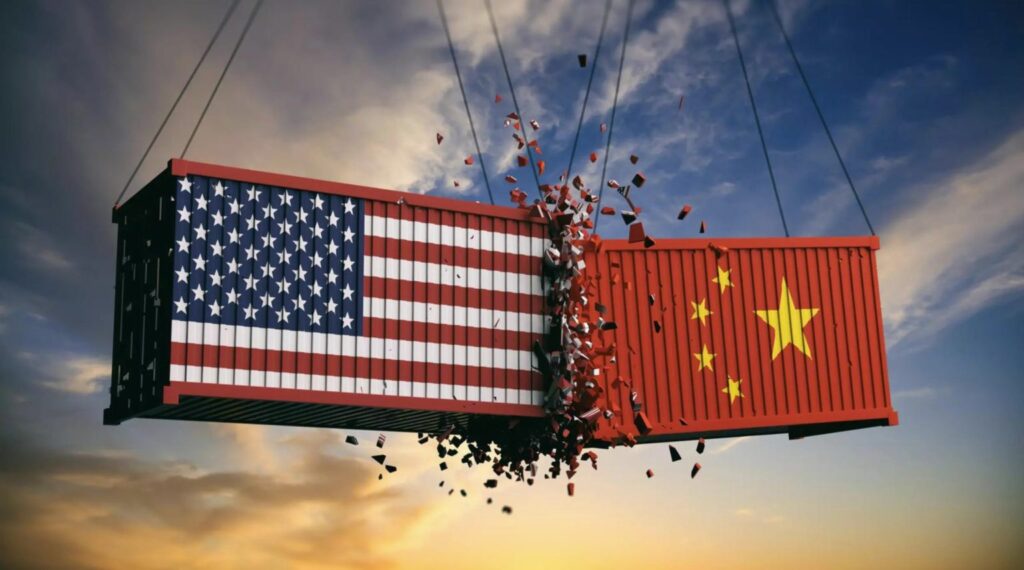
Trade barriers that are competitively escalating have the potential to swiftly expand to other economies. Despite being intended to improve trade imbalances or increase local employment, the effects are frequently intricate and pervasive.
One important concept is tariffs, which are customs taxes applied to imported goods. Both importers and consumers pay more when a nation hikes tariffs. Domestic producers may benefit from this, but it frequently leads to retaliation, with other countries imposing their own export tariffs in response. This causes protectionism to spin out of control.
Trade wars can affect the world directly or indirectly. A recent example is the declaration of a trade battle by the United States against China, Canada, and Mexico in 2025, which resulted in a significant increase in U.S. tariffs on electronics, steel, and automobiles.
Direct trade between the United States and China was predicted to decline, despite partial suspensions, by as much as 90% in extreme cases, upsetting global supply chains.
Tensions were further heightened by retaliatory tariffs from China and other countries, which caused the average U.S. tariff to reach levels not seen since the middle of the 20th century.
The financial markets and macroeconomies are affected by this disruption. The World Bank has reduced its 2025 global growth projections from 2.7% to 2.3%, citing rising tariffs and trade tensions as the main causes.
Due to tariff announcements, equity markets, particularly the S&P 500, have seen steep declines, and volatility has increased.
Ironically, market confidence has occasionally permitted more escalation, resulting in a “doom loop” whereby robust markets give protectionist policies more clout.
Tariffs also increase future costs. Since April 2025, U.S. import duties have averaged between 15 and 23 percent, which has raised production costs and ultimately resulted in higher prices for consumers, hence increasing inflationary pressures.
For instance, 145% taxes on Chinese goods caused toy merchants to confront declining inventory and increased expenses before to the 2025 Christmas season.
Macroeconomically speaking, research indicates that prolonged tariffs might lower the U.S. GDP by 1.6% to 1.6% by 2028 and, in the case of extreme retaliation, by 1% or more.
Real earnings have also decreased, and employment is shifting unevenly, with large losses in services and agriculture potentially offsetting gains in manufacturing.
Trade wars encourage friendshoring in global supply chains, which involves moving production to allies in order to avoid tariff risk.
Long-standing value chains are broken up, costs are increased, and inefficiencies are exacerbated. Some industries adjust by avoiding tariffs by passing product components through foreign nations (such as Vietnam or Mexico), which reduces supply chain transparency.
Economies are impacted in several ways. Real income has decreased by more than 3% in over half of the U.S. states, and the country experiences losses in wages, output, and growth.
Canada’s economy might go into recession, and tens of thousands of jobs could be lost in industries like auto manufacturing and energy.
China’s output decreases are less severe (~0.7%), and some trading margins are impacted, but these are frequently covered by domestic producers.
Strategic sectors are also distorted by trade disputes. If export earnings decline, supply chains for renewable energy could be hampered, slowing China’s clean energy development, a worldwide climate worry.
In conclusion, trade wars, despite their political allure, frequently have negative economic effects. In many nations, they lower wages, impede growth, cause supply chain disruptions, and fuel inflation. Financial markets are volatile, and recessionary pressures can even affect favorable trading partners. Protective tariffs may help some businesses for a short time, but the gains are frequently outweighed by global inefficiencies and wider macroeconomic effects.