
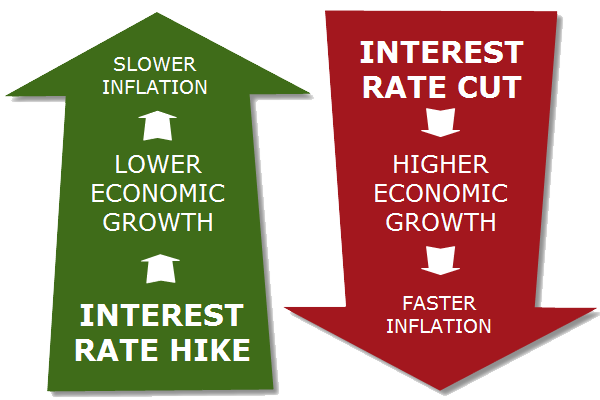
Falling interest rates make loans more affordable for borrowers, put more money in households, make it easier for businesses to finance projects, and attract more investment. In general, this results in higher capital expenditures, more robust consumption, the creation of jobs, and a more robust GDP trajectory. Additionally, lower interest rates often devalue a nation’s currency, which boosts export competitiveness and promotes overall growth, especially in export-oriented economies.
On the other hand, increasing interest rates can be used to cool down overheated economies and curb inflation. Consumer spending on credit-driven products, homes, and vehicles is reduced by higher borrowing costs. Companies that have less money tend to postpone plans for growth, reduce investment, and hire more slowly. Such tightening lowers the danger of asset bubbles and directly cuts aggregate demand, which in turn pushes inflation lower.
It takes time for rate changes to be reflected in the actual economy, though. Multiple channels, including interest rates, credit, exchange rates, and asset prices, are used by monetary policy, and its
Impacts take months or even years to manifest. The impact of a central bank’s rate changes on employment, corporate investment, consumer sentiment, and construction often becomes apparent over time.
Context is quite important. Tariffs, not just domestic demand, have contributed to the current 2.7–2.9% inflation rate in the United States. Susan Collins of the Boston Fed and other policymakers advise patience, pointing out that external price shocks may be the cause of inflation and that it may abate without drastic rate decreases. This cautious approach is reflected in the current policy rates, which range from 4.25 to 4.50% and seek to strike a balance between promoting growth and preserving price stability.
Mexico’s central bank, on the other hand, has been lowering interest rates to boost a faltering economy but cautiously, given that inflation is still higher than expected. The bank indicated fewer future rate cuts to prevent jeopardizing price stability after four straight rate reductions totaling 325 basis points; it only projects 0.2% GDP growth in 2025, according to Reuters.
Another argument is made by the UK. Following two consecutive months of GDP decline (-0.1% in April and May), the Bank of England reduced its policy rate to 4.25% in an attempt to counteract weak consumer, manufacturing, and construction demand. However, poor wage growth, rising loan costs, and sustained inflation of 3–3.4 percent may make monetary policy options more difficult.
The consequences of interest rate fluctuations might be more noticeable when examining developing economies such as Nigeria. High reserve requirements, risk premiums, and banking inefficiencies all contribute to wide interest rate spreads, which make borrowing exceedingly costly and discourage investment and slow GDP development. According to economic research, these spreads have reduced growth potential by as much as 30%, demonstrating how structural banking issues can worsen development
Studies on interest rate volatility in Nigeria also show that unpredictable rate fluctuations erode investor trust, stifle short- and long-term GDP development, and impair company confidence. This illustrates how rates’ volatility as well as their level can have an impact on economic performance.
All things considered, interest rate policy is a potent tool for influencing economic paths, but its efficacy is mostly dependent on external forces, transmission lags, context, and structural elements. If underlying supply restrictions and bank inefficiencies are not a hindrance, cutting rates can spur growth. Inflation can be controlled by raising rates, but doing so too quickly runs the danger of causing the economy to stagnate.
In order to maintain financial stability, boost growth, and stabilize inflation expectations, central banks must balance three competing objectives.
When all is said and done, interest rate policy is a powerful instrument for shaping economic trends, but its effectiveness is mostly reliant on outside factors, transmission delays, context, and structural components. Cutting rates can promote growth if underlying supply constraints and bank inefficiencies are not a barrier. Rates can be raised to manage inflation, but doing so too soon could lead to economic stagnation. Central banks must strike a compromise between three conflicting goals in order to preserve financial stability, stimulate growth, and manage inflation expectations.
Monetary policy is both powerful and complex because of this complex interaction, which affects everything from national output, currency values, and your loan payments to the larger labor market.