- Ovoramen lost his throne to gunboats. Nigeria is losing hers to loans.
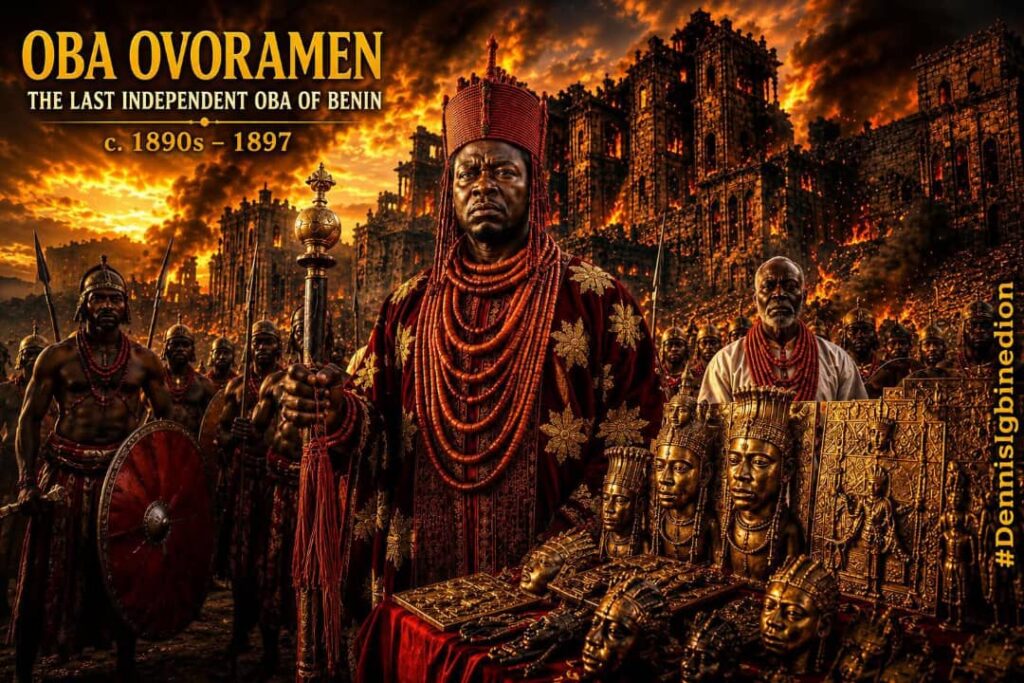
When Oba Ovoramen Nogbaisi ascended the throne of the Benin Kingdom in 1888, he inherited one of the oldest and most sophisticated political systems in West Africa. The kingdom he ruled had endured for centuries, sustained by an intricate balance of palace chiefs, town chiefs, and guilds; by a thriving economy in ivory, pepper, palm oil, and bronze casting; and by a diplomatic tradition that had negotiated with the Portuguese as equals as far back as the fifteenth century. Less than a decade later, in February 1897, British forces sacked Benin City, burned it, carted away thousands of its famous bronzes, and sent the Oba into exile in Calabar, where he died in 1914. Ovoramen was the last independent Oba of Benin. His fall was not merely the end of a reign; it was the end of an idea — the idea that an African polity could govern itself, control its own resources, and deal with the outside world on its own terms.
More than a century later, that idea remains unfinished business in Nigeria. The flags changed in 1960, but the deeper questions Ovoramen’s fall raised — who controls the resources, who sets the terms of trade, whose interests the state serves — have never been fully answered. To look honestly at Nigeria today, at its insecurity, its tribalism, its nepotism, its debt dependency, is to see the long shadow of 1897.
What Was Actually Lost in 1897
It is important to be precise about what Benin lost, because it clarifies what Nigeria has never fully regained.
First, Benin lost economic sovereignty. The immediate backdrop to the invasion was trade: British merchants and colonial officials resented the Oba’s control over commerce in the region, particularly his monopolies and customs duties on palm oil and other goods. Ovoramen insisted that trade through his territory happen on his kingdom’s terms. The 1892 “treaty” pushed on Benin, and the punitive expedition that followed the ambush of the Phillips party in January 1897, resolved that dispute by force. The lesson was brutal and simple: an African ruler who tried to set the terms of his own economy would be removed.
Second, Benin lost institutional continuity. The kingdom’s political system — for all its imperfections — was legitimate in the eyes of its people, rooted in centuries of custom, accountability rituals, and shared identity. Colonial rule replaced it with an administration designed for extraction, not representation. The state that eventually became Nigeria was built on that template: a machinery for gathering resources and keeping order, answerable upward to foreign interests rather than downward to citizens.
Third, Benin lost its wealth and its memory. The looted bronzes were not just art; they were the kingdom’s archive, its constitutional record cast in metal. Scattering them across European museums was a way of scattering the evidence that Africans had governed themselves competently for centuries.
The Colonial Template Never Left
Nigeria’s independence in 1960 transferred the offices of the extractive state to Nigerians without transforming its logic. This is the root from which today’s crises grow.
Insecurity flourishes because the Nigerian state, like its colonial predecessor, is organized around controlling revenue rather than protecting people. Where the colonial constabulary existed to secure trade routes and put down resistance, today’s security architecture too often secures oil installations and political incumbents while villages in Zamfara, Borno, and the Middle Belt are left to bandits and insurgents. A state built to protect extraction will always under-invest in protecting citizens.
Tribalism and political intolerance are likewise colonial inheritances weaponized by the post-colonial elite. The British governed by amplifying difference — indirect rule in the North, direct administration in the South, censuses and boundaries that hardened fluid identities into rigid blocs. Ovoramen’s Benin, by contrast, had absorbed and integrated diverse peoples for centuries under a shared political order. Modern Nigerian politicians did not invent ethnic mobilization; they inherited it as the cheapest tool of power, and they have used it to avoid ever being judged on performance. When every election becomes a tribal headcount, no leader needs to deliver security, schools, or hospitals.
Nepotism follows naturally. In a state where legitimacy comes from group loyalty rather than public service, appointments become spoils. The old Benin system, whatever its flaws, tied chieftaincy titles to service, achievement, and elaborate mechanisms of accountability to the Oba and the community. The modern Nigerian system ties office to connection.
Resource Mismanagement and the New Concession Hunters
The pattern of 1897 — foreign interests partnering with local intermediaries to extract wealth on unequal terms — did not end with the Royal Niger Company. It evolved. Oil production-sharing contracts negotiated with little transparency, mining licences granted while communities see neither royalties nor remediation, crude exported raw for decades while refineries rusted and fuel was imported back at a premium: these are the modern descendants of the palm oil concessions Ovoramen resisted. The nationality of the partners has diversified — European, American, Asian — but the structure is familiar: Nigeria supplies raw wealth and absorbs the environmental and social costs; value is added, and captured, elsewhere; and a domestic elite is compensated for keeping the arrangement running.
Debt as the Softer Conquest
Where the nineteenth century used gunboats, critics argue the modern era uses balance sheets. IMF and World Bank lending, from the structural adjustment programmes of the 1980s to today’s facilities, has come attached to conditions — devaluation, subsidy removal, austerity, trade liberalization — that many Nigerians experience as decisions made about them without them. Whatever the stated intentions, the observable cycle is hard to deny: borrow to cover deficits created by mismanaged resources, accept conditions that deepen hardship and dependence on imports, then borrow again to service the last loan. A country that spends a crippling share of its revenue on debt service is not fully sovereign in any meaningful sense; its budget is written, in part, by its creditors. Ovoramen at least knew he was facing an invasion. Debt dependency is quieter, and it is signed for voluntarily by leaders insulated from its consequences — which makes it, in some ways, harder to resist.
What a Truly Independent Nigeria Would Look Like
Ovoramen’s Benin offers not nostalgia but a standard. A truly independent Nigeria would, like the old kingdom at its best, insist on setting the terms of its own economy: processing its oil, gas, and minerals at home; negotiating contracts in the open; taxing extraction to build what lasts. It would fund its development primarily from its own plugged leakages — the billions lost yearly to theft, waste, and opaque subsidies — rather than from loans whose conditions it does not control, borrowing, when necessary, on terms it can publish and defend to its citizens.
It would rebuild legitimacy from below: security forces recruited from and answerable to the communities they protect; a public service where office is earned, not allocated by ethnicity; leaders judged by delivery rather than tribe, so that political competition becomes an argument about performance instead of a mobilization of fear. And it would recover its memory — not only the physical return of the Benin Bronzes, now slowly underway, but the deeper reclamation of confidence they represent: the knowledge that self-government is not an experiment Nigerians are attempting for the first time, but an inheritance interrupted.
Ovoramen lost his kingdom because the world of 1897 permitted sovereignty to be taken by force. Nigeria’s sovereignty today is not taken; it is traded away in increments — a concession here, a loan condition there, an election reduced to a tribal census. The last independent Oba of Benin could not choose his fate. Nigerians can. That is the difference, and the challenge.