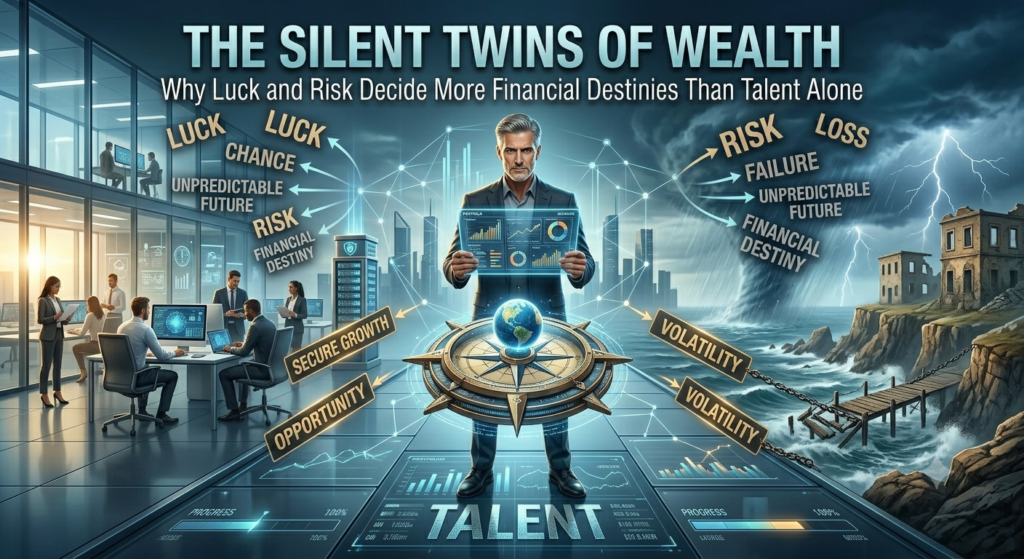
- The Dangerous Lie That Hard Work Alone Makes People Wealthy — And Why Every Investor Must Respect Risk
- Before You Envy the Rich or Mock the Broke, Understand the Hidden Forces Behind Every Financial Outcome
The Part of Money Nobody Likes to Admit
There is a dangerous arrogance that enters a man’s heart when success begins to smile at him. He looks at his bank account, his properties, his rising business, his growing influence, and he begins to believe that every result came purely from his intelligence, discipline, prayer, strategy, and hard work. He forgets the unseen doors that opened without noise. He forgets the accidents that did not happen. He forgets the helper who showed up at the right time. He forgets the market wave he entered before it became crowded. He forgets that another person, equally hardworking and perhaps even wiser, entered the same road and met a pothole that swallowed his capital.
This is one of the most humbling truths about money: luck and risk are twins wearing different clothes.
Luck is when uncertainty favours you.
Risk is when uncertainty wounds you.
Both are born from the same mother: a world too complex for human effort to control completely.
You can wake up early, work hard, save money, study investing, build relationships, pray, plan, and still face outcomes you did not invite. That is not because effort is useless. Effort is powerful. Discipline matters. Knowledge matters. Character matters. But no serious student of money should ever make the mistake of believing that effort alone explains every financial result.
“Hard work is the seed, but uncertainty is the weather. A farmer can plant well and still need rain.”
This is the lesson many Nigerians and Africans need to understand in this season of inflation, exchange rate pressure, job insecurity, business instability, rising rent, black tax, and the emotional storm called “sapa.” Some people are not poor because they are lazy. Some businesses did not collapse because the owners were foolish. Some investors did not lose money because they were greedy. Sometimes they simply ended up on the painful side of probability.
And some people did not become wealthy only because they were geniuses. Sometimes they stood where opportunity passed.
The Core Philosophy: Luck and Risk Are the Same Force in Different Directions
Every outcome in life is influenced by things inside your control and things outside your control. Your effort, skill, patience, discipline, savings habit, research, negotiation ability, emotional control, and courage are inside your circle of influence. But outside that circle are inflation, government policy, exchange rate swings, sudden illness, betrayal, market timing, family emergencies, pandemics, political instability, industry disruption, regulatory changes, and plain randomness.
This is why two people can take similar actions and get different results.
Two young Nigerians can start the same POS business in different locations. One location becomes a goldmine because a new market opens nearby. The other struggles because insecurity increases and customer traffic disappears.
Two people can buy land. One area becomes the next Lekki corridor. The other becomes trapped in land dispute.
Two friends can invest in crypto. One enters before a bull run and becomes the “investment genius” of the family WhatsApp group. The other enters later, buys the same asset, and becomes the warning example everyone uses during family meetings.
Two graduates can apply for jobs. One meets an interviewer who likes his school, accent, energy, and timing. Another with better qualifications meets a company under hiring freeze.
That is life.
“The same decision can make one man look wise and another man look foolish, depending on the season that meets them.”
This does not mean we should surrender to chance. It means we should become wiser, humbler, and more strategic. The wise person does not ignore luck. The wise person builds systems that can survive bad luck and maximize good luck.
The Psychology: Why We Ignore Luck in Success and Overblame Risk in Failure
Human beings are poor judges of outcomes. We love clean stories. We want every success to have a heroic explanation and every failure to have a moral lesson. This is why society often says, “He made it because he is smart,” and “She failed because she was careless.”
But life is not always that tidy.
Behavioural economics teaches us that people suffer from outcome bias. This means we judge the quality of a decision based on the result, not based on the process. If a man borrows ₦5 million to invest in a risky scheme and it doubles, people call him bold. If the same scheme crashes, they call him foolish. But the decision was risky before the result arrived.
We also suffer from survivorship bias. We study only the winners and forget the graveyard of people who took similar steps and disappeared. We listen to the billionaire who says, “I dropped out of school and followed my passion,” but we ignore thousands who dropped out, followed passion, and ended up begging for another chance.
This is dangerous because it teaches people to copy outcomes without understanding conditions.
A Nigerian sees someone making money from importation and rushes into the business without understanding exchange rate exposure, customs charges, supplier fraud, logistics delay, and inventory risk. Another sees someone succeeding in real estate and jumps in without checking title documents, land history, government acquisition, drainage plans, and liquidity risk. Another hears that someone made money from poultry and enters without understanding feed cost, disease control, mortality rate, and market timing.
Then when loss comes, they say, “Village people.”
No, my brother. Sometimes it is not village people. Sometimes it is probability collecting its tax.
“When you copy a man’s success, make sure you also study the risks he survived, the help he received, and the luck he may never confess.”
Luck is uncomfortable because it reduces the ego of successful people. Risk is uncomfortable because it threatens the confidence of ambitious people. So we prefer motivational lies. We say, “Just believe.” We say, “Failure is not my portion.” We say, “Nothing can go wrong.” But finance does not respect empty confidence. Markets punish denial. Business punishes poor preparation. Life punishes arrogance.
Faith is powerful, but faith is not foolishness. Wisdom builds an ark before the rain.
The Mechanics: How Luck and Risk Work in Wealth Creation
Every serious wealth builder must understand probability. Not every good decision produces a good outcome. Not every bad decision produces an immediate bad outcome. This is where many people get deceived.
A trader can make money from a reckless trade and think he has discovered wisdom. A business owner can survive without proper records for years and assume documentation is unnecessary. A family can live without health insurance until one medical emergency wipes out ten years of savings. A man can drive without proper vehicle insurance and feel smart until accident comes.
Risk often hides during good times.
That is why intelligent investors do not only ask, “How much can I make?” They ask, “What can destroy me?” They ask, “What happens if I am wrong?” They ask, “Can I survive if the exchange rate moves against me?” They ask, “Can I still feed my family if this business delays profit for six months?” They ask, “What if the tenant does not pay?” They ask, “What if the customer defaults?” They ask, “What if the platform crashes?” They ask, “What if government policy changes?”
This is not fear. This is financial maturity.
“The amateur counts profit first. The professional counts survival first.”
In investing, risk management is not about avoiding all risk. That is impossible. Everything worth pursuing has uncertainty. Marriage has risk. Business has risk. Career change has risk. Investing has risk. Remaining in one place also has risk. Even doing nothing has risk because inflation quietly steals the value of idle money.
The goal is not to eliminate risk. The goal is to take risks that are intelligent, measured, affordable, and survivable.
A man who puts all his savings into one investment because someone promised 10% monthly return is not investing; he is gambling with grammar. A woman who builds an emergency fund, diversifies her income, learns before investing, avoids debt traps, and still takes calculated opportunities is not afraid; she is wise.
Luck favours exposure. Risk punishes overexposure.
You need enough exposure to opportunity to benefit when luck comes, but not so much exposure that one bad outcome destroys your financial life.
The Nigerian and African Context: Why This Lesson Is Urgent Now
In Nigeria and across Africa, the role of luck and risk is even more visible because the environment itself carries volatility. A business owner can plan well, only for diesel price to rise. A salary earner can budget carefully, only for food inflation to scatter the plan. A parent can save school fees, only for exchange rate changes to double foreign tuition. A young person can invest in “Japa” plans, only for visa rules to change. A landlord can increase rent because construction cost rose, while tenants suffer because salary did not rise.
This is the African financial battlefield.
There are people who bought dollars early and looked like prophets. There are people who kept all savings in naira and watched purchasing power bleed. There are people who bought land before road development and became rich quietly. There are people who bought land in the wrong place and entered court for ten years. There are people who started online businesses before digital adoption exploded. There are people who entered the same space later and met saturation, ads cost, logistics frustration, and customer distrust.
Same continent. Same hustle. Different outcomes.
This is why we must stop giving lazy explanations for people’s financial lives.
Do not see a struggling man and automatically call him unserious. You do not know the medical bill that hit his family. You do not know the business partner who betrayed him. You do not know the loan he took for a sibling. You do not know the black tax he carries. You do not know the opportunity that failed after he had done his part.
And do not see a successful man and automatically worship him as if he controls the universe. Celebrate his discipline, yes. Learn from his strategy, yes. Respect his courage, yes. But do not forget that timing, access, family background, networks, industry wave, and chance may have played roles too.
“Humility is not denying your effort. Humility is remembering that your effort did not work alone.”
The Danger: The Financial Traps That Come From Misunderstanding Luck and Risk
When people ignore luck, they become arrogant. When they ignore risk, they become reckless. Both mistakes are expensive.
The arrogant successful person begins to believe every opinion he has is wisdom. Because one business worked, he thinks every business idea he touches will succeed. Because one investment paid, he thinks he understands all markets. Because one season favoured him, he mistakes a tailwind for permanent genius.
This is how wealthy people lose wealth.
They increase their lifestyle too fast. They borrow too aggressively. They stop listening. They insult caution. They confuse confidence with competence. Then one bad cycle exposes the weakness that success covered.
On the other side, the person who has experienced failure may become bitter, ashamed, or permanently afraid. Because one business failed, he says business is not for him. Because one investment went bad, he says all investments are scams. Because one helper disappointed him, he refuses partnership forever. But failure does not always mean you are foolish. Sometimes failure is feedback. Sometimes it is tuition. Sometimes it is risk showing you the part of the equation you ignored.
The danger is drawing the wrong lesson from both success and failure.
Success should teach gratitude, not arrogance.
Failure should teach wisdom, not paralysis.
“Never let success make you careless, and never let failure make you hopeless.”
Another trap is hero worship. Many people worship financial influencers, business gurus, crypto prophets, real estate kings, and motivational speakers without asking hard questions. They see the cars, the houses, the screenshots, the luxury trips, the confident voice, and they assume the person has mastered money. But a loud result is not always proof of a sound process.
Some people are lucky before they are exposed. Some people are rich on borrowed money. Some people are marketing confidence, not wisdom. Some people are showing you harvest while hiding the debt, pressure, and risk behind the farm.
This is why the Business Apostle must speak plainly: do not outsource your financial thinking to another person’s highlight reel.
The Blueprint: How to Build Wealth While Respecting Luck and Risk
The first practical lesson is to judge your decisions by process, not just outcome. Before you invest, ask whether the logic is sound. What is the asset? How does it generate value? What can go wrong? Who is managing it? How liquid is it? What is the downside? What evidence supports the expected return? If you cannot explain how the money is made, you are not investing; you are donating your peace of mind to uncertainty.
The second lesson is to build a margin of safety. This means leaving room for error. Do not plan your life as if everything will go perfectly. If your rent is ₦2 million, do not wait until the last month before you start preparing. If your business depends on imported goods, do not price products as if exchange rate will remain stable forever. If you are borrowing, do not assume sales will always be smooth. If you are investing, do not put emergency money into long-term or volatile assets.
The third lesson is diversification. This does not mean scattering money foolishly. It means not allowing one failure to destroy everything. Have different sources of income if possible. Do not keep all savings in one weak structure. Do not put all investment capital into one opportunity. Do not depend forever on one customer, one platform, one supplier, one employer, or one country’s economy if you can gradually build alternatives.
The fourth lesson is emotional discipline. Luck can make you overconfident. Risk can make you fearful. You need a stable inner compass. When you win, do not increase your appetite for stupidity. When you lose, do not abandon wisdom. Money rewards those who can remain sane in both favour and fire.
The fifth lesson is record keeping. Many Africans run businesses with spiritual confidence but no financial data. They do not know their true profit. They do not separate personal spending from business money. They do not track cash flow. They do not price risk. They do not calculate hidden costs. Then they blame enemies when the business collapses. No, sir. Numbers are not Western culture. Numbers are survival tools.
“What you do not measure, you will eventually mismanage.”
The sixth lesson is to prepare for bad luck before it arrives. Build emergency funds. Insure what can ruin you. Avoid unnecessary debt. Keep your health seriously. Protect your reputation. Maintain relationships. Learn valuable skills. Keep some liquidity. Create options. A person with options can survive storms that bury people who are trapped.
The seventh lesson is to increase your surface area for good luck. Meet people. Learn skills. Publish your ideas. Start small projects. Show up where opportunity gathers. Build competence. Help others. Improve your communication. Study trends. Position yourself. Luck often looks random, but it visits prepared people more often because prepared people are visible when opportunity is moving.
A young person learning tech, sales, writing, AI tools, finance, logistics, design, or data analysis is increasing the surface area for luck. A business owner who documents processes, treats customers well, builds online presence, and manages cash flow is increasing the surface area for luck. An investor who studies patiently and avoids emotional gambling is increasing the surface area for luck.
Luck may not be controllable, but preparation makes you easier for luck to find.
The Wealth Psychology of Humility
The deeper lesson here is humility. Not weakness. Not timidity. Not lack of ambition. Humility is accurate self-assessment. It is knowing that you matter, but you are not the whole equation.
A humble investor does not say, “I can never lose.” He says, “I may be wrong, so let me size this wisely.”
A humble entrepreneur does not say, “My business cannot fail.” She says, “Let me build systems, reserves, and customer trust so I can survive hard seasons.”
A humble salary earner does not say, “My job is secure forever.” He says, “Let me grow skills, save money, and build options.”
A humble successful person does not mock the struggling. He remembers that life can turn.
A humble struggling person does not envy the successful blindly. He learns what he can, rejects shame, and keeps building.
This is the kind of financial wisdom Africa needs. Not noise. Not fake luxury. Not motivational intoxication. Not poverty glorification. Not reckless risk-taking baptized as faith. We need disciplined courage.
“Respect luck enough to stay grateful. Respect risk enough to stay prepared.”
The Benediction: Walk Boldly, But Walk Wisely
You are not powerless. Never believe that lie. Your effort matters. Your discipline matters. Your habits matter. Your knowledge matters. Your network matters. Your courage matters. Your prayers matter. Your ability to delay gratification matters. Your willingness to learn from failure matters.
But you are also not God. You do not control every outcome. You cannot command every market. You cannot predict every policy. You cannot prevent every betrayal. You cannot see every storm before it forms.
So, build your financial life with both faith and wisdom.
Dream big but calculate risk.
Work hard but remain humble.
Invest boldly but protect your downside.
Celebrate success, but do not worship it.
Learn from failure, but do not let it bury your spirit.
When luck smiles on you, do not become proud. Use the favour to build systems, help others, and prepare for seasons that may not clap for you.
When risk wounds you, do not conclude that your destiny is over. Pain is not always punishment. Sometimes it is instruction. Sometimes it is redirection. Sometimes it is the school fees wisdom collects before promotion.
The world is complex. Outcomes are never fully under your control. But your response, your preparation, your discipline, your humility, and your persistence remain powerful.
That is where your dignity lives.
That is where your future is rebuilt.
That is where wealth begins to respect you.
Subscribe to Naija Street Matters for regular news update and click on the Whats-app green button below to join our community.