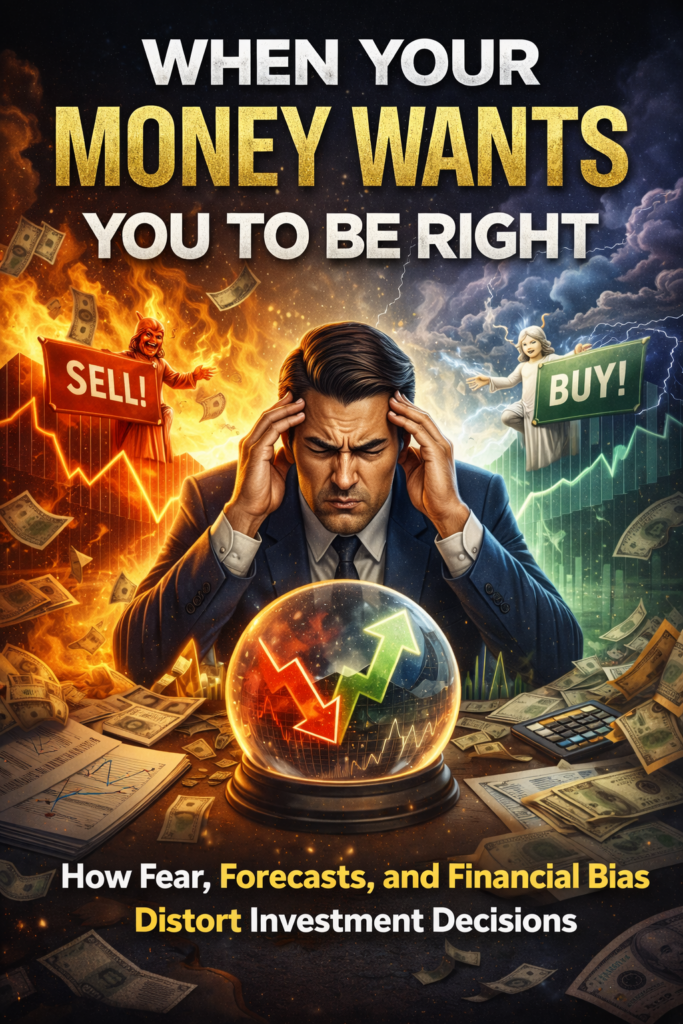
- Why Smart Investors See Doom After They Bet on Doom: The Hidden Bias Destroying Financial Judgment
- When Your Money Starts Praying for Bad News: How Fear and Ego Trap Investors Before the Market Does
Money does not only live in bank accounts, stocks, real estate, businesses, treasury bills, crypto wallets, or investment platforms. Money also lives inside our emotions. It sits quietly inside our fear, pride, hope, ego, reputation, identity, political loyalty, social status, and deep need to be right.
That is why financial decisions are rarely as neutral as people think.
A man sells all his stocks because he believes a recession is coming. From that moment, every negative headline begins to look like confirmation. A company lays off workers, and he says, “I told you.” The exchange rate moves badly, and he says, “Can you see?” A bank stock drops for two days, and he says, “The crash has started.” Even when the market recovers, he calls it temporary. Even when good earnings appear, he calls them manipulation. Even when the evidence becomes mixed, his mind has already chosen a direction.
Why?
Because his money is now positioned for doom.
And when your money is positioned for a certain outcome, your mind may begin to search for evidence that the outcome must happen.
This is one of the most dangerous forces in finance. Not uncertainty. Not volatility. Not recession. Not inflation. Not even market crashes. The deeper danger is the way people bend reality to defend decisions they have already made.
A person who buys land in a developing area begins to interpret every small road grading, every fence construction, every rumour of a new estate, every truck passing nearby as proof that the location will soon explode in value. A business owner who borrows heavily to launch a new idea begins to treat every compliment as market validation, even when customers are not paying. A salary earner who converts all savings to dollars because of naira fear begins to see every exchange-rate movement as evidence that he is a genius, even when he has created liquidity problems for himself. A person who joins a Ponzi scheme begins to defend it because admitting danger means admitting possible loss.
This is not because people are foolish. It is because human beings are emotional creatures. We often protect our decisions before we protect the truth.
So the question every serious investor, entrepreneur, policymaker, salary earner, business owner, and wealth builder must ask is this:
Am I reading reality clearly, or am I looking for evidence that protects my decision?
When Your Forecast Becomes Your Master
A forecast is supposed to serve you. It is supposed to guide planning, not control your mind. But many people allow one forecast to become the commander of their entire financial future.
They say, “The economy will collapse,” and suddenly they interpret everything through collapse. They say, “The stock market will crash,” and every minor decline becomes prophecy fulfilled. They say, “This land will become the next Lekki,” and every small sign becomes proof of destiny. They say, “This business will blow,” and every friendly compliment becomes evidence of demand. They say, “This crypto will recover,” and every small green candle becomes the beginning of a bull run.
That is how a forecast becomes a master.
The danger is not that people make predictions. Everybody makes predictions. Every investment is a prediction. Every business decision is a prediction. Every land purchase is a prediction. Every hiring decision is a prediction. Every loan application is a prediction. Every decision to save, spend, relocate, invest, or expand is built on some expectation about the future.
The danger begins when people stop treating predictions as probabilities and start treating them as identity.
Once a prediction becomes identity, changing your mind feels like humiliation. Accepting contrary evidence feels like betrayal. Listening to opposing views feels like weakness. At that point, you are no longer asking, “What is true?” You are asking, “What proves I was right?”
And that is where financial blindness begins.
The Mind Sees What the Money Wants
The mind often sees what the money wants to prove.
Once your ego enters your investment account, every headline becomes dangerous. You no longer read news for understanding; you read it for confirmation. You no longer study markets for clarity; you study them to defend your position. You no longer listen to experts to learn; you listen only to the ones who agree with you.
This is called confirmation bias.
Confirmation bias is the tendency to notice and accept information that supports what you already believe, while ignoring or rejecting information that challenges it. In finance, this bias can be extremely expensive.
An investor who has sold his shares because he expects a crash will pay more attention to bad news than good news. If the market falls slightly, he feels intelligent. If the market rises, he dismisses it as temporary. If companies report profits, he says the numbers are not sustainable. If analysts become optimistic, he says they are deceiving people. His mind has become a lawyer defending his decision.
But confirmation bias is not alone. It travels with other dangerous relatives.
There is motivated reasoning, where people use intelligence not to find truth but to defend what they want to believe. There is loss aversion, where the pain of admitting a mistake becomes stronger than the desire to make a rational decision. There is sunk cost fallacy, where people keep funding a failing decision because they have already spent too much to turn back. There is ego protection, where people would rather lose money quietly than admit publicly that they were wrong. There is narrative bias, where a good story becomes more convincing than hard evidence. There is herd mentality, where people believe something is safe because many people around them believe it too.
Then there is cognitive dissonance—the mental discomfort that appears when reality challenges what you believe. Instead of adjusting, many people attack the evidence.
This is why smart people can misread the economy. This is why educated investors can defend bad decisions. This is why business owners can ignore warning signs. This is why political supporters can interpret economic data through loyalty rather than reality. This is why people in investment schemes keep saying, “They are still paying,” even when the structure is already showing danger.
The issue is not intelligence. The issue is attachment.
When your money needs you to be right, your eyes may stop seeing clearly.
Why Policymakers Struggle to Say the Word “Recession”
It is not only individuals who struggle with biased interpretation. Policymakers, economists, public officials, and political actors also face incentives that make objective forecasting difficult.
A policymaker may avoid predicting a recession because saying it publicly can create panic, damage investor confidence, weaken public trust, expose policy failures, or complicate their career. Even when warning signs are visible, the language may become soft. Instead of saying “recession risk,” they may say “temporary adjustment.” Instead of saying “economic weakness,” they may say “transition.” Instead of saying “hardship,” they may say “reform pain.”
This does not always mean they are lying. Sometimes, they are managing expectations. Sometimes, they are trying to prevent panic. But sometimes, incentives can blind them to reality.
The same thing happens in politics. A supporter of a government may refuse to acknowledge economic weakness because doing so feels like betraying the party. An opponent may refuse to acknowledge progress because doing so weakens their criticism. Both sides may look at the same inflation, exchange rate, unemployment, or growth data and see two different countries.
Why?
Because they are not only reading data. They are defending identity.
This is dangerous because money decisions made through political loyalty can destroy households. Your investment plan should not be controlled by party emotion. Your business strategy should not be built on propaganda. Your savings plan should not depend on who you like or hate in government. The economy does not care about your political affection. Prices do not reduce because you are loyal. Exchange rates do not obey your party card. Markets do not reward emotional citizenship.
A wise person can have political views and still protect financial judgment.
When Investors Start Praying for the Market to Fall
There is a strange thing that happens when someone sells out of the market too early. Secretly, they begin to want the market to fall.
Not because they hate other investors. Not because they love suffering. But because a falling market proves them right.
This is one of the most subtle emotional traps in investing. A person sells stocks because they fear a crash. If the market rises afterward, they feel regret. So they begin to welcome bad news. They begin to feel relief when prices drop. They begin to share pessimistic forecasts. They begin to look for experts predicting doom. Their financial position has created an emotional appetite.
At that point, their mind is no longer neutral.
This is why investors must be careful with all-or-nothing decisions. When you move all your money into cash, you may start wanting assets to fall. When you move all your cash into stocks, you may start ignoring risk. When you convert everything to dollars, you may start wanting the naira to fail. When you buy only land, you may start dismissing liquidity problems. When you invest everything in one business, you may start treating every warning as negativity.
The best investors do not need the future to obey their emotions. They build systems that can survive even when their forecast is wrong.
That is the real game.
The Economy Does Not Care About Your Prediction
The economy does not care about your prediction. The market does not exist to validate your opinion. The naira does not move to protect your ego. A stock does not rise because you bought it. Land does not appreciate because you announced it. A business does not succeed because you love the idea. A Ponzi scheme does not become safe because your friend has withdrawn once.
Reality is not loyal to your forecast.
This is why financial humility is not weakness. It is survival.
A wise investor understands that markets can recover when everyone expects collapse. Markets can fall when everyone expects growth. Good businesses can suffer temporarily. Bad investments can look good for a while. A single headline does not define the future. A single data point does not complete the story. A loud influencer does not replace due diligence.
Financial maturity is the ability to change your mind before reality forces you to.
That is why the best investors do not worship prediction. They respect preparation.
Preparation Is Wisdom; Panic Is Expensive
Prediction says, “I know exactly what will happen.”
Preparation says, “I do not know exactly what will happen, so I will build a plan that can survive different outcomes.”
That difference is everything.
A person who predicts recession may sell everything and sit in cash for years. But a person who prepares for recession may keep an emergency fund, reduce unnecessary debt, diversify investments, maintain liquidity, improve income skills, avoid reckless borrowing, and still remain positioned for opportunities.
A person who predicts naira collapse may convert every naira to dollars and create daily living stress. But a person who prepares for currency risk may hold some foreign currency exposure, some local assets, some income-producing investments, and enough naira liquidity for obligations.
A person who predicts stock market collapse may run away completely. But a person who prepares for volatility may adjust asset allocation, keep cash for opportunities, buy quality gradually, diversify across sectors, and avoid overexposure.
Preparation protects wealth. Panic destroys judgment.
A wise investor prepares for recession without becoming addicted to bad news. He prepares for opportunity without worshipping optimism. He protects capital without allowing fear to become his financial religion.
There is a difference between being cautious and being permanently afraid.
Caution asks questions. Fear refuses to move.
Caution studies risk. Fear sees risk everywhere.
Caution prepares for downside. Fear builds a house inside pessimism.
Caution protects capital. Fear prevents growth.
Do not let fear become your financial religion.
The Rich Prepare for Many Futures; the Poor Bet Everything on One Emotion
Poverty often trains people to think in extremes. When money is scarce, every decision feels like survival. People become desperate for certainty. They want one answer, one miracle, one investment, one opportunity, one person, one forecast that will save them.
But wealth builders think differently.
They do not bet everything on one emotion. They prepare for many futures. They understand that the future can disappoint both optimists and pessimists. So they build structures instead of relying only on predictions.
That is where asset allocation comes in. Asset allocation means spreading money across different types of assets based on goals, risk tolerance, time horizon, and liquidity needs. It may include cash, treasury bills, stocks, real estate, business capital, foreign currency exposure, and other investments depending on the individual situation.
Diversification protects you from being destroyed by one wrong forecast. Position sizing prevents one mistake from ruining your life. Liquidity planning ensures you are not forced to sell assets at the worst time. Rebalancing helps you bring your portfolio back to discipline when emotions or market movements distort it. Margin of safety prevents you from overpaying for an attractive story. Scenario planning asks, “What if I am wrong?”
This is how wealthy thinkers behave.
They do not need to know the future perfectly. They need a plan strong enough to survive uncertainty.
A Bad Headline Is Not Always a Bad Future
In Nigeria and Africa, people make financial decisions under real pressure. Inflation can hurt families. Exchange-rate instability can disrupt businesses. Unemployment can create fear. Infrastructure weakness can increase operating costs. Political uncertainty can make planning difficult. Social responsibility can drain savings. School fees, rent, healthcare, generator fuel, transport, and family obligations can press people from every side.
These pressures are real.
But emotional bias can still destroy judgment.
A business owner who says “Nigeria is finished” may refuse to expand, hire, invest, or innovate. Every bad headline becomes proof. Meanwhile, another entrepreneur in the same environment studies demand, solves a painful problem, builds distribution, and grows. The difference is not that one is blind to reality. The difference is that one turned pessimism into prison while the other turned difficulty into strategy.
A salary earner may delay investing forever because “the economy is too bad,” while inflation quietly destroys idle cash. A real estate buyer may insist an area will explode in value and ignore title issues. A crypto trader may see every small price recovery as proof of a major bull run. A Ponzi participant may defend the scheme because admitting the truth would mean facing loss. An NGX investor may sell because of recession fear and then interpret every market decline as proof, even if fundamentals remain strong.
A bad headline is not always a bad future.
Sometimes, it is noise. Sometimes, it is warning. Sometimes, it is temporary. Sometimes, it is structural. Wisdom is knowing the difference.
Before You Trust Your Economic Opinion, Ask These Questions
Before you make a major financial decision, pause. Do not let one headline, one fear, one forecast, one influencer, one political opinion, or one market movement control your money.
Ask yourself:
What do I want to happen?
What financial decision have I already made?
Am I looking for truth or confirmation?
What evidence would prove me wrong?
Am I overreacting to one headline?
Am I confusing a temporary blip with a permanent trend?
Am I making an all-or-nothing decision?
Can my plan survive if my forecast is wrong?
Who benefits if I believe this narrative?
Am I protecting my money or protecting my ego?
Am I preparing wisely or panicking emotionally?
Have I considered the opposite possibility?
What would a neutral observer see that I am refusing to see?
These questions may not make you perfect, but they can make you wiser. They force your mind to slow down before emotion hijacks your wallet.
Then take practical steps.
Avoid making major financial decisions in emotional extremes. Keep an emergency fund before investing aggressively. Diversify instead of betting everything on one forecast. Review investments based on evidence, not pride. Write down why you made a decision before your emotions rewrite the story. Set rules before crises happen. Seek opposing views from competent people. Prepare for recession, but do not worship recession. Prepare for opportunity, but do not worship optimism.
The goal is not to remove emotion completely. That is impossible.
The goal is to stop emotion from becoming the chairman of your financial life.
Do Not Let One Forecast Become the Prison of Your Future
One forecast can ruin a person if they build their entire life around it.
Some people predicted permanent stock market collapse and missed recovery. Some predicted endless naira stability and ignored currency risk. Some predicted land would always appreciate and got trapped in illiquid, disputed property. Some predicted a business would boom and kept borrowing after customers rejected the offer. Some predicted a Ponzi would keep paying and lost everything. Some predicted a political miracle and made no personal financial plan.
Do not let one forecast become the prison of your financial future.
It is better to build a plan that survives uncertainty than to build your life around a prediction.
The best investors know they can be wrong. The economy can surprise them. Markets can remain irrational longer than investors can remain patient. A strong opinion can become weak when facts change. A frightening period can create opportunity. A booming period can hide danger.
Humility is one of the greatest investment tools because it reminds you that the future is bigger than your opinion.
Your Financial Plan Must Be Stronger Than Your Forecast
At the end of the day, financial wisdom is not about pretending to know the future perfectly. It is about preparing intelligently, thinking clearly, managing risk, protecting capital, investing patiently, and refusing to let emotions distort reality.
You do not need perfect forecasts to build wealth. You need disciplined systems.
You need emergency savings. You need income growth. You need controlled spending. You need diversified assets. You need liquidity. You need patience. You need risk management. You need humility. You need the courage to invest when evidence supports it and the wisdom to step back when risk is too high.
Most importantly, you need the ability to separate your identity from your financial opinion.
You are not your forecast.
You are not weak because you changed your mind.
You are not foolish because you reviewed your position.
You are not a failure because you admitted uncertainty.
The true failure is refusing to see clearly because your ego wants applause.
Do not let your money turn your eyes against the truth. Do not let your fear become your prophet. Do not let your pride become your portfolio manager. Do not let one forecast become the commander of your future.
Prepare wisely. Invest humbly. Manage risk carefully. Build patiently.
The future will surprise everyone.
Make sure your financial life is strong enough to survive the surprise.
Final Call to Action
Think deeper. Question your forecasts. Manage risk wisely. Prepare without panic. Invest with humility. Build diversified assets. Protect capital. Avoid emotional all-or-nothing decisions. Study before acting. Choose truth over ego. Build wealth intentionally and patiently.
When your money wants you to be right, your mind may try to edit reality.
Do not allow it.
Let truth lead. Let wisdom guide. Let discipline protect. Let patience compound.
That is how wealth is built.