

- Every Nigerian startup enters the valley. Only prepared founders and ecosystems exit.
- Read this before your next pitch; it might save your startup’s life.
When I talk about the valley of death in entrepreneurship, I’m not describing a physical place; I’m describing a stage I’ve seen over and over again in business journeys across Nigeria. Whether in Lagos, Kano, Port Harcourt or smaller cities and towns, entrepreneurs eventually hit a quiet but dangerous stretch where their dreams are tested, their cash is burning, and the future of the business hangs in the balance. That is the valley of death: the period between having a promising idea and building a business that can stand on its own feet.
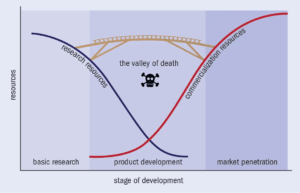
At the start of any venture, excitement is high. There is an idea, maybe even a prototype or a small group of pilot customers. At the other end of the journey, if things go well, there is regular revenue, a growing customer base and the ability to at least pay salaries and basic bills. But between these two points lies a long stretch where the business consistently spends more money than it earns. Rent, salaries, fuel, data, marketing, registration, licenses and technology costs all pile up while sales remain small and inconsistent. This is the reality many Nigerian entrepreneurs face, and this phase can last not just months but sometimes years.
Because of our context, most founders here rely on personal savings, small contributions from family and friends, cooperative societies, or small grants from competitions to survive this period. Banks often feel distant and inaccessible: they tend to demand collateral, a strong financial history and detailed documentation that many early-stage businesses simply do not have. In this fragile stage, almost anything can push a startup to the edge. One new government policy, one major customer walking away, or a sudden currency swing can force a business that was already struggling to finally close its doors. The valley of death is therefore feared not because our ideas are weak, but because the financial and institutional support to sustain those ideas is thin.
Nigeria’s wider economic environment deepens this valley. Power supply remains unreliable, forcing small businesses to spend heavily on generators and diesel. Poor roads, traffic and security challenges make logistics more expensive than they should be. Multiple taxes and levies can appear from federal, state and local authorities. Inflation reduces the real income of customers, while volatility in the foreign exchange market pushes up the cost of imported raw materials and equipment. A founder may plan carefully and calculate a six-month financial runway, only to watch it shrink to three months when fuel prices or rent suddenly jump. The valley becomes steeper, and the risk of running out of cash becomes painfully real.
However, I do not see entrepreneurs walking alone in a vacuum. Around every business is what I describe as an entrepreneurial ecosystem—a web of actors and institutions that can either help build bridges across the valley of death or make that valley even more treacherous. This ecosystem includes investors, banks, microfinance institutions, government agencies, universities, innovation hubs, accelerators, professional service providers, corporate buyers, the media and community networks. When these pieces connect well, they create an environment where more ideas can mature into sustainable companies. When they are disconnected or biased, they leave entrepreneurs struggling on their own.
In Nigeria, I see an ecosystem that is growing and energetic, yet uneven. Lagos stands out as a major startup hub on the continent. Co-working spaces, tech hubs and accelerators offer young businesses not just desks and internet, but also mentoring, networks and occasionally early-stage funding. Government initiatives and donor programmes provide training, grants and loans to micro, small and medium-sized enterprises. Industry associations create channels between startups and regulators, banks and big corporations. International accelerators now deliberately scout for African founders, giving them exposure to global mentors and investors. To me, these are the green shoots of a more supportive environment.
At the same time, I have to acknowledge how patchy this support is. Tech-enabled startups—especially in fintech—attract most of the attention and capital. Traditional businesses in manufacturing, agro-processing, local services or education often remain in the shadows. Geographically, Lagos and a handful of big cities dominate the map, while many talented entrepreneurs in other states operate with almost no access to hubs, networks or sophisticated investors. In the crucial funding range between tiny microcredit and large institutional capital, there is still a major gap. I call this the missing middle, and it is precisely where many businesses need help to move from pilot operations to stable, revenue-generating growth.
Because of these gaps, the valley of death in Nigeria is not just a cashflow problem within one company; it is a mirror of weaknesses in the ecosystem around it. When there are too few angel investors willing to take a risk on young but promising enterprises; when banks are unwilling or unable to design financial products suited to early-stage ventures; when policy is unclear or changes suddenly; when universities operate in isolation from industry and do not convert research into real products—then the valley widens. Founders must cross using only their personal resources, hustle and sheer determination.
To make this more concrete, I use a simple illustration in my piece. I describe a young founder in Abuja who builds a digital platform connecting local farmers with urban buyers. She uses her savings to build a prototype, tests it with a few farmers and customers, and receives very positive feedback. To expand properly, however, she needs funds for a small team, better servers, marketing in multiple cities and vehicles for last-mile delivery. When she approaches a bank, she is turned away for lack of collateral. Investors tell her they are focusing on more fashionable sectors. A grant programme she qualifies for has just closed its application window. Meanwhile, her costs are rising and her limited pilot revenue cannot support expansion. This is exactly what the valley of death looks like in practice. If the ecosystem could have provided a small grant, a flexible loan, a local accelerator programme with a stipend, or a corporate partnership with a supermarket chain, her chances of survival would be dramatically higher.
But I also highlight positive examples. There are startups that have passed through accelerators, used co-working vouchers to reduce rent, enjoyed guidance from experienced founders and won their first big contracts through corporate innovation challenges. These entrepreneurs commonly say the same thing: those ecosystem supports gave them breathing space in their harsh early years. They were still in the valley, but someone had built a small bridge that allowed them to keep moving forward instead of giving up.
From all of this, I draw two major lessons for Nigerian founders. First, I insist that the valley of death is not a myth or an exaggeration; it is a predictable phase in almost every entrepreneurial journey. Because it is predictable, it must be planned for. Entrepreneurs need to know their monthly costs, be brutally honest about how long their current cash can last, and start generating revenue as early as possible instead of endlessly perfecting their product. They must resist the temptation to over-build or over-spend before the market has responded. A beautiful idea is not enough. Cash flow is the lifeblood that keeps a good idea alive long enough for it to grow.
Second, I emphasise that founders must not try to do everything in isolation. They have to plug intentionally into the ecosystem around them. That means joining hubs, associations and networks; attending pitch events and training programmes; actively seeking mentors; and repeatedly applying for grants and accelerator opportunities. Yes, government agencies and donor-funded SME programmes can be slow or bureaucratic, but when approached strategically they offer useful support. By forming partnerships with cooperatives, schools, churches, professional bodies or trade associations, entrepreneurs can unlock new markets without spending huge sums on advertising. Media exposure—whether on traditional platforms or social media—helps build credibility, and credibility in turn attracts both customers and financiers.
I then turn my attention to policy makers and ecosystem builders. If we want more Nigerian entrepreneurs to safely cross the valley of death, our ecosystem must continue to mature. It is not enough to celebrate a few unicorns or high-profile tech successes. We need a broad base of support for many types of small and growing businesses—not just flashy apps, but also the “boring” companies that process food, fix logistics, improve education or provide essential services. This means clearer and more consistent regulations, simpler processes for registering and running businesses, targeted tax relief for early-stage firms, better physical infrastructure and smarter funding schemes that truly reflect the risk profile of startups. Universities have to work more closely with industry to commercialize research, and banks and investors must design instruments that fit early-stage realities rather than only established companies with long track records.
Ultimately, I conclude that entrepreneurship will always involve risk. There will never be a world where the valley of death disappears entirely. But the depth of that valley and the number of bridges across it are not fixed by nature; they are shaped by the decisions societies make about policy, finance, education and support systems. In a country like Nigeria, where talent, creativity and hustle are everywhere, we have a massive opportunity. If we keep strengthening our entrepreneurial ecosystem—spreading support beyond a few sectors and cities, filling the missing middle in finance, and aligning policy, finance and knowledge—then more of the people who step into the valley will emerge on the other side as resilient businesses, employers of labour and engines of national growth. That is the future I want to see, and it is why I wrote about surviving the valley of death in the Nigerian context.