- The Illusion of Control: Why Smart People Still Fall for Market Forecasts in a World Nobody Can Predict
- Why the Future Keeps Humbling Confident Investors: The Brutal Truth About Risk, Wealth, and Uncertainty
The future does not become safer because someone predicted it with confidence.
That sentence alone can save your money, your business, your peace of mind, and possibly your financial destiny. Yet every day, investors, salary earners, business owners, retirees, politicians, policymakers, and young people searching for financial freedom surrender their judgment to people who speak about the future as if they have just returned from tomorrow.
They want to know where the naira is going. They want to know whether inflation will rise or fall. They want to know whether the Nigerian stock market will rally or crash. They want to know whether real estate in Lagos will continue to appreciate. They want to know whether treasury bills will remain attractive. They want to know whether cryptocurrency will recover, whether recession is coming, whether interest rates will drop, whether oil prices will rise, whether elections will affect the economy, whether their money is safe.
They want certainty.
But the world does not owe anybody certainty.
The world is too complex. Markets are too adaptive. Human behaviour is too unpredictable. Policy is too unstable. Emotions are too powerful. Risk is too creative. The economy is not a machine that obeys one button. It is a living organism made of millions of decisions, fears, ambitions, mistakes, shocks, incentives, rumours, policies, greed, panic, innovation, war, weather, politics, and human foolishness.
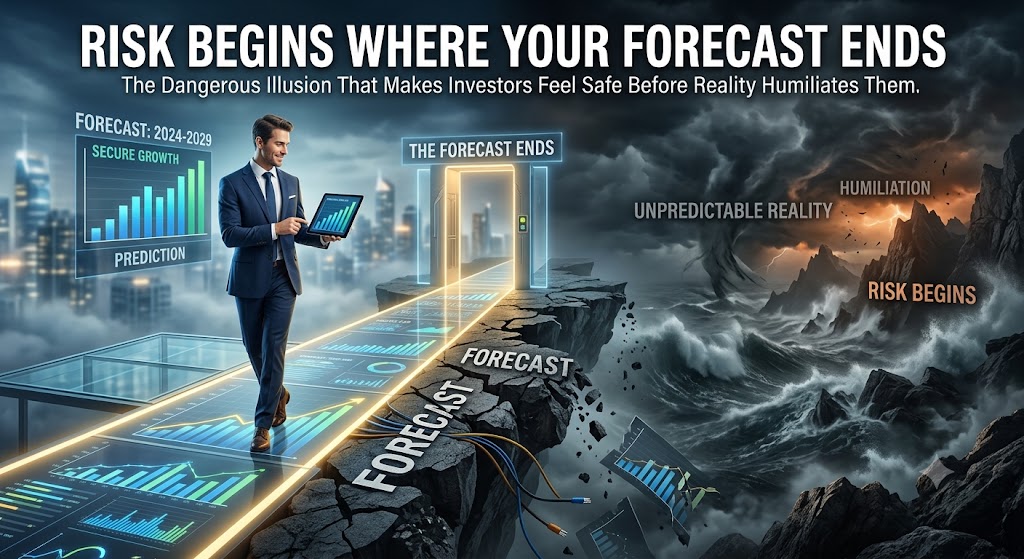
That is why Carl Richards’ warning is so powerful: “Risk is what is left over when you think you’ve thought of everything.”
Risk is the visitor that arrives after your plan says the house is full.
You think you have calculated exchange rate. Then government policy changes. You think you have priced inflation. Then fuel prices jump. You think your business projections are solid. Then customer purchasing power collapses. You think land will appreciate. Then title issues appear. You think stocks will crash. Then the market rallies without asking for your permission. You think a forecast has captured the future. Then reality laughs.
The greatest mistake many investors make is not that they listen to forecasts. Forecasts can be useful. They can help us think. They can show possible scenarios. They can prepare the mind. The mistake begins when people treat forecasts as certainty. A forecast is not a guarantee. A forecast is a story about what might happen. Some stories are intelligent. Some are lazy. Some are emotional. Some are data-driven. Some are designed to sell fear. Some are designed to sell greed. But no forecast is God.
The market does not kneel before your spreadsheet.
The Future Does Not Obey Confident People
One of the most dangerous things in finance is a confident voice.
Confidence can make error look like wisdom. Confidence can make assumption sound like evidence. Confidence can make a guess feel like prophecy. Confidence can turn a presenter into an oracle and an analyst into a prophet. But confidence is not accuracy.
A person can be confident and wrong.
A person can have charts and still be wrong. A person can have titles and still be wrong. A person can wear a suit, speak English with authority, quote data, appear on television, run a YouTube channel, manage a Telegram group, or call himself an expert and still be wrong.
Expertise is not omniscience.
A beautiful financial model can still miss the one thing that matters most. A smooth chart can still fail to capture human panic. A detailed report can still be destroyed by policy shock. A brilliant projection can still collapse because of one assumption nobody questioned.
Risk often hides in the assumptions people do not question.
This is why serious investors must learn to respect forecasts without worshipping them. A forecast can guide your thinking, but it must not become the foundation of your entire financial life. The moment your peace depends on one prediction coming true, you have built your future on fragile ground.
Why We Love Forecasts Even When They Fail Us
Human beings crave forecasts because uncertainty is emotionally painful.
Uncertainty makes us feel exposed. It reminds us that we are not in control. It forces us to confront the uncomfortable truth that tomorrow can surprise everybody—the rich, the poor, the educated, the powerful, the analyst, the trader, the banker, the entrepreneur, the policymaker, the investor, and the person who thinks he has seen it all.
So when someone speaks with certainty, we feel relief.
That is why psychologist Philip Tetlock’s insight is so piercing: human beings need to believe they live in a predictable, controllable world, so they turn to authoritative-sounding people who promise to satisfy that need.
People do not only buy forecasts because they want information. They buy forecasts because they want comfort.
They want emotional relief. They want direction. They want protection from regret. They want someone to say, “This is what will happen, so this is what you should do.” They want the future to feel manageable. They want the anxiety of decision-making to disappear. They want somebody else to carry the burden of uncertainty.
This is why confident wrong answers often attract more followers than honest uncertain answers.
Tell people, “The market may go up or down depending on earnings, liquidity, inflation, policy, valuation, and investor sentiment,” and many will yawn. Tell them, “The market will crash by September,” and suddenly everyone listens. Tell them, “The naira will definitely hit a certain rate,” and WhatsApp groups will carry it like gospel. Tell them, “This crypto will 10x before December,” and desperate people will rush in. Tell them, “Lagos property never fails,” and buyers will ignore title risk, drainage, access roads, liquidity, and legal verification.
Certainty sells because uncertainty is uncomfortable.
The more uncertain the world becomes, the more people pay attention to those who sound certain.
A Forecast Can Calm Your Fear and Still Destroy Your Money
This is where the illusion of control becomes expensive.
A salary earner hears a confident prediction that the naira will collapse further. Out of fear, he converts all his savings to dollars. At first, he feels intelligent. But then school fees, rent, food, hospital bills, and family obligations come in naira. He has no liquidity. If the exchange rate moves against him temporarily or if he needs cash urgently, he may be forced to sell at a bad time. His forecast may eventually be partly right, but his financial structure is wrong.
A business owner imports goods because someone confidently predicted that exchange rate would stabilize. By the time the goods arrive, the rate has moved, clearing costs have changed, purchasing power has dropped, and customers are resisting higher prices. The forecast sounded reasonable, but the business did not prepare for surprise.
A real estate buyer assumes land prices will always rise because “Lagos property never fails.” He buys without proper due diligence. Later, he discovers title problems, government acquisition issues, poor access, drainage problems, or weak resale demand. The forecast said property rises. Reality said not all property is wealth.
An investor avoids all Nigerian stocks because a commentator said the economy is finished. While he waits in fear, quality companies recover, declare dividends, and reward those who positioned with discipline. His fear felt intelligent, but fear is not always wisdom.
A young person joins crypto, forex, or a Ponzi-like platform because influencers predicted massive returns. The story is sweet. The returns are exciting. The screenshots are convincing. The Telegram group is loud. But by the time reality appears, the money has disappeared.
That is how forecasts can calm your emotions and still damage your wealth.
The Human Mind Hates Randomness
When markets rise, people want a reason. When markets fall, people want a reason. When the naira weakens, people want one explanation. When inflation rises, people want one villain. When stocks rally, people want one magic answer. When real estate booms, people want one story.
The human mind hates randomness. It wants patterns. It wants explanations. It wants order.
This is not always bad. Pattern recognition helps human beings survive. But in finance, the same instinct can become dangerous. We begin to see certainty where there is only probability. We begin to see patterns where there may be noise. We begin to believe that because something happened before, it must happen again.
That is recency bias.
We anchor on old prices and assume they must return. That is anchoring.
We follow the crowd because many people cannot be wrong. That is herd mentality.
We trust someone because they sound authoritative. That is authority bias.
We search for information that supports what we already believe. That is confirmation bias.
We remember past events as if they were obvious all along. That is hindsight bias.
We overestimate what we know. That is overconfidence.
We believe that because we have more information, we have more control. That is the illusion of knowledge.
We believe that because we have planned, the future must respect our plan. That is the illusion of control.
And when money is involved, these biases become expensive.
The danger is not only that people lack information. Sometimes the danger is that they have too much information and too little humility.
The Market Does Not Care About Your Prediction
The market does not care that you are convinced.
The market does not care that your favourite analyst said something. It does not care that your WhatsApp group agreed. It does not care that you prayed over the investment. It does not care that the chart looked perfect. It does not care that your political party promised improvement. It does not care that your influencer sounded confident.
Reality is not loyal to your forecast.
A stock does not rise because you bought it. Land does not appreciate because you announced it. A business does not succeed because you love the idea. The naira does not obey your optimism or your fear. Inflation does not pity your budget. A Ponzi scheme does not become legitimate because your friend withdrew once.
This is why financial humility is not weakness. Humility is risk management.
The wise investor understands that uncertainty is permanent. He does not build a portfolio that requires one forecast to come true. He builds a financial life that can survive many possible futures.
That is the difference between prediction and preparation.
Prediction Feeds Ego; Preparation Protects Wealth
Prediction says, “I know what will happen.”
Preparation says, “I do not know exactly what will happen, so I will build a financial life that can survive different outcomes.”
Prediction often feeds ego. Preparation protects wealth.
The person addicted to prediction wants to be right. The person committed to preparation wants to survive, adapt, and grow.
A prediction-driven person may sell everything because one analyst says recession is coming. A preparation-driven person may keep emergency savings, reduce unnecessary debt, maintain liquidity, diversify investments, improve income skills, and remain ready to buy quality assets if fear creates opportunity.
A prediction-driven person may put all money into one asset because someone says it will explode. A preparation-driven person asks, “What if this does not happen? What if it takes longer? What if I need cash? What if regulation changes? What if the opposite happens?”
Preparation is not fear. Preparation is wisdom.
Preparation includes emergency funds, diversified investments, multiple income streams, insurance where appropriate, avoiding excessive debt, keeping liquidity, building skills, reviewing assumptions, and avoiding all-or-nothing bets.
A wise investor prepares for inflation, recession, opportunity, and surprise. He does not worship pessimism. He does not worship optimism. He respects uncertainty.
The goal is not to predict perfectly. The goal is to prepare wisely.
The Wise Investor Prepares for Many Futures
Great investors think in probabilities, not guarantees.
They understand that the future can disappoint both optimists and pessimists. Markets can rise when news is bad. Markets can fall when news is good. Inflation can last longer than expected. Interest rates can stay high longer than people assume. Exchange rates can overshoot. Real estate can become illiquid. Businesses can look profitable on paper and still die from cash-flow pressure.
So they build systems.
They diversify because they know one asset can disappoint.
They practice asset allocation because different goals require different financial structures.
They keep liquidity because opportunity often appears when others are desperate.
They avoid excessive leverage because debt can turn a temporary problem into permanent damage.
They use margin of safety because assumptions can fail.
They size positions carefully because no single opportunity should destroy the whole future.
They rebalance because markets move and emotions distort portfolios.
They preserve capital because the investor who survives uncertainty long enough will meet opportunities that the overconfident investor never lives to enjoy.
This is why the wealthy do not merely chase returns. They manage risk.
The poor often chase predictions; the wealthy build preparation.
Do Not Worship Certainty in a World Built on Surprise
Nigeria and Africa teach uncertainty every day.
Fuel prices can change business costs overnight. Exchange-rate instability can disrupt importers. Inflation can destroy household budgets. Government policy can change industry economics. Unemployment can affect consumer demand. Power supply can increase operating costs. Weak infrastructure can crush logistics. Security challenges can disrupt agriculture and trade. Taxes, levies, customs duties, road conditions, regulation, and political decisions can all affect money.
Because uncertainty is real, people need better preparation, not blind dependence on confident forecasts.
A family keeping all money in cash because they fear risk may feel safe, while inflation quietly reduces purchasing power. A trader overstocking goods because someone predicted scarcity may later face slow sales and locked-up capital. A cooperative member borrowing based on future income that was assumed guaranteed may suffer when income delays. A political supporter interpreting economic forecasts through loyalty rather than evidence may make dangerous financial decisions. Young people following Telegram, TikTok, WhatsApp, or Instagram investment predictions may discover too late that confidence is not competence.
Your financial plan must be stronger than your favourite forecast.
Before You Believe Any Forecast, Ask These Questions
Before you believe any forecast, pause and interrogate it.
What assumptions are behind this forecast?
What could make it wrong?
Is the person making this prediction accountable if they are wrong?
Does this person benefit if I believe them?
Am I attracted to this forecast because it is true or because it comforts me?
What evidence supports it?
What evidence challenges it?
Am I making an all-or-nothing decision based on one opinion?
Can my finances survive if this prediction fails?
Am I confusing confidence with competence?
What is the downside if I act on this forecast?
What is my plan if the opposite happens?
Am I preparing for uncertainty or pretending uncertainty does not exist?
These questions can save you from emotional investing.
Never base your entire financial life on one forecast. Use forecasts as inputs, not instructions. Diversify across assets and income sources. Keep emergency funds. Avoid excessive leverage. Do not chase every prediction on social media. Build systems instead of reacting emotionally. Review financial decisions with humility. Learn basic investment principles. Seek professional advice before major decisions. Prepare for recession, inflation, opportunity, and surprise.
A wise investor respects forecasts but never worships them.
The Illusion of Control Is Expensive
The illusion of control makes people think that because they have read reports, watched videos, checked charts, listened to experts, and built models, the future has been captured.
But the future is not a goat you can tie to a tree.
The future moves.
It changes when people change. It shifts when policy changes. It surprises when incentives change. It breaks patterns. It creates new risks. It rewards patience. It punishes arrogance.
This is why overconfidence is dangerous. It makes people borrow too much, concentrate too much, trade too much, spend too much, and ignore too much. It makes people believe they have eliminated risk when they have only stopped seeing it.
A confident forecast can be emotional poison wearing a suit.
Do not drink it blindly.
Great Investors Stay Humble Because Reality Is Bigger Than Intelligence
Humility is one of the most underrated tools in wealth creation.
Great investors admit they can be wrong. They prepare for surprises. They avoid reckless certainty. They diversify intelligently. They keep cash or liquidity. They manage debt carefully. They think in probabilities, not guarantees. They adapt when facts change. They focus on long-term survival. They protect capital before chasing glory.
They understand that no matter how intelligent they are, reality is bigger than their intelligence.
The investor who survives uncertainty long enough will often meet opportunities that the overconfident investor never gets to enjoy.
This is the real secret: survival is a strategy.
You cannot compound money you have destroyed. You cannot seize opportunity if you have no liquidity. You cannot recover from a mistake if one position wiped you out. You cannot grow wealth if your ego keeps fighting reality.
The future punishes those who confuse confidence with control.
Build a Financial Life That Can Survive Surprise
Do not let the illusion of control seduce your money into danger.
Do not let confident voices replace disciplined thinking. Do not build your future on one forecast, one opinion, one prediction, one influencer, one asset, one income source, one political outcome, or one economic story.
Build a financial life that can survive uncertainty, adapt to change, and grow through wisdom, patience, and preparation.
Financial wisdom is not about pretending to know everything. It is about knowing that you do not know everything and still building wisely.
You do not need perfect certainty to build wealth. You need discipline. You need humility. You need patience. You need risk management. You need emergency savings. You need diversified assets. You need income growth. You need liquidity. You need the courage to act when opportunities appear and the wisdom to avoid reckless bets when everyone is shouting.
The future will surprise everybody.
Make sure it does not destroy you.
Final Call to Action
Think deeper. Question forecasts. Respect uncertainty. Manage risk wisely. Build emergency savings. Diversify intelligently. Avoid emotional decisions. Prepare for multiple futures. Learn before investing. Protect capital. Build wealth with discipline, humility, and patience.
Do not worship certainty in a world built on surprise.
Use forecasts, but do not become their prisoner.
Listen to experts, but do not surrender your thinking.
Plan for tomorrow, but do not pretend you control tomorrow.
Because in the end, the strongest financial life is not the one that predicted everything correctly.
It is the one that prepared wisely enough to survive what nobody saw coming.