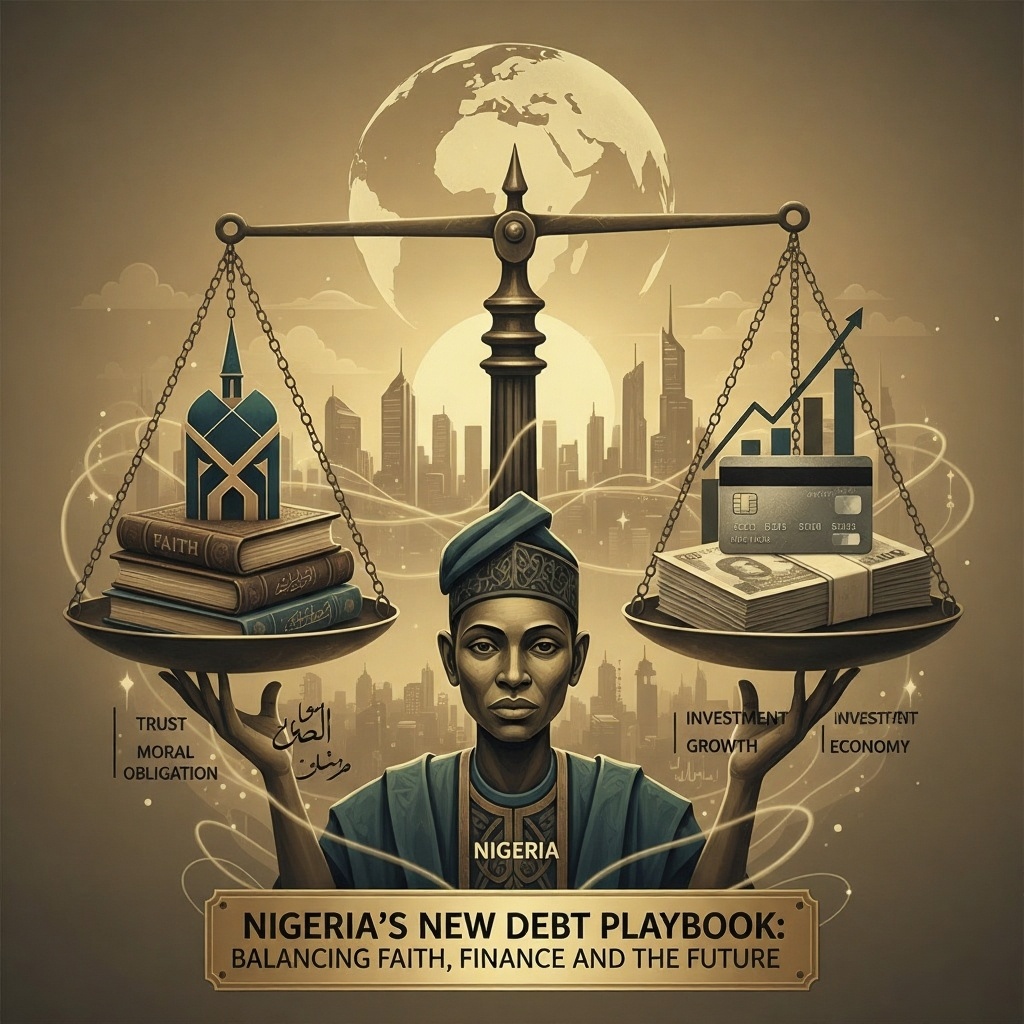
Nigeria is rewriting its fiscal story with a bold new chapter one that merges faith-based finance with global investment strategy. The Federal Government’s recent announcement of its debut global sukuk issuance, alongside a broader plan to tap into international debt markets, signals a calculated shift in the country’s public debt approach. It’s not just about borrowing; it’s about borrowing differently. As the nation grapples with inflation, a weakened naira, and widening fiscal deficits, this new playbook seeks to attract ethical investors while spreading Nigeria’s economic risks beyond traditional Eurobonds and domestic loans.
At the heart of this shift lies the sovereign sukuk, an Islamic financial instrument that avoids interest (riba) and instead ties returns to tangible assets or projects. For Nigeria, a nation with a significant Muslim population and an urgent need for infrastructural expansion, this move is both strategic and symbolic. By venturing into global sukuk markets, the government positions itself as a leader in inclusive financial innovation, aligning fiscal growth with faith-based values. More importantly, it taps into the trillion-dollar global Islamic finance market, creating new pathways for foreign investment that respect cultural and ethical boundaries.
However, the timing of this shift is as critical as the innovation itself. Nigeria’s public debt has surpassed ₦121 trillion, raising alarms about sustainability. Yet, unlike conventional borrowing driven by consumption, the government’s focus appears to be on productive debt, funding infrastructure, renewable energy, and industrial growth. Experts argue that if managed transparently, the new debt strategy could stabilize long-term growth and attract investors seeking both returns and responsibility. The question remains: can Nigeria maintain this delicate balance between expansion and accountability?
The sukuk’s potential impact extends beyond economics. It also represents a diplomatic and reputational tool. A successful issuance would not only broaden Nigeria’s investor base but also project the country as a credible and adaptable player in global finance. By introducing ethical instruments into its portfolio, Nigeria could appeal to Middle Eastern and Southeast Asian investors, strengthen relations with Islamic financial hubs, and rebrand itself as an African model for diversified fiscal management.
Ultimately, Nigeria’s debt strategy overhaul is not a sign of desperation, it’s a sign of evolution. The global sukuk debut, if executed with discipline and transparency, could mark the beginning of a more balanced economic era, one where cultural identity meets financial ingenuity. For a country long caught between oil dependency and developmental ambition, this shift signals something deeper than policy: a renewed belief that Nigeria’s recovery can be both principled and profitable.