
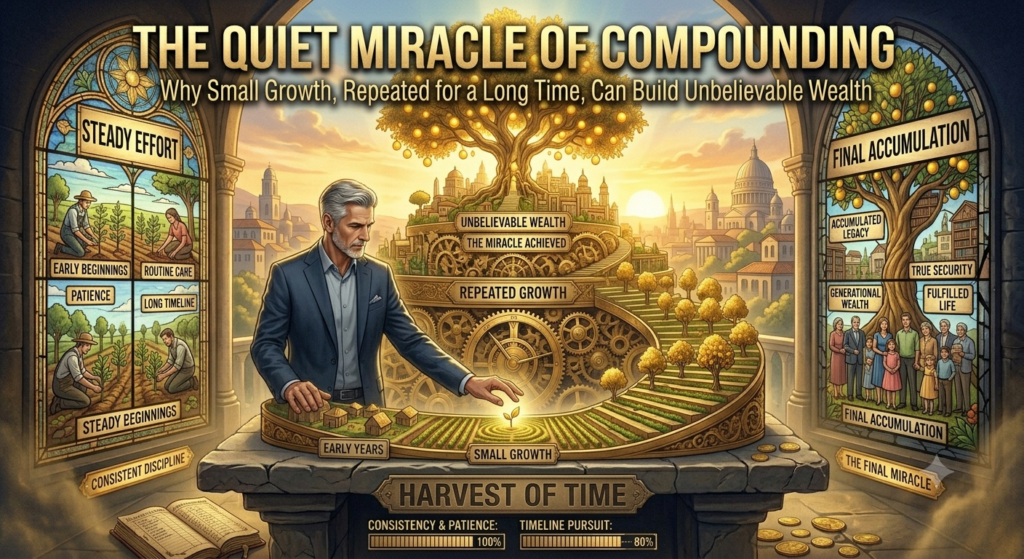
- The Small Seed That Becomes a Forest: How Compounding Turns Ordinary Money Into Extraordinary Wealth
- You Don’t Need Explosive Returns to Build Wealth — You Need Time, Patience, and Repetition
The Wealth Secret That Looks Too Slow Until It Becomes Too Big to Ignore
There is a kind of power in life that does not shout. It does not rush. It does not announce itself with noise, drama, or sudden fireworks. It moves quietly, almost invisibly, like a small stream cutting through stone, like roots growing beneath the soil, like a child growing taller while the parents only notice after many months.
That power is called compounding.
At the beginning, it looks weak. It looks boring. It looks too slow for a generation addicted to fast money, instant alerts, quick returns, crypto pumps, betting slips, Ponzi promises, and overnight success stories. But give compounding enough time, and what looked small will begin to look supernatural.
A small starting base, if allowed to grow and feed future growth, can produce results so large that people will begin to call it luck. They will say, “How did this happen?” They will say, “This person must have discovered one secret.” They will say, “There must be something hidden.” But the secret is often not hidden. The secret is usually too simple for impatient people to respect.
Small growth, repeated for a long time, becomes a financial miracle.
That is the lesson of compounding. That is the lesson of the Ice Age. That is the lesson of Warren Buffett. That is the lesson many Nigerians and Africans must understand if they truly want to build wealth that does not depend on gambling, fraud, political connection, or sudden windfall.
“Wealth does not always come from one big explosion. Sometimes it comes from small fires that are never allowed to go out.”
The Core Philosophy: Tremendous Results Do Not Always Require Tremendous Force
One of the greatest misunderstandings about success is that people think extraordinary outcomes must come from extraordinary actions. We assume that if someone became wealthy, they must have made one giant move. If a business became powerful, it must have had one secret strategy. If a person became influential, they must have had one massive opportunity. If an investor became rich, they must have found one magical stock.
Sometimes that is true.
But many times, the greatest results in life come from ordinary actions repeated for an extraordinary length of time.
The Ice Age did not happen because one day the earth suddenly received a violent blast of cold that froze everything at once. It happened because small changes accumulated. Slight shifts. Small variations. Repeated effects. Gradual buildup. What began as something almost unnoticeable eventually became a force large enough to reshape the planet.
That is compounding.
You do not always need tremendous force to create tremendous results. You need a process that feeds on itself. You need growth that becomes fuel for more growth. You need patience long enough for small gains to begin producing larger gains.
This is why compounding is one of the most important ideas in finance, business, health, knowledge, reputation, relationships, and personal development.
Money compounds when returns generate more returns.
Knowledge compounds when learning makes future learning easier.
Reputation compounds when trust creates more opportunities.
Skills compound when practice improves performance and performance attracts bigger platforms.
Relationships compound when goodwill creates access, support, referrals, and influence.
Habits compound when small daily behaviours shape identity over time.
“Compounding is what happens when yesterday’s growth becomes today’s worker.”
The Warren Buffett Lesson: His Skill Is Investing, But His Secret Is Time
Warren Buffett is one of the most respected investors in modern history. Many people study his stock picks, his letters, his interviews, his investment philosophy, and his discipline. They talk about value investing. They talk about buying wonderful companies at fair prices. They talk about patience, temperament, cash flow, moats, and management quality.
All these things matter.
But there is one factor that many people underrate: time.
Buffett did not merely become wealthy because he earned high returns. He became extraordinarily wealthy because he started early and stayed in the game for an unusually long period. His financial base began forming when he was young, and he allowed compounding to work across decades. His investing skill was important, but his longevity made the skill explosive.
That is the miracle.
A person who earns a good return for five years may become comfortable. A person who earns a good return for ten years may become rich. But a person who earns a good return for fifty, sixty, or seventy years can become almost unbelievable.
This is where many investors get the lesson wrong. They are searching for the highest return, but the highest return is often difficult to repeat. It may come from luck, timing, speculation, leverage, or one unusual opportunity. The real power is not always in finding a 200% return once. The real power is in finding reasonable returns that can be repeated again and again without destroying you.
“The investor who can stay alive long enough will often defeat the investor who is always trying to look brilliant.”
Buffett’s secret is not just intelligence. It is endurance. It is consistency. It is the ability to avoid ruin. It is the discipline to let time do what human force cannot do.
The Psychology: Why People Reject Compounding
The tragedy of compounding is that almost everyone understands it intellectually, but very few people obey it emotionally.
Why?
Because compounding is boring at the beginning.
A Nigerian youth under pressure does not want to hear that ₦50,000 invested monthly for many years can become serious wealth. He wants to hear how ₦50,000 can become ₦5 million before December. A small business owner struggling with rent, salaries, diesel, school fees, and black tax does not want to hear about slow growth. He wants one breakthrough contract. A salary earner watching inflation eat his income does not want patience. He wants escape.
This is understandable. Economic pressure makes people impatient. When life is hard, slow advice can sound insulting. When rent is due, compounding can feel like grammar. When family members are calling for urgent support, long-term investing can feel unrealistic.
But impatience is exactly why many people remain trapped.
They abandon good systems because the early results are small. They jump from one business to another. They chase quick schemes. They sell investments too early. They enter trends late. They compare their year two to another person’s year twenty. They mistake slow progress for failure.
“Most people do not fail because compounding does not work. They fail because they interrupt it too early.”
Behavioural economics explains this through present bias. Human beings naturally prefer immediate rewards over future rewards. ₦100,000 today feels more real than ₦1 million later. Pleasure today feels stronger than security tomorrow. This is why people spend money they should invest, abandon skills they should master, and chase opportunities they do not understand.
Compounding requires emotional maturity because it asks you to delay visible glory.
It asks you to keep planting when there is no forest yet.
It asks you to keep learning when nobody is clapping.
It asks you to keep saving when the amount looks small.
It asks you to keep investing when the market is not exciting.
It asks you to keep showing up before the world notices.
That is why compounding is not only a financial principle. It is a character test.
The Nigerian and African Context: Why Compounding Is Hard but Necessary
In Nigeria and across Africa, compounding is difficult because the environment fights patience. Inflation is high. Currencies weaken. Government policies can change suddenly. Businesses face poor power supply, logistics challenges, taxation pressure, unreliable infrastructure, and customer purchasing power issues. Families depend on one or two successful members. Emergencies are frequent. Medical bills, school fees, rent, burial contributions, wedding obligations, village projects, and sibling support can break financial plans.
This is why many Africans think long-term wealth building is only for people born into privilege.
But that is not completely true.
Yes, the environment is hard. Yes, starting capital matters. Yes, inequality is real. Yes, some people have advantages others do not. But compounding remains one of the few wealth principles available to ordinary people because it rewards consistency more than drama.
A young Nigerian who learns a valuable skill for two hours daily may not see much in three months. But after five years, that skill can become a business, a remote job, a consulting practice, or a source of influence.
A small trader who reinvests profit carefully instead of consuming everything may not look rich in the first year. But after ten years, she may control inventory, customer relationships, cash flow, and market wisdom that newcomers cannot buy.
A salary earner who invests steadily in productive assets may not trend online. But after fifteen years, he may have built quiet financial strength while louder people are still servicing lifestyle debt.
A content creator who publishes consistently may be ignored for months. But if the work improves and the audience grows, old content can continue attracting new followers, new opportunities, and new income.
A business that treats customers well may not explode immediately. But trust compounds. Referrals compound. Reputation compounds. Operational excellence compounds. One satisfied customer brings another. One good delivery builds confidence. One consistent brand promise becomes market advantage.
“In Africa, where many systems are unstable, your greatest advantage is building personal systems that are stable.”
The Danger: Chasing the Highest Return Instead of the Longest Repeatable Return
One of the most dangerous mistakes in investing is believing that the best investment is the one with the highest promised return. This thinking has destroyed many people.
The highest returns are often one-off hits. They may come from risky speculation, lucky timing, insider access, or unsustainable models. They may work once and fail the second time. They may enrich early participants and destroy latecomers. They may produce screenshots but not lasting wealth.
This is why Ponzi schemes succeed. They appeal to impatience. They promise what compounding cannot honestly promise in a short time. They say, “Double your money in 30 days.” They say, “Guaranteed 20% monthly.” They say, “No risk.” They use testimonies, pressure, fake scarcity, celebrity endorsement, and emotional manipulation.
But real wealth is rarely built by promises that sound too sweet.
Good investing is not necessarily about earning the highest returns. It is about earning pretty good returns that you can stick with and repeat for a very long time.
That sentence can change your financial life.
Pretty good returns repeated for decades can beat spectacular returns that disappear quickly.
A business that grows 15% to 20% steadily for many years can become more valuable than a business that grows 200% one year and collapses the next.
An investor who earns moderate returns while avoiding ruin can outperform someone who makes huge gains and then loses everything through leverage, greed, or panic.
A professional who improves steadily every year can surpass a naturally talented person who lacks discipline.
The enemy of compounding is not low returns. The enemy is interruption.
Interruption can come from panic selling, reckless debt, poor health, fraud, lack of emergency funds, lifestyle inflation, bad partnerships, overconfidence, or trying to get rich too fast.
“Compounding does not require perfection. It requires survival.”
The Mechanics: How Compounding Actually Runs Wild
Compounding works because growth begins to build on itself. In simple terms, when you invest money and earn returns, those returns become part of the base that earns future returns. Over time, the base becomes bigger, the returns become bigger, and the growth curve begins to bend upward.
At first, the difference may look small.
That is why people underestimate it.
In year one, the result may not impress anybody. In year three, it may still look ordinary. In year five, people may still mock the discipline. But after enough time, the growth becomes visible. Then it becomes surprising. Then it becomes powerful.
The same thing happens in business. A company starts with a few customers. If it serves them well, some return. Some refer others. The company improves its process. The brand becomes known. Suppliers trust it more. Employees get better. Systems become stronger. Cash flow improves. The business can now take advantage of opportunities that were impossible earlier. Growth starts feeding growth.
The same thing happens in knowledge. At first, learning finance, coding, writing, sales, logistics, accounting, digital marketing, or leadership may be difficult. But as your knowledge base grows, new ideas connect faster. You begin to see patterns. You make better decisions. You avoid beginner mistakes. Your competence begins to compound.
This is why the beginning is so important. The early stage of compounding is usually unattractive, but it is the foundation of everything.
“Do not despise small beginnings. Small beginnings are where compounding hides its engine.”
The Blueprint: How to Make Compounding Work for You
The first step is to start earlier than feels comfortable. Do not wait until you have millions. Start with what you can. Start with learning. Start with saving. Start with investing. Start with building. Start with documenting. Start with improving. The size of the beginning matters less than the length of the runway.
The second step is to choose a game you can stay in. Do not build your financial life around strategies that require constant luck, emotional stress, or perfect timing. Choose investments, businesses, and skills that can survive bad seasons. If the strategy can destroy you in one mistake, it is not friendly to compounding.
The third step is to avoid ruin. This is more important than looking brilliant. Do not risk all your capital on one idea. Do not borrow recklessly. Do not put emergency funds into volatile assets. Do not invest in what you do not understand. Do not follow crowd excitement without risk control. The person who avoids ruin gives compounding time to work.
The fourth step is to reinvest. Compounding becomes powerful when growth is not consumed too quickly. If every profit is eaten, the base never expands. This does not mean you should not enjoy life. It means you must not let enjoyment kill the engine of future wealth. In business, reinvest in inventory, systems, people, technology, and customer experience. In personal finance, reinvest in assets, skills, health, and networks.
The fifth step is to be patient with boring progress. The world rewards noise, but wealth rewards endurance. Do not be ashamed of slow growth if the direction is right. Do not abandon a good plan because another person is showing faster results. You do not know their risk. You do not know their debt. You do not know their foundation. Stay with your intelligent process.
The sixth step is to extend your time horizon. Most people ask, “What can this do for me now?” Wealth builders ask, “What can this become if I stay consistent for ten years?” That question separates traders from builders, gamblers from investors, and noise-makers from legacy creators.
The seventh step is to protect your health and relationships. You cannot compound wealth properly if your body collapses or your household is in constant chaos. Time is the secret ingredient. To benefit from time, you must stay alive, sane, healthy, and grounded.
“Time is the silent partner in every great fortune.”
The Deeper Lesson: Compounding Rewards the Faithful, Not the Frantic
We live in a frantic age. Everybody wants speed. People want fast money, fast fame, fast business growth, fast body transformation, fast influence, fast investment returns, fast everything. But many of the things that truly matter still obey the law of time.
A pregnancy cannot be rushed into one month because you are impatient. A tree cannot become an iroko overnight because you shouted at it. A reputation cannot be built in one week because you printed a beautiful logo. A great investor cannot be manufactured by one bull market. A wise entrepreneur cannot be formed by one successful sale.
The greatest things compound.
That is why patience is not weakness. Patience is strategy. Patience is not laziness. Patience is controlled aggression. Patience is not lack of ambition. Patience is ambition that has submitted to wisdom.
“The impatient man wants harvest without seasons. The wise man respects the calendar of greatness.”
The Benediction: Let Time Fight for You
You may not have a rich family background. You may not have political connections. You may not have millions sitting in your account today. You may not have the loudest brand, the biggest shop, the strongest network, or the most glamorous life.
But you have something powerful if you choose to use it well: time.
Start where you are and begin with what is within your reach. Start small but start honestly. Begin learning, saving, investing, building your reputation, improving your skills, treating customers well, documenting your process, protecting your capital, avoiding foolish risks, and above all, staying in the game. These small and seemingly ordinary acts may not look impressive at first, but if you remain faithful to them and refuse to interrupt the process, something remarkable begins to happen. Over time, the little things you are doing now start to grow beyond what logic seems able to explain. People will look at the results and call it luck. They will describe it as sudden, or label it overnight success. But you will know the truth. You will know it was never overnight. You will know it was the product of years of quiet discipline, of small growth feeding future growth, of steady effort accumulating beneath the surface, and of the miracle that happens when a person simply refuses to stop. You will know it was compounding.
So do not chase only the highest return. Chase the return you can repeat. Do not chase only fast success. Chase the success you can sustain. Do not chase only applause. Chase the discipline that keeps working after applause has gone silent.
Let others gamble with speed.
You build with time.
Let others worship sudden wealth.
You honour steady growth.
Let others chase one big hit.
You build a system that can keep producing.
Because when compounding finally wakes up, even small beginnings can become empires.
Subscribe to Naija Street Matters for regular news update and click on the Whats-app green button below to join our community.